America’s Crusade for Democracy Abroad Was Built Upon the Colonization of the Hawaiian Kingdom
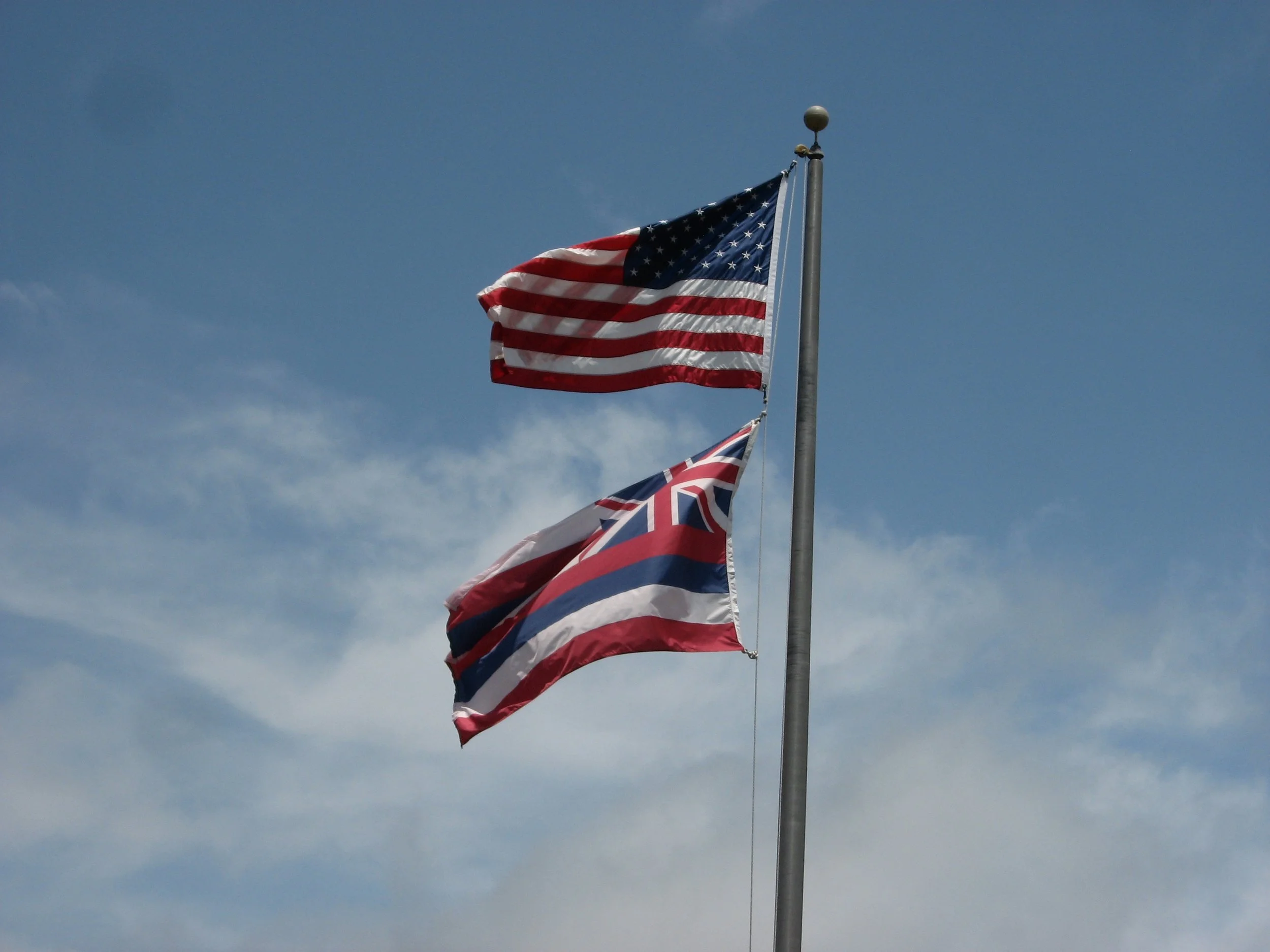
Shown here is the Hawai’i State flag flying below the United States national flag. Photo courtesy of Ken Lund via Flickr.
Ask most Americans how Hawai’i became America’s fiftieth state, and you’ll likely hear about Pearl Harbor and World War II, not an illegal coup backed by U.S. officials and military forces that spanned over 70 years. When taught at all, Hawai’i’s history isn’t taught as a sovereign nation deprived of its independence. This silence goes beyond mere oversight, acting as an extension of American policy. The erasure of Hawai’i’s long and brutal imperial takeover from the public education system has allowed the United States to portray itself as the leading example of a democratic society. From Cold War rhetoric to today’s bans on ‘un-American’ content, America has clung to a policy of forgetting, disguising the expansion of the American empire as bringing democracy to nations in need.
The historical record of Hawai’i’s annexation and statehood tells a story far removed from the one taught in most American classrooms. In January 1893, a group of American and European businessmen and sugar planters backed by U.S. officials and military forces overthrew the sovereign Hawaiian Kingdom and forced Queen Lili’uokalani to abdicate. Their goal was to secure economic control and eventual U.S. annexation, despite the fact that Hawai’i was internationally recognized as an independent nation through treaties with many countries, including the United States. President Grover Cleveland condemned the coup as a “substantial wrong” and “perversion of our national mission,” and withdrew the annexation treaty from the Senate. His successor, William McKinley, was an ardent imperialist who bypassed the need for annexation by using a joint resolution of Congress in 1898 to annex the Hawaiian Islands. Many scholars have argued that this method was illegal under both American and international law.
None of this complexity appears in the versions of history most students learn. But even this account omits documented native opposition and the legal controversy surrounding Hawai’i’s overthrow. The Ku’e Petitions of 1897, signed by more than 38,000 to protest annexation, are practically unheard of among American students across the country. Furthermore, few textbooks mention that Hawai’i’s 1959 statehood plebiscite vote excluded large numbers of native residents. By 1959, Hawai’i had already been under American ‘control’ for 66 years, during which many Native Hawaiians and ethnically diverse residents lost political power and land ownership through targeted disenfranchisement and widespread American settlement. The plebiscite was thus not in compliance with international mandates, which allowed America to continue the narrative of a voluntary union.
When public education presents the annexation as a peaceful and democratic process, students are fed the persistent American narrative that the United States perpetuates democratic progress, not settler colonialism. This sanitized version of history was institutionalized in the early twentieth century, and it provided the foundation for how Hawai’i’s statehood would be misrepresented as a Cold War symbol of America’s moral obligation to spread its democracy around the world. Unlike other territories acquired through war or forceful takeover, its occupation began before the age of widespread American involvement in foreign affairs and ended with the absorption of the sovereign nation into the United States. This outcome hid the imperial rule of Hawai’i from the world, deeply embedding the legacy of its conquest within the nation’s supposedly democratic identity.
World War II accelerated Hawai’i’s transformation to statehood, especially after the attack on Pearl Harbor. Hawai’i was placed under martial law from 1941 to 1944 following the bombing, during which civilian governance was suspended and habeas corpus was revoked. Residents, both military and civilian, were subject to military courts that surveilled, censored, and interned Japanese Americans—who made up one-third of Hawai’i’s population—and those accused of being subversives. America fought for freedom abroad, but denied it to those within its own sphere of influence whose labor and sacrifice sustained these very efforts.
Yet, the United States carefully managed public perception—so much so that many are currently still unaware of the aftermath of December 7 in Hawai’i—to avoid showing the islands as a site of occupation. Instead, wartime propaganda portrayed the islands as a site of multicultural harmony under U.S. democratic rule, downplaying both racial oppression and the clear suspension of civil rights. Hawai’i’s image as an undeniably loyal state crucial to the war effort helped justify American military presence, which was useful to America’s next big mission: containing communism.
In the wake of the 1941 Atlantic Charter, which emphasized the right of all nations to self-determination and to choose their own form of government, the U.S. faced growing criticism for maintaining overseas territories while condemning European colonialism. Hawai’i’s status was called into question by foreign powers. If the United States had an ideological campaign to maintain its moral mission to defend democracy across the globe, why were the people of Hawai’i not given the same rights and privileges as other U.S. citizens? Senate Majority Leader Lyndon Johnson recognized the need to incorporate Hawai’i to reconcile this contradiction and broke the legislative deadlock to make way for the passage of the Hawaii Admission Act.
Statehood in 1959 allowed the United States to present Hawai’i as evidence that its system could integrate nonwhite populations and govern diverse people without imperialism. While signing the Hawaii Admission Act of 1959, President Eisenhower stated that “in Hawaii you have an economy that is self-supporting, there is a large population, and on top of that, they delivered a record in World War Two that to my mind clearly entitles them to the privileges of statehood.” Soviet propaganda during the Cold War often capitalized on America’s poor treatment of its African American population and other communities of color who were also fighting for their rights, making Hawai’i’s statehood a direct rebuttal to these accusations of racism and imperialism.
By the time the Vietnam War took place, Hawai’i was depicted as a model of successful modernization under American guidance; the new state became a showcase of democracy and civil rights progress in the Pacific, supporting the moral legitimacy of U.S. involvement abroad. The U.S. turned a clear act of imperial control into evidence of its moral democratic mission by linking Hawai’i’s statehood to the fight against communist aggression, even though the military and strategic benefits of Hawai’i’s geographic location were glaringly obvious, helping America maintain its hegemony in Asia by serving as a significant launching point for the Vietnam War.
In most U.S. states, though, Hawai’i appears only briefly in history standards that usually focus on annexation and statehood as milestones of expansion, while overlooking the overthrow, native resistance, and questions of legality. Within Hawai’i itself, however, the education system has long reflected U.S. occupation. Early twentieth-century schooling was designed to “Americanize” Native Hawaiian children through English-only instruction, and civic instruction has been described as a “settler colonial instrument of assimilation.” The speaking of ‘Ōlelo Hawai’i, the native language of the Hawaiian people, was banned from schools. As a result, generations of students have inherited an education that is inherently skewed in favor of America.
This ideological framing, avoiding America’s treatment of minorities, has, in recent years, been codified in state education policy. For example, Florida’s proposed Stop W.O.K.E. Act attempted to prohibit classroom discussion that might cause “discomfort” over historical racism and would effectively curb honest acknowledgment of America’s colonial and racial origins. While that policy was blocked by a federal judge who called the act “dystopian,” new standards approved by Florida in 2023 instruct educators to teach that enslaved people “developed skills” that “could be applied for their personal benefit.”
Texas has also enacted similar restrictions that mirror this trend. In 2021, the Texas state legislature passed Senate Bill 3, which prohibits teachers from requiring students to read the 1619 Project essays, a New York Times initiative attempting to reframe American history by centering “the consequences of slavery and contributions of black Americans.” By treating subjects like critical race theory as inherently partisan, SB3 implies that critical engagement with America’s ugly past undermines civic education and democratic progress.
If American schools can’t even truthfully teach about the nation’s history of enslavement and racial violence, it becomes nearly impossible to confront the history of U.S. intervention abroad. The same political pressure that led to the removal of lessons about systemic racism from classrooms now shapes how the United States can excuse its actions overseas, specifically in Hawai’i. In both cases, the goal is to protect a national narrative that portrays America’s reputation as a morally upstanding actor in the global and historical battle for democracy. That is why this chilling effect on the discussion of racism towards black Americans has grave implications for educating students about how the United States overthrew a constitutional monarchy in the Hawaiian Islands. They learn that America ‘fought tyranny’ around the world, but not the many instances in which the U.S. used military rule to do so, including on an independent kingdom in the Pacific that it later claimed as a state.
Treating uncomfortable facts as threats results in a civic education that obscures the continuity between domestic injustice and foreign domination, which in turn renders students less able to see how those same hierarchies of power operate within U.S. borders and beyond in the modern day. The belief that American power is inherently just and destined to expand for the sake of progress has always been undermined by the tyranny of its foreign and domestic affairs. This disconnect is the intentional product of an education system designed to uphold the national myths of exceptionalism and moral obligation by diluting the darker realities of the past.
Reckoning with Hawai’i’s history is more than just correcting a regional oversight; it is a challenge to the claim that the United States lives up to the democratic values it teaches. The overthrow of the Hawaiian Kingdom, the annexation of the islands, and their statehood are continually misrepresented in education. For decades, the U.S. has celebrated its role as the global defender of free government while suppressing evidence of the territories and peoples whose autonomy it erased in that endeavor. Correctly teaching Hawai’i’s story, and the lived realities of its native people and residents, would strengthen civic education—contrary to common arguments that it would threaten democracy—and force America to confront the blatant contradictions between its advocated ideals and its actions. Understanding the history of U.S. expansion and foreign involvement both encourages students to think critically about power and responsibility and forces them to engage with the idea that democracy isn’t static, but rather must be continually reexamined and evaluated. A democracy that cannot teach the full scope of its history cannot claim to fully represent it.
Jasmine Lianalyn Rocha CC ‘27 is a junior studying Political Science and 20th Century American Political History. She can be reached at jar2383@columbia.edu.