
Why Some Lebanese Claim to Be Phoenicians
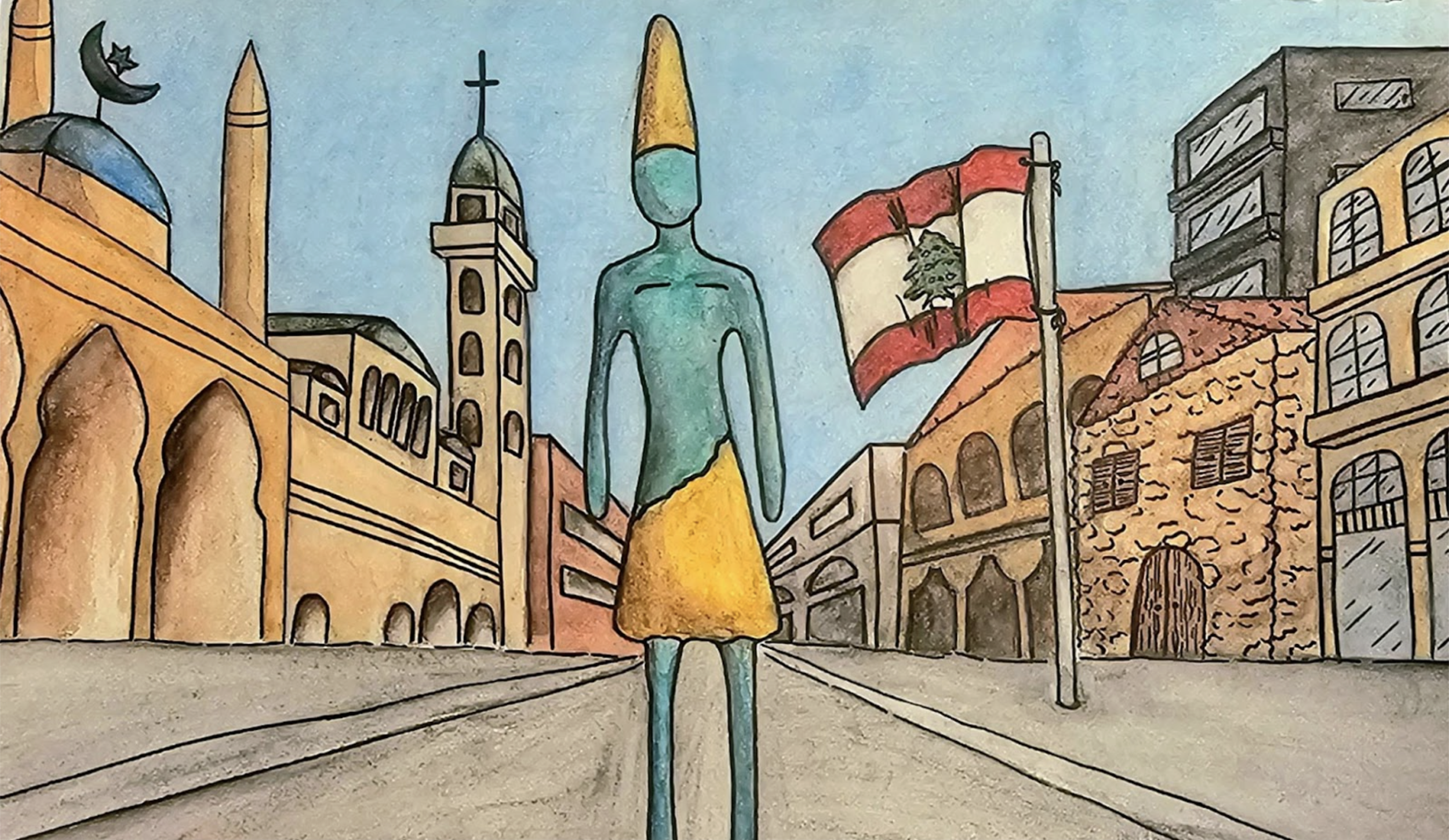
An imagined, stereotypical “Phoenician statuette” or “Byblos figurine” stands between a mosque and a church, symbolizing how the Phoenician-Arab identity debate remains relevant in Lebanese society today. Drawing by Sandrine Sader.
The Preamble of the Lebanese Constitution states that “Lebanon has an Arab identity and belonging.” Despite such formal codification, some Lebanese citizens reject Arab identity entirely, claiming instead to be Phoenicians, descendants of the ancient civilization of skilled sailors and merchants who lived along the Mediterranean coast between 1550 and 300 B.C.E.. Why do some Lebanese choose to self-identify in this way, and what does it tell us about Lebanese society
In contemporary Lebanon, the Phoenician narrative has been leveraged for political ends. It largely reflects the social and political divisions that define the multiconfessional Lebanese society, exacerbated by the dynamics produced by the Civil War (1975-1990) and solidified by Lebanon’s governance structure. Religious and political groups adopt historical narratives in an attempt to distinguish themselves from political opponents. The Phoenician claim deepens sectarianism by further politicizing religious identity and contributing to the “us versus them” discourse that pervades much of Lebanese political society. This discourse is rooted in misunderstandings of Lebanon’s history and the enduring imprint of colonial influence.
Lebanon officially recognizes eighteen religious sects, the majority of which are Christian and Muslim. Its confessional government, established by the 1926 Constitution and cemented through the 1943 “National Pact” between President Bechara El Khoury and Prime Minister Riad El Solh, distributed political and institutional power proportionally among religious groups. In theory, it aimed to ensure the representation of groups and social cohesion. In practice, this structure entrenched political divisions between religious communities that were brutally exacerbated by the Civil War. The Taif Agreement of 1989, which ended the war, restructured the government and resulted in an equal power-sharing structure between Christians and Muslims. Within this unique political framework, the Phoenician narrative has been mobilized by Maronite Christian groups to distinguish themselves from Lebanon’s Muslim population, in turn perpetuating sectarian divisions.
Tracing the historical emergence of the Phoenician claim illustrates its manufactured political construction to distinguish the Maronite Christian population and highlights its use as a foundation of nationalist discourse. In his book, Reviving Phoenicia: The Search for Identity in Lebanon (2004), Asher Kaufman argues that the Phoenician idea emerged as a myth of origin that shaped Lebanon’s social, intellectual, and political landscape. Echoing this sentiment, Mouannes Hojairi, assistant professor of history at the American University in Cairo, states that it was adopted by Christian communities in the early twentieth century in an effort to construct a “narrative of return” to an ancient golden age in opposition to Arabism. Hojairi asserts that by 1919, the Phoenician claim had become clearly associated with a non-Arab, non-Syrian, and pro-Western political discourse. In other words, the elevation of the Phoenician as an ancestor to Lebanese national identity illustrates how ancient civilizations are leveraged by communities as political tools to claim the creation of a nation itself.
Kaufman also notes that Phoenician heritage was mobilized in the political sphere as a foundation in the early state-building efforts. Maronite Patriarch Elias Peter Hoayek sent a delegation to the 1919-1920 Paris Peace Conference, which sought to define postwar borders according to the principle of self-determination. The delegation invoked Lebanon’s purported Phoenician identity to distinguish it from an Arab one and to lobby for an independent state.
The Maronite population of Mount Lebanon had historically been close to the West, particularly to France, which exerted influence over Lebanon and presented itself as the community’s protector. France formalized its mandate over Lebanon in 1920, implementing the territorial divisions outlined in the secret Sykes-Picot Agreement of 1916, which partitioned the remaining Ottoman lands between France and Britain. This process led to the separation of Lebanon from what was then Greater Syria, in large part because of the perception that it held a distinct identity. The Maronites’ cultural affinity for Western and especially French culture contributed to and was reinforced by their self-perceived separation from Muslims and from Arab identity.
The complexity in the term “Arab identity” also allows for this feeling of distinction to emerge, favoring characteristically stronger communal ties. The Arab world encompasses a broad array of diverse populations, traditions, and cultures across different Arab countries. Wide variations in regional dialects, the presence of different religious groups despite the predominance of Islam, and the lack of political and diplomatic unity within the Arab League, among other factors, illustrate the absence of a clear objective definition of “Arab identity.” Thus, it can ultimately be attributed to shared historical experiences and modern political considerations, which are then translated into a personal, subjective form of identification.
Proponents of the Phoenician claim also argue that Lebanese are genetically Phoenician. Lebanese biologist Pierre Zalloua tested this claim, concluding that roughly 30 percent of Lebanese males carry a genetic strain present in Phoenician Y-chromosomes. However, he found no correlation between religion and genetic variation, describing religion as a way to “paint over” preexisting genetic differences. His finding disproves the validity of some Maronite Christians’ efforts to distinguish themselves from other Arabs and Muslims. Historian Charles El Hayek similarly criticizes the genetic argument made by some Maronite Christians, noting there is no cultural continuity between the ancient civilization and contemporary Lebanese society. Regardless of genetic origins, there is no conclusive evidence linking modern Lebanese identity to the ancient Phoenician civilization.
Understanding why some Lebanese identify as Phoenicians rather than Arabs is essential to grasping the deep social and political layers of Lebanese society. The Phoenician claim originates partly from European colonial interests, which later provided a foundation for nationalist discourse. Its resurgence today reflects religious divisions in Lebanon and is strengthened by the country’s confessional political structure. Moving forward, the pressing issue should not be the revival of a centuries-old civilization, but the cultivation of social cohesion and political reform. It is necessary to establish a more complete and critical educational approach to the teaching of the country’s history, in order to reckon with its colonial past and the Civil War’s lasting impact on social fracture.
Sandrine Sader (Sciences Po ‘26) is an exchange student at Columbia College, studying political science with a focus on Mediterranean and Middle East politics. She aims to pursue a career in international affairs and diplomacy. She can be reached at ss7597@columbia.edu.