Trump Administration’s Ideological War Against the Liberal Order: The Halt of USAID in Ukraine
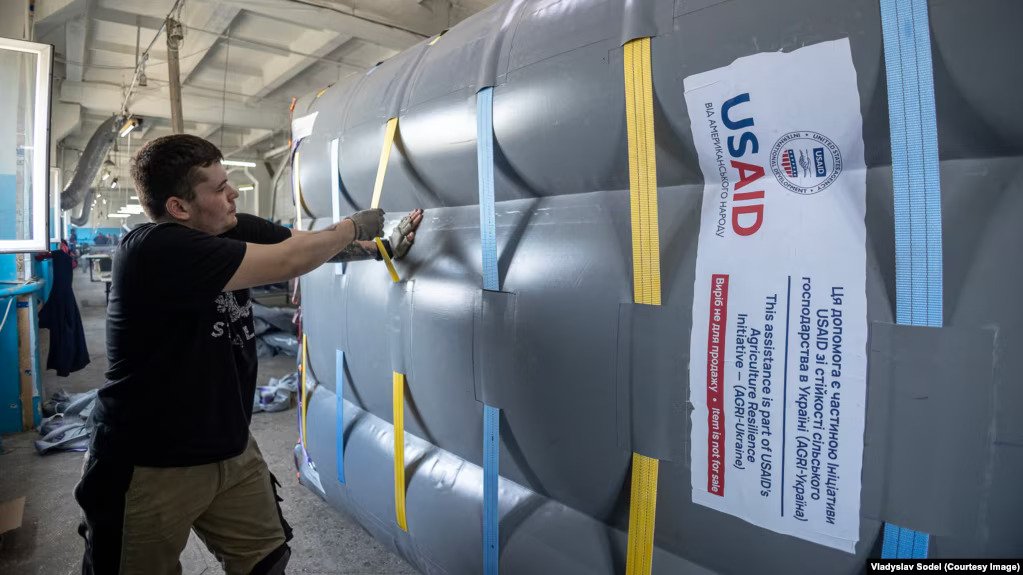
A worker opening an agriculture Ukrainian aid package fromUSAID. Photo courtesy of Vladyslav Sodel.
While most Americans and observers around the world were not surprised by the Trump administration’s sudden halt of the United States Agency for International Development (USAID), some expected a waiver for the $7.6 billion in humanitarian aid that USAID has sent to Ukraine since February 2022, following Russia’s invasion. However, these hopes were crushed by the abrupt stop-work order that left many Ukrainian projects without funding “until further notice,” creating uncertainty and lowering the national morale in the war against Russia.
The effects of the stop-work order are wide-ranging, from critical energy infrastructure to everyday support for veterans impacted by the war. USAID played a vital role in helping Ukraine restore its energy grid, which has been under constant attack since the war began in 2022. However, the pause in aid has had a tangible and immediate impact, leaving some regions of Ukraine without power overnight. Another critical area affected is independent media outlets. Bohdan Lohvynenko, the founder of Ukraïner—a “multilingual non-profit media organization that shares stories about Ukraine and stands in defense of democratic values”—admitted that more than 80 percent of the organization’s funding came from the U.S. Collectively, USAID not only helped Ukraine avoid a larger economic catastrophe but also enabled the country to maintain control over the narrative surrounding the war, countering Russia’s false rhetoric and offering a portal of truth to the outside world.
While the halt of USAID has direct effects on the daily lives of the Ukrainian people, it also signals a broader geopolitical shift regarding U.S. foreign policy in the region. The suspension has created a power vacuum in Eastern Europe, emboldening Trump’s “authoritarian populist” allies, such as Ilham Aliyev in Azerbaijan, Viktor Orbán in Hungary, or Vladimir Putin in Russia. As one USAID official involved in the Ukraine mission noted, the end of USAID’s mission in Ukraine would “signal to Russia that we don’t care about Ukraine or our past investments.” According to Richard Giragosian, director of the Regional Studies Center, an independent Armenian think tank, these “investments” include countries like Armenia, Georgia, and Ukraine, “where Russia’s shadow looms large.” In essence, these cuts would strengthen Moscow’s influence in the region and reinforce the narrative of “unreliable Western partners.”
The very belief in democracy—and the values it entails—is at stake as authoritarian leaders are filling the ideological gap left by the end of U.S. democratic influence in affected regions. In other words, the halt of USAID is not only about humanitarian aid and funding; it signifies a threat to worldwide democracy by undermining U.S. credibility and creating space for the dominance of Russian and other authoritarian narratives. As a channel of American soft power worldwide, USAID promotes liberal democratic values through its support for civil society, independent media, and human rights, precisely the institutions authoritarian regimes seek to dismantle. This strategic use of institutions such as USAID to promote Western ideals is not new: during the Cold War, the U.S. employed Voice of America (VOA) to broadcast news and culture into the Soviet Union, aiming to counter Soviet propaganda and promote a favorable image of American democracy. Just as Soviet authorities attempted to suppress or discredit VOA transmissions, today’s authoritarian populists similarly view organizations like USAID as an ideological threat to their grip on power. Hungary’s Viktor Orbán, whose administration has been locally and internationally accused of democratic backsliding, serves as an example of such dictators recognizing and trying to yield illiberal ideological control, stating that it was time to eliminate the “shadow army” of NGOs, journalists, judges, and politicians funded by USAID and similar organizations. Through legislative changes, Orbán’s Fidesz party aims to control the free press, speech, and information, undermining the media’s ability to report accurately on the government and consequently hold it accountable. This suppression of press freedom creates distorted information for voters and the general public. As a result, voters are prevented from making informed decisions during elections or voicing their opinions regarding critical policy changes, thereby jeopardizing fundamental democratic pillars.
More troubling still, the rhetoric surrounding USAID in its home country has changed, amplifying the effects of the sought-after territorial and ideological expansion of Trump, Putin, and their coalition of authoritarian “bullies.” On his platform, X, Musk called USAID a “criminal organization,” while Trump stated that it was “run by a bunch of radical lunatics.” These comments eerily echo the rhetoric of Viktor Orbán and former Russian president Dmitri Medvedev regarding USAID, who have praised Trump and Musk for the halt of USAID, calling it a “cleansing wind” and “smart move.” The message is clear—the Trump administration will dismantle USAID and its entailing liberal democratic ideology, signaling alignment with the far right in Eastern Europe.
This shift in governmental attitudes toward USAID reflects a larger movement in the rise of right-wing populist movements worldwide, marking the decline of the Liberal International Order established after World War II. America is growing increasingly isolationist, ushering in a new era of de-globalization. The Trump administration, in particular, has leveraged the increasing discontent within the American public regarding the country’s foreign investments, pursuing a retreat from global commitments. A 2023 AP-NORC poll found that roughly 7 in 10 Americans believe the U.S. is spending too much on foreign aid, including assistance to Ukraine. However, this perception runs contrary to the numbers: while the U.S. spends more on humanitarian aid than any other country, the USAID foreign spending is about 1 percent of the federal budget.
Yet, this inward turn in American politics is not without precedent. The current moment echoes the interwar period between World War I and World War II, when major global powers, including the U.S., adopted nationalist and isolationist stances. That era, shaped by protectionist tariffs, economic anxiety, and disillusionment with liberal ideals, created fertile ground for radical ideologies such as Fascism and Nazism to flourish. As political analyst Ian Lesser put it, World War II emerged from “a toxic brew of nationalism, economic anxiety, and faith in the power of political will to beat the strategic odds.” Today’s political climate shows troubling parallels, suggesting that ignoring the lessons of the past could have serious consequences for peace and stability in Ukraine and beyond.
Against this historical backdrop, the U.S.’s recent retreat from international engagement—symbolized by the withdrawal of USAID—has left a leadership void in Eastern Europe. This shift is particularly significant in light of the hegemonic stability theory, which argues that “stability is most likely when there is a single dominant state.” Thus, with America relinquishing its role as the global policeman, it is ultimately time for the E.U. and the rest of NATO to step up and fill the gap—with funding for civil rights groups, humanitarian organizations, independent media outlets, and others committed to promoting democratic values. As Dr. Akhvlediani, a Research Fellow in the E.U. Foreign Policy Unit at CEPS, noted: “If the E.U. aspires to be a geopolitical actor that is committed to its enlargement process, then it must step up,” she said. “Otherwise, its credibility is at stake”—and so are the prospects for peace in Ukraine and the future of democratic development in Eastern Europe and beyond.
Ani Bayramyan (CC ‘28) is a staff writer for Policy 360, studying economics and applied mathematics. She is interested in legal systems, comparative governance, and public policy design.