All Articles

Generation Blowhard
Rhetorically speaking, the pundit is a strange animal: a kind of crippled orphan using the language of a priest, a self-righteous uncle and a used car salesman combined.
Digital Neocolonialism or Benevolent Hegemony?
The Internet’s capacity for making information seamlessly accessible is even more impressive given its largely unregulated and decentralized nature. This freedom from regulation has allowed superior technologies like Google to quickly make themselves the standard. Yet although the protocols and codes for the Internet belong to the private sector, important components of the Internet rest within the grasp of a single power: the United States government.
The Nuclear Option
The nuclear industry, despite a rough patch in the past few decades, may be poised for a major renaissance. As the prices of conventional fuels such as coal and natural gas skyrocket, nuclear power has become increasingly attractive to utilities looking for stable operating costs, environmentally friendly sources of energy, and insurance against geopolitical threats to energy security. Finally, in an era of rising concern over energy security, the nuclear industry is being promoted as a domestic solution to the nation’s demand for imported energy.
The New Spy in Town
Americans across the political spectrum have attacked George W. Bush’s administration for creating a double standard with respect to sensitive information getting leaked to the press.
Reaching for the Stars
The responsibility for choosing the proper judicial body reverts back to the UN. Unfortunately, as the oil-for-food scandal has shown, it is no longer clear that the international community can afford to place its trust in the UN.
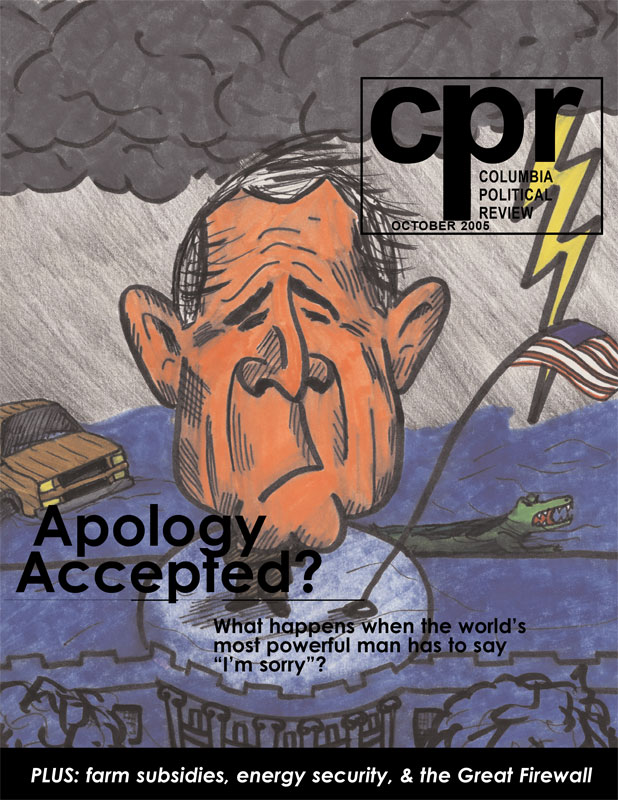
Apology Accepted?
On September 13, to the astonishment of both the public and political pundits, George W. Bush said he was sorry.
The Rise of Harry Reid
The boldness of the recently chosen leading Senate Democrat was surprising given his moderate record, but appropriate given the current political climate. Reid normally exhibits outspoken moderation, which is emblematic of the larger uncertainty within the Democratic Party as a whole.
Africa's New Union
“Extreme poverty can be ended, not in the time of our grandchildren, but our time,” wrote Jeffrey Sachs, director of Columbia’s Earth Institute and Special Adviser to Kofi Annan on the Millennium Development Goals, in his new book, The End of Poverty.
Left Hanging
If a donkey brays in the woods, but nobody hears it, does it make a sound? Democrats must wonder. And what makes them all the more ignorant is that donkeys aren’t normally found in the woods.
Ellen Malcolm
Ellen Malcolm is Co-Founder and President of EMILY’s List, a political action committee dedicated to supporting pro-choice Democratic women get elected to all levels of government.
Don't Step on the Crack
While numerous cities have witnessed closing factories, sluggish economies, and population attrition due to urban flight, America has only one “Most Dangerous City.” What went wrong in Camden? The answer is simple: crack-cocaine. In 1985, there were twelve homicides in Camden. Ten years later, in 1995, there were sixty. What happened in the interim? Crack-cocaine arrived in the mid-1980s, followed by the proliferation of open-air drug markets – venues for outdoor drug sales – throughout the city.
East Meets West
President Mikheil Saakashvili of Georgia won’t soon forget the last fifteen months. His political whirlwind began with the nation’s “Rose Revolution” of November 2003, a nonviolent popular uprising that served as a model for last fall’s Ukrainian “Orange Revolution.”
Can America Stomach the Consumption Tax?
President Bush is leading a major tax code overhaul. For more than two decades, a growing number of free-market economists and conservative politicians have been planning to overthrow the entire federal taxation system. If successful, these radical reformers would effectively shift the burden of taxation from wealth onto wages and therefore onto lowerincome Americans. This idea is known as the consumption tax.
Unshackling The DNC
As long as the unity of the ever-fractious Democratic constituency is tied up in party leaders threatened by term limits and local electoral battles, the party remains one unlucky election away from disarray. Fortunately, they already have a perfect candidate to take responsibility for a party-wide message—the Democratic National Committee (DNC).

Ready To Serve?
After twenty years of efforts to forge a true national service movement, proponents see in next year’s election the potential for a much more expansive discussion of what service and citizenship can mean in the post-9/11 era. They’re looking for a quantum leap in the politically possible. And one candidate in particular seems to have staked his candidacy on just such an appeal.
Schoolhouse Crock
Proponents of the standardized curriculum say it promotes continuity and consistency throughout the public school system, but opponents, especially teachers, say it prioritizes cosmetic changes over real classroom needs.
The Anti-Politicians
On the Campaign Trail ‘72, a remarkably entertaining and, more often than one would expect, insightful account of the campaign, from the fight for the Democratic nomination to the race between George McGovern and Richard Nixon for the presidency. For Democrats interested in winning the 2004 election, Thompson’s analysis of the ‘72 campaign is a must-read, especially in light of the frequent comparisons between McGovern and current frontrunner Howard Dean that one hears from commentators left and right these days.