Gutting Law in the Name of Legality: Inside Trump's Immigration Courts
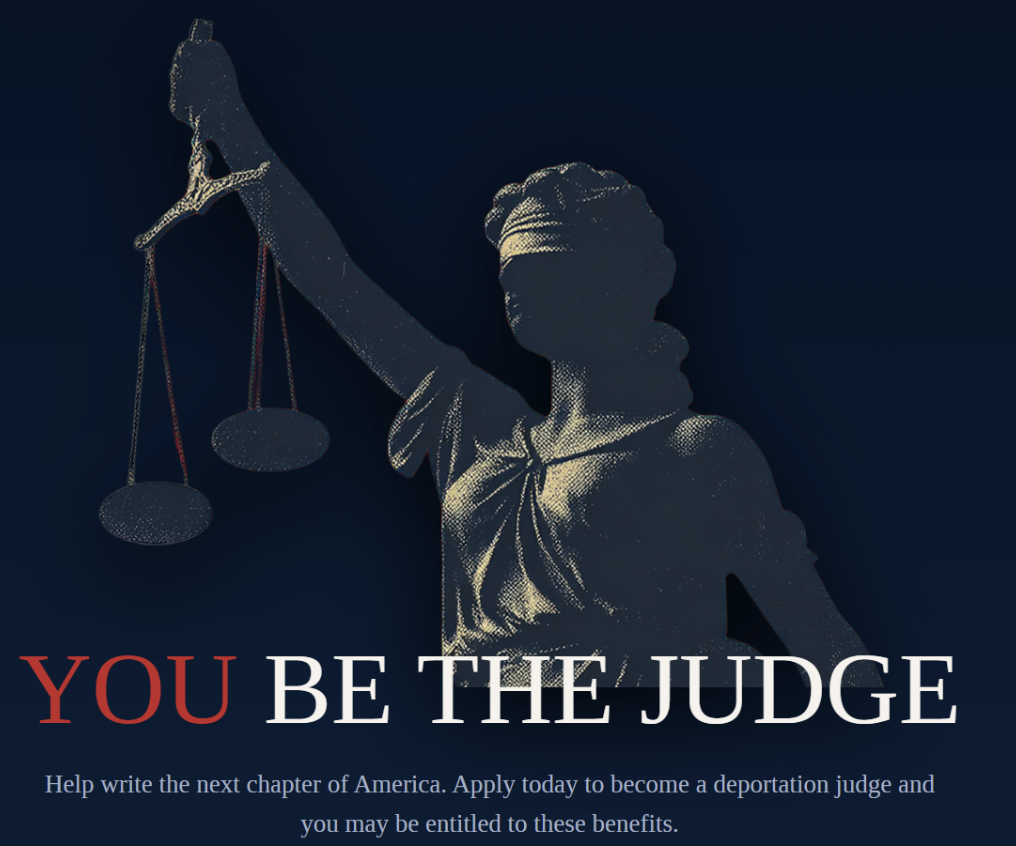
A page from the Department of Homeland Security advertising an opportunity to become a “deportation judge” after mass firing immigration judges. Photo from the Department of Homeland Security.
In his second term, President Donald Trump's domestic agenda has been characterized by unforgettable scenes of federal agents raiding apartment buildings and detaining people in the streets. This crackdown on the immigrant population has been framed around the premise of legality — as a solution to illegal immigration. But a closer look at the legal processes behind the visible crackdown on the immigrant population reveal that Trump’s Department of Homeland Security has used unpublicized procedural changes, weaponized incompetence, and intimidation tactics to co-opt the very system designed to process immigration.
As a result, a fundamental tension has emerged: while the administration has justified its crackdown in the name of legality, it has worked in practice to undermine the very institutions designed to fairly adjudicate who even has the right to be legally admissible and stay in the United States in the first place.
I, like hundreds of people across American cities, have served as an immigration court observer. Our job is twofold. First, we provide support in and outside the lobbies of courtrooms, talking to unrepresented immigrants about their rights and what to expect during their trial. We also collect emergency contact information in the event that they are detained by ICE agents stationed in courthouses. Second, we observe and take notes during immigration proceedings, gather information about tactics used by DHS attorneys and judges, and relay it to immigration lawyers and immigrants rights organizations who can then prepare their clients accordingly.
Throughout Trump's second term, court observing has become an increasingly popular practice, as rapid changes to immigration proceedings have created a need from legal advocates to keep an on-the-ground awareness of what is going on inside the courtrooms themselves on a daily basis, as procedures change with unprecedented speed, and often without notice.
These tactics have evolved since Trump stepped into office. During the summer of 2025, masked ICE officers lurked in the hallways and stairwells of federal immigration courts, detaining people coming out of Master Calendar Hearings, which are standard initial hearings that determine whether a person currently residing in the United States is deportable. It was difficult to find any explanation for how people were being selected for deportation by ICE. Initially, ICE officers appeared to be aware of which plaintiffs had gotten their case dismissed and would arrest people coming from those cases.
However, as time progressed, case dismissals did not sufficiently explain who was being taken. In some cases I and other volunteers witnessed, ICE officers did even appear to know the names of the people they were detaining. It thus became increasingly difficult for attorneys and legal advocates to determine grounds for defense and, it became even more difficult to provide guidance for respondents. After a couple months, court arrests attracted massive press and public outrage, and ICE stepped away from this tactic. But this was just the beginning.
In a much more covert effort, starting November 2025, the Trump Administration drastically escalated its use of Asylum Cooperative Agreements (ACA), a previously dormant practice of deporting asylum seekers to seek refuge in a third country instead of in the United States. These third countries were established through an opaque web of bilateral agreements which included agreements with Honduras, Ecuador, Uganda, Cameroon, El Salvador, and Guatemala.
In court, ACAs were used by DHS attorneys to issue pretermissions of cases. Pretermissions entail denying asylum applications at any stage, without even having a hearing regarding respondents’ asylum claims. Under the ACA, an asylum case could be entirely dismissed under the grounds that the person would be safe to seek asylum in a third country. ACA data from the Executive Office for Immigration Review collected by the nonprofit Mobile Pathways indicates that 13,000 cases had resulted in deportation via an ACA between the months of November 2025 and March 2026.
In practice, ACAs attempted to move the fate of people in the American immigration system outside the reach of US law entirely. Instead, the fate of people in the immigration system is relegated to a web of opaque foreign treaties. In one instance, in a Seattle immigration court in January, a Venezuelan woman, accompanied by her two children who sat with me in the back of the room as she faced the judge, received a pretermission order to Ecuador. The woman was crying, trying to negotiate with the judge to let her at least go home to Venezuela. The judge refused, citing the order from the DHS attorney. At one point he said “I’m sorry. The agreement between these two countries is higher than this court.”
To further limit the power of traditional legal oversight, the power of immigration judges to challenge these pretermissions has been drastically eroded. In October 2025, the Board of Immigration appeals — the Department of Justice tribunal that reviews decisions by immigration judges — issued an opinion in Matter of C-I-G-M- & L-V-S-G that limited immigration judges to only being allowed to challenge DHS-issued ACAs if the person could prove that they would be persecuted in a third country. For most people faced with ACA based deportation orders, proving persecution in their DHS assigned country proves near impossible as most of them have never been to the country they are assigned deportation to. Furthermore, ACA motions have frequently been issued orally by the DHS attorney on the spot, and any argument by the respondents or their attorneys has to be made immediately, without time to prepare.
Upon closer examination, ACAs are often fraught with errors and inconsistencies which brings into question how they are meant to play out in practice. For instance, the Spanish language version of the government’s ACA agreement with Guatemala published in the Guatemalan federal registry limits the number of people eligible to be transferred there to just 10 individuals per month. The English version, on the other hand, features no such limit. The inconsistencies and opacity of these agreements do not just raise concerns about the logistic feasibility of immigration procedure, but it makes anticipating and understanding legal procedures almost impossible for lawyers.
There are also needless bureaucratic procedures surrounding the process of combating an ACA-based deportation order. For instance, when issued a notice of deportation via ACA in the mail, immigrants have 10 days from the date the motion was mailed to write a response and send it back. But the postal service in the United States is reliably slow and the people who receive these orders have to get through pages of legal jargon — including sections on treaties and human rights conditions in other countries—to understand that there is a deadline to respond at all. The result is a trap, whereby somebody does not have the sufficient time to present evidence to appeal their case. There is no reason to rush these cases, but a 10 day deadline makes it incredibly difficult for somebody to find a lawyer or understand the proper way to respond, especially when the window is likely halfway over by the time they receive the motion.
On March 12th, in an email to DHS attorneys leaked to The Seattle Times, but not available on any public records database, the Trump Administration ordered for Immigration and Customs Enforcement lawyers to stop filing motions for ACA agreement-based deportations. No rationale was given in the email to explain this change or indicate whether it would be temporary or permanent. Furthermore, judges have continued to grant existing pretermissions motions in court. Thus, it is incredibly difficult for lawyers to determine whether or not a pretermission could occur. Uncertainty and fear have permeated into once fairly standardized processes.
Also crucial to the Trump Administration's efforts to hijack the immigration legal system is his drastic reshuffling of immigration judges. In 2025, President Trump laid off a massive number of judges with sympathetic track records toward asylum seekers. In their place, he appointed hardliners and military judges who were largely unqualified to impartially judge immigration law. This development was made possible by a regulatory change implemented in August by the Department of Justice which broadened the qualifications for temporary immigration judgeships to include military and veterans’ appeal judges, private attorneys, and government lawyers. The change also waived the prior requirement for experience in immigration law. There are major consequences to this, as immigration judges determine whether people are to be ordered detained and deported.
A former career immigration judge, Ryan Wood, has expressed serious concerns about sending military lawyers to serve as temporary immigration judges, arguing that “immigration law is extremely complex. It's only rivaled by the tax code in complexity. It takes a year or two to really get up to speed and to understand the law and how to make good, fair decisions. But we're pulling these people out of private practice for six-month details.” These layoffs send a clear message to existing judges: agree to deport as many people as possible and keep your job.
Trump's court co-optation goes all the way up to the top. In October 2025, he promoted hardliner Teresa L. Riley, an Ohio immigration judge, to Chief Immigration Judge. The Chief Immigration Judge is responsible for overseeing policy implementation for the immigration courts. Between 2020 and 2025, immigration judges nationwide denied an average of 58.9 percent of asylum claims. Judge Riley denied 81.0%.
Beyond just replacing or intimidating the judges which sit in actual courtrooms, the Trump administration has also gone behind the scenes to manipulate the very body that oversees immigration judge decisions, the Board of Immigration Appeals. Although lesser known, the BIA plays a crucial role in the immigration oversight process. It is tasked with determining whether the decisions of immigration judges were lawful, thereby setting immigration precedents and rules for the whole country.
The White House has weaponized the BIA to significantly narrow down the due process and forms of relief available for immigrants. To do so, they drastically shrank its size, fired all but two of the judges appointed by previous presidents, and stacked the remaining slate of 15 judges with President Trump’s appointees. Despite the cut down in personnel, the BIA has issued more decisions in 2025 than in all the Biden years combined. By no coincidence, in 2025, BIA attorneys sided with DHS attorneys 97% of the time, while only siding with immigrants for 3% of cases. This contrasts to 2024, when BIA rulings sided with DHS attorneys 64% of the time, and immigrants 36%. Reviewing these cases takes time, but with half the judges and more than 4 times the number of decisions issued, it is doubtful that each case is receiving the thorough review they warrant.
Effectively, at the same time that the Trump Administration has preached for legality within the immigration system, it has co-opted and undermined every step of the legal immigration review process. This hypocrisy carries a devastating human cost. People seeking asylum—a pathway enshrined in law as a legitimate method of immigration to the United States-–are being deported to foreign countries or held in brutal detention centers.
While immigration raids are public and largely documented, procedural and legal changes share a common design: they move consequential decisions into spaces that are difficult to monitor, challenge, or even understand. The March 12th email halting ACA new filings, issued without explanation and not entered into public record, suggests the administration itself is still improvising.
The result is, without public awareness of the legal machinery underneath the visible crackdown, immigration advocates and experts have been left to take on an increasingly convoluted and massive caseload alone. But there are things ordinary people can do to help.
From elementary school teachers to former US Marines, I have been extremely moved by the people I have gotten to know and interact with who have mobilized to document detentions or accompany people into intimidating court hearings. But you don't have to show up to court—you can get involved with local immigrant rights organizations, volunteer at asylum legal clinics, or donate to organizations offering pro-bono legal services to immigrants.
In a deportation push deliberately engineered to insulate itself from oversight mechanisms, paying attention, and refusing to remain indifferent, is not a passive act. It is a powerful method of ensuring direct support to people most affected, and accountability for the perpetrators.
Lora Tseytlin (BC ’27) is a columnist at CPR studying political science and economics. She is from Washington state and misses seeing signs of nature while in the city. Contact her at lt2956@barnard.edu