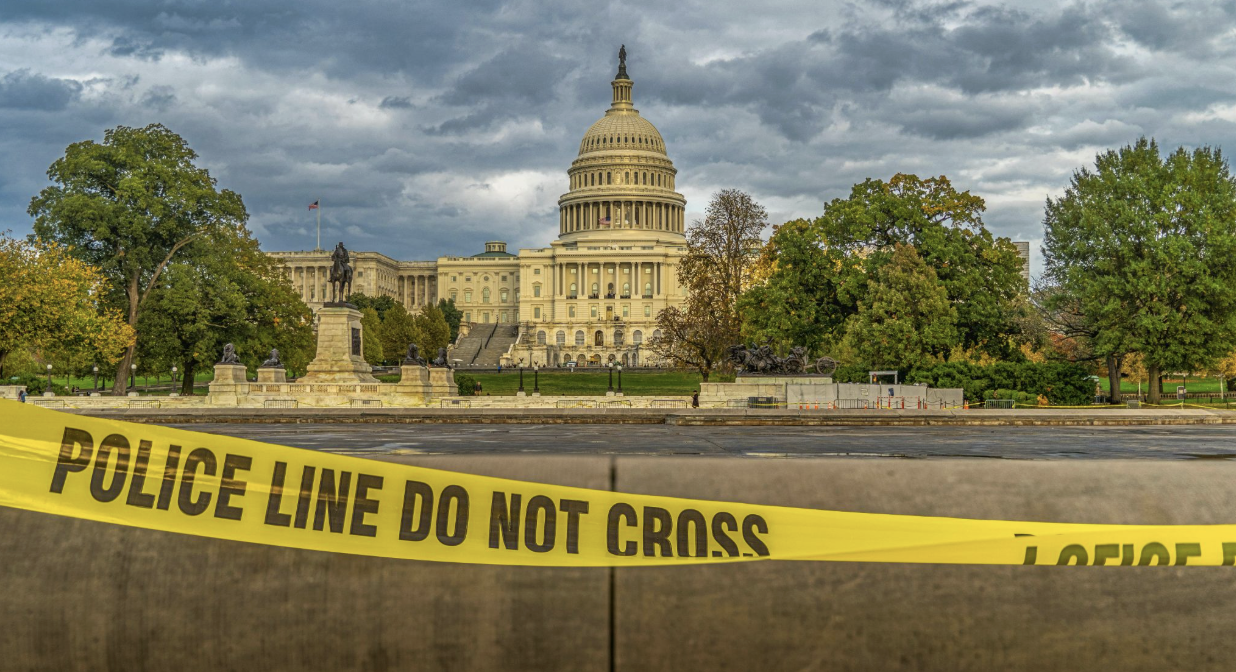
View of the U.S. Capitol Building. Photo courtesy of Pierre Blaché.
After Charlie Kirk’s assassination, headlines loudly declared that political violence was “on the rise” and “a feature of US life.” These claims also drew on the cases of Brian Thompson and Luigi Mangione, the assassination attempts on President Donald Trump, the fatal shooting of Speaker of the Minnesota House of Representatives Melissa Hortman and her husband, and other incidents that have shaken the nation.
Despite the appearance that political violence has only recently spiked, people forget that it has always been a feature of American politics. A closer look at history suggests that the rise in political violence is not as dramatic as it appears.
The Civil Rights Movement is the closest equivalent to the level of violence we see today. Kevin Boyle, a historian at Northwestern University, notes, “Over a third of the presidents in the 20th century experienced assassination attempts, and two of them were killed.” Presidential candidates, like John F. Kennedy and Robert F. Kennedy, as well as civil rights leaders, like Martin Luther King Jr., were also assassinated in this period.
Clearly, we have seen political violence before. What makes our era so different?
The first difference is that political violence has become significantly more visible. “Most mainstream politicians in [the late 19th to mid 20th century], outside of the Jim Crow south, avoided violent rhetoric,” Boyle states. “That’s no longer the case.”
Compared to the 1960s, both pundits and politicians today seem much more willing to embrace violent language, particularly along partisan lines. Lilliana Mason of Johns Hopkins University observes that the main shift is that the violence of today is more explicitly partisan. Thus, as figures like Trump point fingers at “the radical left,” increasingly violent rhetoric coupled with intense polarization seems to suggest an exaggerated rise in political violence.
A jarring example of such language is Trump’s comments toward former FBI Director Robert Mueller, whose professional relationship suffered from intense partisan strain as Mueller led the investigation into Russian interference in the 2016 election. Trump had said in response to his death, “Good, I’m glad he’s dead. He can no longer hurt innocent people!” While Trump has long conceded morality, this goes to show that if a leader of a country speaks and acts in such a manner, what can we expect of his constituents and the rest of the population?
A second explanation for the seeming rise in political violence is the normalization of it. Robert Pape, professor of political science at the University of Chicago, finds that there are “historically high levels of support for political violence on both the right and the left.” An October 2025 PBS News/NPR/Marist poll showed that at least a third of Americans believe that violent action might be necessary to “get the country back on track.” Among this group, a jarring 11 percent “strongly agree.”
The reality is that increasingly violent rhetoric, rising partisanship, and the normalization of violence seem to suggest a greater rise in political violence than is actually taking place.
Paul J. Becker and Art Jipson, associate professors of sociology at the University of Dayton, argue that “Politically motivated violence in the U.S. is rare compared with overall violent crime. Political violence has a disproportionate impact because even rare incidents can amplify fear, influence policy, and deepen societal polarization.”
Amid widespread fear spanning the political spectrum, the polarization that contributes to the partisan framing of these incidents, perpetuated by prominent political figures and media outlets, amplifies the perception of political violence. This creates a vicious cycle: as the belief in a “rise” in partisan violence grows, it becomes easier to demonize those across the political aisle. This, in turn, can intensify violent rhetoric and heighten the risk of further political violence.
Take Luigi Mangione and Brian Thompson. Thompson himself is a businessman, not a political figure. Yet, this assassination was instantly politicized. As things have become more partisan, frustration with the healthcare system is seen as “left-wing,” amplifying a polarized rhetoric. This is not something that would have happened in the 1960s.
As Roudabeh Kishi, chief research officer of Princeton University’s Bridging Divides Initiative, implores, “Blaming whole groups of people or whole sides of the political spectrum is what really risks broader violence.” While recent acts of violence strike us as extreme, they are not unprecedented. What is new is the dangerous rate of partisan polarization, which is leading us down the path of actual dramatic rises in violence.
To break this cycle, we need to move forward by recognizing the complexities behind the political violence of today. Only by understanding the specific challenges of our moment can we face them.
June Ying Liu (BC ’29) is a staff writer from Hong Kong and New York City, studying Political Science and Biology. She can be reached at jl7042@barnard.edu.