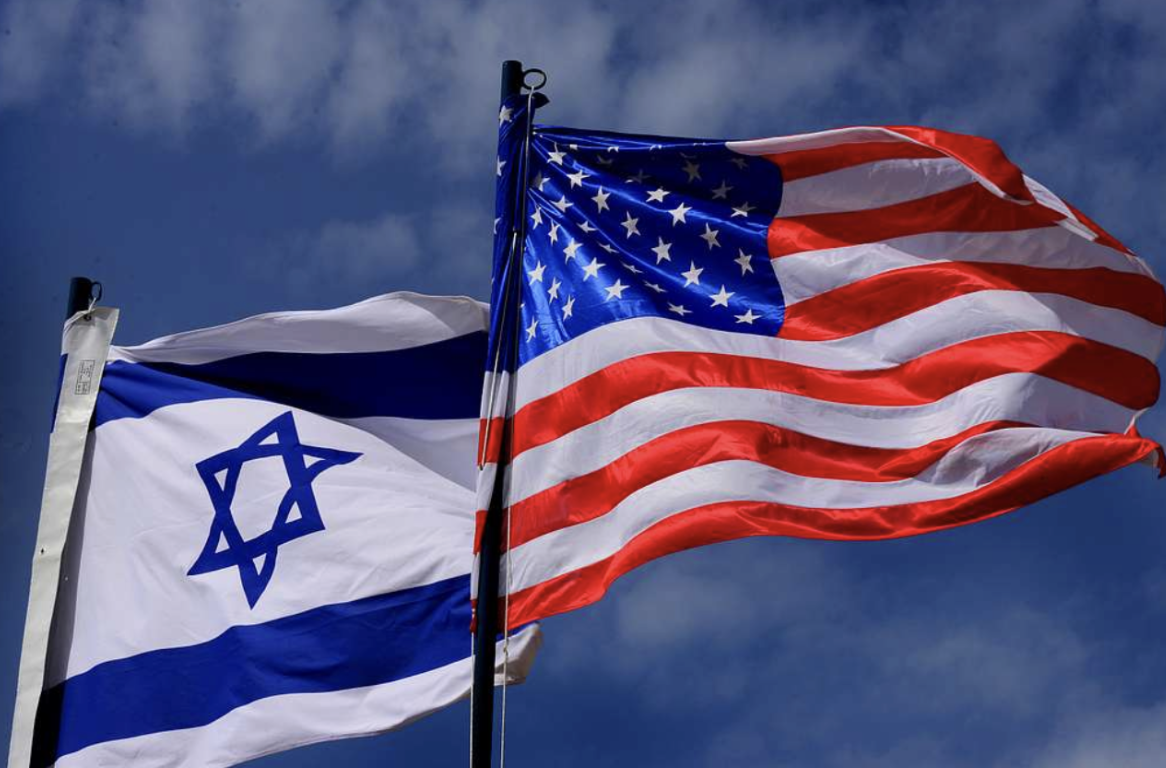
The American and Israeli flags fly side by side. Photo courtesy of picryl
As a Christian, I have found the discourse among conservative Christians regarding the justification for the United States’ support of Israel frustrating. The source of my vexation, along with many other Christians, is what lies at the heart of this fruitless discourse: Christian Zionism.
But what exactly is Christian Zionism? Even if you are not familiar with the term, you have certainly come across its fundamental precepts before. Many of us have heard a number of prominent right-wing politicians base their support for Israel on the notion that “those who bless Israel will be blessed, and those who curse Israel will be cursed.” Take United States Senator Ted Cruz, for example, a self-proclaimed “leading defender of Israel.” Cruz, along with other Christian Zionists, cite Old Testament verses like Genesis 12:1-3—in which God promises to the prophet Abraham and his descendants a “great nation”—to argue in favor of the United States’ alliance with Israel.
Christian Zionism, not to be confused with Zionism—a nationalist movement that argues in support of a Jewish state from the perspective of Jewish self-determination—grounds its arguments in the fringe evangelical theological framework of dispensationalism. Put simply, dispensationalism, though more theologically complex, espouses that the modern state of Israel fulfills God’s “unconditional promises to national Israel in the Old Testament.” In other words, the Jewish people, who are the descendants of Abraham, are entitled to their ancestral homeland by God’s Old Testament covenant.
As Christian Zionism is itself a peripheral viewpoint rejected by the majority of Christians, it comes as no surprise that Christian Zionism was decried by the Patriarchs and Heads of the Christian Churches in Jerusalem as a “damaging” ideology being wielded by some political actors in Israel to push a particular “political agenda.” This dynamic is similarly evident here in the United States.
The American manifestation of Christian Zionism is apparent in how some right-wing politicians use Christian Zionism to advance a particular political agenda, often characterized by an unwavering and indiscriminate support for the Israeli government. This is not to suggest that Christian Zionists are using their religious position as a guise for a nefarious political project—if anything, the opposite is true. Their ardent support for the Israeli government is stated openly and unambiguously.
The more salient consideration is not to try to decipher the underlying intentions that Christian Zionists may have, but rather to assess whether it is prudent for certain prominent voices on the political right to continue invoking their Christian Zionist beliefs as a legitimate rationale for US support of Israel. In addressing this point, a recent interview between conservative political commentator Tucker Carlson and United States Ambassador to Israel Mike Huckabee provides key insights. The fact that Huckabee—the central diplomatic figure in US-Israeli relations—grounds his understanding of that alliance in Christian Zionism should be cause for concern.
Carlson, with his cunning interview tactics and idiosyncratic laugh, pressed Ambassador Huckabee on both Israel’s legitimacy and the United States’ policy toward Israel. Carlson raised two main points of contention: he questioned arguments regarding the indigeneity of the descendants of Abraham and their claim to the land, as well as the precise geographical boundaries of the land promised by God to the Jews. Regardless of whether one views Carlson’s scrutiny of Israel as honest or dubious in its intentions, these two points require serious consideration.
On the first point, Huckabee was unclear whether the descendants of Abraham included those with Jewish inheritance, or only those who can be genealogically verified as descendants of Abraham. Furthermore, it is an ideologically discordant position for conservatives like Huckabee to support the existence of Israel on the basis of indigeneity while simultaneously rejecting similar indigeneity claims applied to other settler-colonial projects like the United States. In other words, as expressed by Christopher Rufo, a senior fellow at the Manhattan Institute, conservatives inadvertently place themselves in the same ideological camp as those they oppose—namely, proponents of what he characterizes as the “Third Worldist ideology” of “decolonization” and “land acknowledgments.”
On the second point, the question of what geographical region Jewish people lay claim to brings about a legitimate political concern; God promises Abraham and his descendants everything from the “Wadi[e] of Egypt to the great river, the Euphrates,” encompassing an area of land in the Middle East far greater than the borders of Israel proper today. Mike Huckabee said that he “would be fine if [Israel] took it all,” which raises a serious question for conservatives more generally: would it be geopolitically prudent for the United States, in the name of supporting Israel, to adopt a position of unconditional support if a belligerent Israel sought to secure this full “promised” territory? The answer should be no.
This, obviously, is merely a hypothetical that considers the political ramifications of Christian Zionist ideas were they to become the primary foundation of the United States’ foreign policy—but as of now, this is not the case. In fact, recent US and Israeli military actions against Iran have not been framed by President Trump through a Christian Zionist lens. Instead, he presents the conflict as an effort to preserve US hegemony by eliminating what he calls “the imminent nuclear threat posed by the Iranian regime” and dismantling Iran’s military apparatus and terrorist proxies.
The reality is that the war in Iran, as claimed by the Trump administration, is not being fought by the United States for the sole purpose of fulfilling its duty to aid an emboldened Israel in securing its desired territories. Unfortunately, however, outspoken right-wing politicians who attempt to support Trump’s action in the Middle East using Christian Zionist arguments have allowed this narrative to pervade the mainstream political right. By arguing that the United States’ actions somehow fulfill a divine promise to the state of Israel—and that such support is unconditional—these politicians have only fueled conspiratorial discourse in right-wing spaces suggesting the American government is entirely compromised by foreign influence.
To observe this, it’s worth returning to the political musings of Tucker Carlson. Though his scrutiny is useful in elucidating the issues with Christian Zionism, he errs in the hasty conclusions he draws about the war in Iran. Carlson is not himself a Christian Zionist, but his conclusions reflect the conspiratorial logic that Christian Zionist rhetoric inevitably invites. Carlson makes claims about the Israeli government’s clandestine influence over American politics, specifically asserting that the “United States committed troops to this conflict because the Prime Minister of Israel…Benjamin Netanyahu…demanded it.” Rooted in a similar perspective on the current state of American foreign policy, though more rhetorically provocative, prominent right-wing influencer Candace Owens claimed that the war in Iran was evidence that “satanic Zionists occupy the White House” and control the Trump administration. In this way, both figures take the Christian Zionist premise—that the US is bound to Israel’s interests—and push it to its conspiratorial extreme, substituting divine obligation for foreign coercion. Ironically, by suggesting Israel has covert control over the American government, they partially absolve Trump of the culpability they seek to ascribe to his administration, for if he were under coercion by foreign influence, one cannot entirely blame him for the consequences of the United States’ belligerence in the Middle East.
While it is theoretically possible that right-wing influencers like Tucker Carlson and Candace Owens will be vindicated in the future, their claims remain, as of now, unfalsifiable, and only function to obscure the substantive conversations that should be taking place regarding the justifications and consequences of the war in Iran. In this way, Christian Zionism, by appealing to theological abstractions, has contributed to steering the discourse around the war in Iran away from practical politics and into the realm of malignant and unsubstantiated insinuations. For if certain politicians can assert that God has ordained the United States’ servitude to Israel, it creates space for political pundits and prognosticators to make similarly unfalsifiable claims, often far outside of the Overton window.
Thus, it is evident that Christian Zionism is an untenable and imprudent ideology, both for its dubious potential political ramifications as well as its contributions to fruitless discourse, and it ought to be rejected politically as a justification for the United States’ support of Israel. Instead, the political right ought to ground the United States’ support for Israel elsewhere.
Political commentator Michael Knowles, expounding upon the ideas of political philosopher Leo Strauss, argues, “it seems to behoove the pro-Israel side to ground their arguments in more modest ways,” and that we should remind ourselves to refocus the United States’ alliance with Israel and support for the existence of a Jewish state “on the low but solid ground of…the interest of great powers”—the promotion of the United States as the global hegemom that refrains from abstractly invoking theological fulfillment. Doing so places the United States in a more advantageous position—one in which our alliance is not unduly shaped by unconditionality and limited scrutiny that Christian Zionist arguments can produce. This prevents the prioritization of foreign interests over the constitutional interests and general welfare of the American body politic and the nation more broadly. In addition, this prevents the growth of a destructive political discourse surrounding the United States’ foreign involvement with Israel that is unmoored from practical politics and crowds out substantive critique or approbation of American foreign policy.
Ekin Matanza (CC ‘29) is a staff writer at CPR who is interested in political science, economics, and philosophy. He can be reached at ezm2103@columbia.edu.