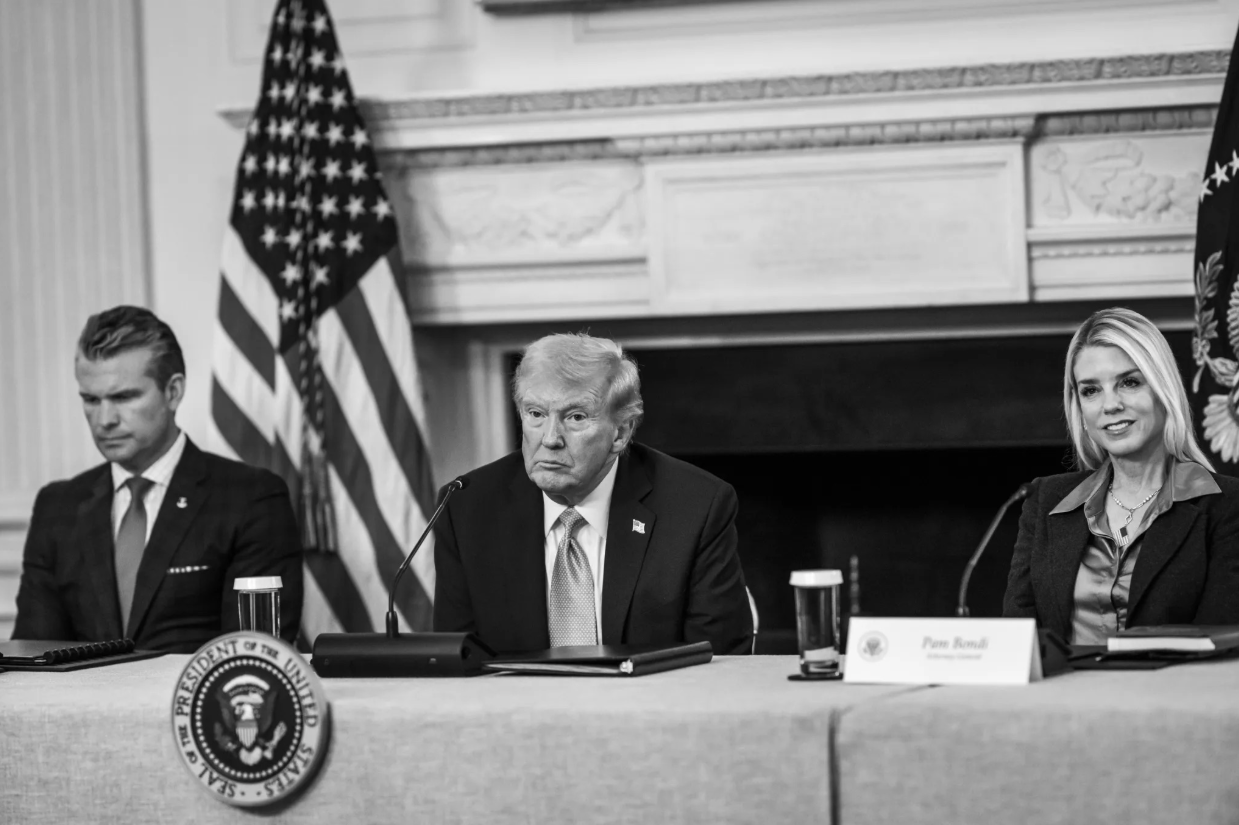
Donald Trump attends a roundtable event to launch the Homeland Security Task force. Photo courtesy of the White House.
April Fools has never been a day I’ve looked forward to. Yet this year, I found myself wishing that the day had lived up to its name.
On April 1, President Donald Trump became the first sitting president to attend oral arguments at the Supreme Court, where the American Civil Liberties Union challenged the constitutionality under the Fourteenth Amendment of his executive order to end birthright citizenship. The move was, at best, a move reflecting the president’s interest in the case; but at worst, it represents a clear attempt to intimidate the Court and shift the results of oral arguments in his favor. In the wake of a series of national events that have highlighted the rampant dysfunction within the Trump administration, especially the firing of high-level officials, his appearance during one of the most consequential oral arguments this year was, to me, the last straw. Trump’s appearance at the Supreme Court was not a spontaneous decision, but part of an intense period of his strategy of intentionally-created chaos that spans all three branches of government—one that has relied heavily on the idea of “flooding the zone.”
The concept of “flooding the zone,” originally employed in football, involves sending multiple receivers into the same area of the field to overwhelm the opposing team’s defensive players. In political contexts, it is most often associated with close Trump ally and disgraced former White House strategist Steve Bannon, who uses the term to refer to the act of intentionally generating chaos and controversy so that the public cannot possibly focus on one thing long enough to hold leaders accountable. In recent weeks, Trump has mounted challenges to nearly every pillar of American governance. His “flood the zone” tactic is at work in his challenges to the independence of national elections, his firing of high-profile cabinet members, and his intimidation at the Supreme Court. These events have overwhelmed national political headlines, undermined Trump’s own administration, and made it impossible for the public to hold him accountable in any meaningful way.
Trump’s executive order mandating state-compiled voting lists and the Republican-sponsored Safeguard American Voter Eligibility (SAVE) Act take aim at the autonomy of state-supervised national elections. The combination of both of these interventions—an executive order and new piece of federal legislation—is a strong example of Trump’s “flood the zone” ethos at work. The SAVE America Act, which passed the House in February and is now being debated in the Senate, is nothing to slouch at. It would require that individuals have documentary proof of citizenship, like a passport or birth certificate, to register to vote in federal elections. More than 21 million Americans lack ready access to those documents, and the act would make it disproportionately harder for younger voters and voters of color to cast ballots in federal elections. Meanwhile, Trump’s executive order aims to restrict mail-in voting, a method that nearly 50 million Americans used in the 2020 presidential election—myself included. Trump’s stated rationale is election integrity, but noncitizen voting is already illegal, prosecuted, and by every available metric, a minuscule issue. For example, back in January, Utah’s governor reported that in an audit of its statewide voter registry of over two million people, they found virtually zero incidents of fraud. The problem that the SAVE America Act and Trump’s new executive order aim to solve is nonexistent, and even if it did, the cost of implementing these so-called solutions puts tens of millions of Americans at a significant disadvantage in upcoming elections.
Nor has the internal operation of the executive branch been spared from Trump’s flooding of the zone. In March, Trump fired Department of Homeland Security Secretary Kristi Noem after months of damaging headlines and a disastrous congressional hearing that month. Less than a month later, Trump ousted Attorney General Pam Bondi after she failed to grant his wishes to prosecute his political adversaries. Trump’s firing of Noem and Bondi—after both appeared before congressional hearings that exposed major failures in their respective departments—has sent a clear signal to his cabinet about loyalty and the stakes of on-the-job incompetence. It also sends a message to his allies that unfettered loyalty, devotion, and an ability to deliver results for the Trump agenda means stable employment tenure. As proof of that, just look to Bondi’s replacement: Todd Blanche, Trump’s personal criminal defense lawyer. The cascade of firings is its own type of “flooding the zone” and generates enough churn that each news cycle is overwhelmed, making it next to impossible for the public to do something in response.
Finally, there’s the judiciary. On April 1st, Trump sat in the Supreme Court gallery for roughly 90 minutes while Solicitor General D. John Sauer defended the president’s executive order to end birthright citizenship, a right that has been enshrined in the Fourteenth Amendment since 1868. Trump left shortly after the opposing counsel, the American Civil Liberties Union’s national legal director, began her argument. While there is much to unpack from Sauer’s absurd claims in court and the scathing skepticism of the justices, the thing that matters most here is Trump’s gesture. His unprecedented appearance at the Supreme Court transformed a serious legal proceeding into an alarming show of presidential intimidation. Yet, even his own Supreme Court appointees were unswayed. Justices Amy Coney Barrett and Neil Gorsuch aggressively questioned the administration’s position throughout oral arguments. But still, Trump’s “flooding the zone” spectacle did substantial work. Headlines around the nation led with Trump’s presence in the Supreme Court and undermined even his own appointees, ensuring that the story the public absorbed was not solely about birthright citizenship, but about the president’s antics as well.
These “flooding the zone” tactics have become a crucial way that the Trump administration deflects responsibility and undermines accountability when things go south for them. And it is not simply that the domestic chaos shrouds Trump’s international failures like the ongoing conflict with Iran in the specter of disaster, but that they share an underlying mission: to eliminate any force—institutional, legal, democratic, or sovereign—capable of opposing or confronting the president. In the cascade of political turmoil and news reporting on the dismal state of the world, Trump’s overreach and disregard of the American democratic norm of separation of powers is itself disorienting. As citizens, we are asked not only to watch the devastation happening in the Middle East, but also to register the growing destruction of our democracy as it beelines towards annihilation with few means to put a stop to any of it. It is an impossible task to do it all at once.
In thinking deeply about the potential consequences of what Trump’s actions mean for the American public, I rely in part on the exchange between Sauer and Chief Justice Roberts, as much as I disagree with both of their politics. At the oral arguments, Sauer contended birthright citizenship has no place because we “live in a new world.” Justice Roberts offered the keen rebuttal that “it’s the same Constitution.” For what it is worth, Justice Roberts is right: it is the same Constitution. It remains relevant today. The question now is whether that still matters to Trump. And if the past year is anything to go by, nobody should hold their breaths waiting for the answer.
Ishaan Barrett (CC ‘26) is a senior studying political science and urban studies. His previous writing has been featured in URBAN Magazine at Columbia GSAPP, the Harvard Urban Review, the Stanford Undergraduate Research Journal, PIDGIN Magazine at the Princeton School of Architecture, the Barnard-Columbia Urban Review, the Columbia Policy Journal, and the Columbia Daily Spectator. A current Arthur Rose Research Fellow and Gilder Lehrman Institute grantee, Barrett has previously held fellowships at the IRCPL, Harriman Institute, and the Holder Initiative, where he currently serves on the board. He can be reached at i.barrett@columbia.edu