And the Award Goes to…Billie Eilish’s Costly Conscience!
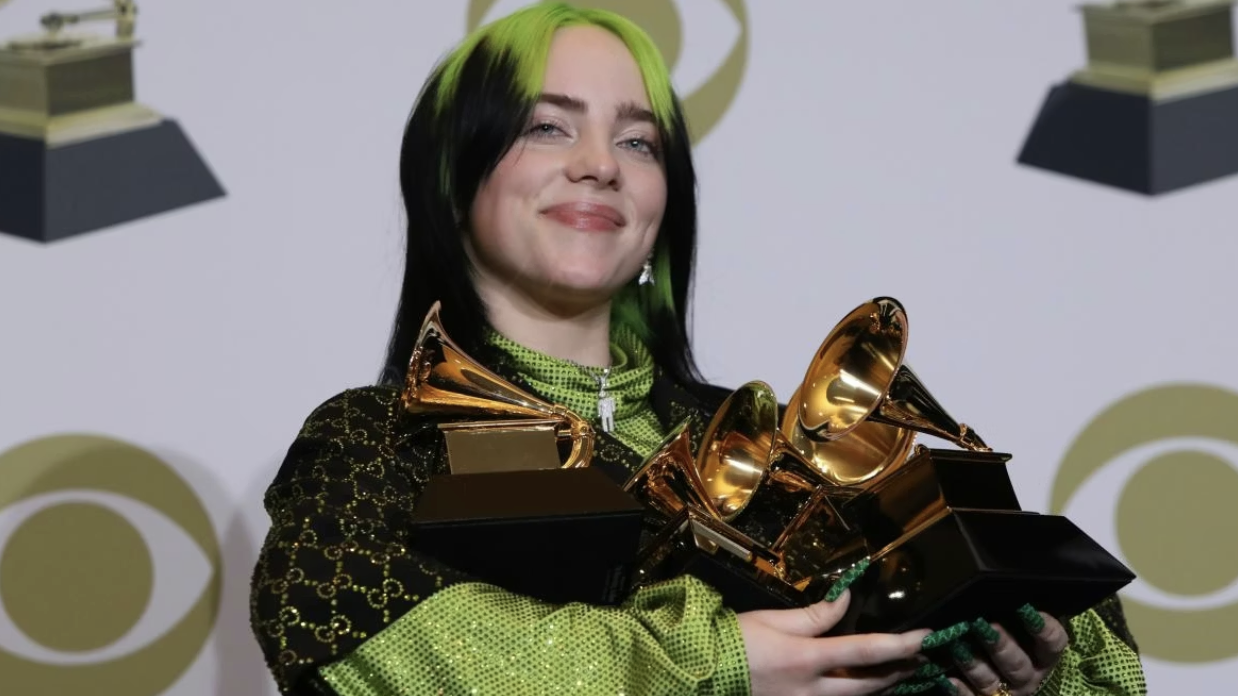
Billie Eilish, a ten-time Grammy Award-winning singer, made a powerful statement at the 2026 Grammy Awards: “No one is illegal on stolen land.” Photo courtesy of Heute.
After winning Song of the Year for “Wildflower” at the 2026 Grammy Awards, Billie Eilish stepped up to receive her award in a seemingly routine fashion. A moment typically characterized by gratitude towards fans, family, and industry peers, she also aimed to inspire solidarity, urging the public to “keep fighting” and “protesting” amid recent Immigration and Customs Enforcement (ICE) raids. However, one of her remarks instantly caused a media storm of backlash: “No one is illegal on stolen land.”
A slogan commonly used in support of more lenient immigration policies, it challenges the moral authority of states to criminalize and restrict immigrants by highlighting how their original land acquisition was illegitimate. Used in the context of the United States, the slogan conveys that because its land was forcibly taken from Indigenous peoples, it does not have the right to forcibly remove others from it.
Yet, critics of the statement ground their backlash in legal principles that reject the idea of historical ownership claims. For example, Professor Richard Epstein from New York University School of Law argues that Americans are technically not thieves on stolen land because legal doctrines such as adverse possession (acquiring ownership due to long, unopposed possession) and jus tertii (third party holds true legal title) prevent ownership from being challenged indefinitely based on past injustices. The logic behind this argument makes sense: without limits on historical claims, nearly every modern landowner could be blamed for conflicts that occurred a long time ago. The argument could even extend to Billie Eilish—should no one be able to step foot in her home because the land was once Indigenous territory?
Such arguments miss the point of her statement and instead rely on legal technicalities to dismiss the broader critique she was making. It would be ethically inconsistent to condemn others for violating borders when those borders themselves were established through violence, actions that would brazenly violate international standards such as the UN Charter, if done today. Deportation policies, in this sense, rest on the assumption that the land is rightfully owned, even though that claim disregards its historically unjust acquisition. Saying this statement now is especially relevant when there has been a record of detentions and arrests due to an increase in ICE enforcement and raids.
Apart from the statement’s moral value, however, it also exposes a psychological barrier many Americans place between the past and the present. Analyzing the historical ownership argument, people are often comfortable apologizing and dismissing historical injustices like Indigenous displacement because their acknowledgement is costless and creates the feeling that enough has been done to address the issue. It becomes unsettling when they are pressured to take action to fully repair the harm, since doing so requires taking responsibility for something they did not cause. However, if the effects of those injustices continue in the present, and if people continue to benefit from it, corrective action remains necessary. Because Indigenous peoples continue to experience material and cultural consequences from historical displacement, the issue cannot be simply dismissed. Thus, by connecting ICE’s actions to the history of Indigenous displacement, Billie Eilish breaks this psychological barrier and forces Americans to take accountability for something they view as merely historical.
After all, recalling our debt to the past is meant to help maintain our moral compass by preventing the repetition of the same injustices. From the 17th to 19th century, the nation forcibly displaced Indigenous peoples while claiming “all men are created equal.” The Trail of Tears specifically forced Indigenous peoples to leave their homelands, exposed them to death and disease during their journey, and forced them to sign treaties under duress. Truly paying our debt for the Trail of Tears is not only recognizing its injustice, but also ensuring that the same injustice is not repeated by implementing laws and policies that protect the rights of marginalized communities.
However, now, ICE agents can detain individuals based on factors such as their race and language, subject immigrants to harsh conditions, and, at times, overlook due process. In this context, Billie Eilish’s statement reveals that the United States has not yet realized the guiding American principle that “all men are created equal” through its emphasis on persisting injustice against immigrants. But why are Americans hesitant to make this connection between the past and present?
Americans who find Billie Eilish’s statement uncomfortable experience what can be described as “costless virtue signaling” when confronting the nation’s past—a psychological response that allows them to acknowledge historical injustices without feeling responsible for its present-day consequences. Americans recognize that the displacement of Indigenous peoples was wrong, but they acknowledge it only through gestures that are costless. For example, the United States has implemented Indigenous Peoples’ Day, adopted land acknowledgments, and created monuments and memorials commemorating the Trail of Tears, but these actions do not reflect a high cost for those taking them; they are more about appearing progressive than genuinely reckoning with the wrongs the country committed.
Responsibility-based guilt, on the other hand, is examining the issue and taking accountability for the harm caused by trying to repair the damage. This could come at a high cost, and in this case, could mean implementing policies that create significant institutional change, such as land restitution or expanded tribal sovereignty. However, because this is demanding, Americans instead virtue signal to cope with their guilt of the nation’s past. In the context of Billie Eilish’s statement, Americans’ virtue signaling of Indigenous displacement causes them to not recognize how it can apply to the present.
Further, Americans do not see this connection because their costless virtue signaling is rooted in American exceptionalism, which is the belief that the United States is “a unique and even morally superior country for historical, ideological, or religious reasons.” Exceptionalism assumes the nation has moved beyond the kinds of injustices seen elsewhere, meaning that human rights abuses must belong to history or to other countries, not the United States today. It reinforces costless virtue signaling by making it easier to dismiss past injustices as mere history that could not happen in America today. Billie Eilish’s phrasing, particularly the words “no one is illegal” and “stolen land,” disrupts this belief. The term “illegal” exposes how the nation continues to criminalize certain groups to justify exclusion, while “stolen land” brings the past to the present by reminding Americans that the country was built on dispossession. Her statement therefore forces Americans to think of whether the United States has truly moved beyond its wrongdoings by examining if current policies, such as immigration enforcement and deportation, still reproduce the same patterns of displacement and exclusion that the United States claims to have left behind in the past.
It may be argued that Indigenous peoples and immigrants come from different historical and legal contexts, making direct comparisons with the contemporary immigrant situation difficult. After all, Indigenous peoples were already living on the land before colonization and were forcibly displaced, whereas immigrants came later and had not previously occupied the same land. Although these histories are fundamentally different, the comparison reveals a similar underlying pattern of exclusion and hierarchy. In both cases, institutions have determined who belongs on the land and who must be excluded. Laws such as the Emergency Quota Act of 1921 drastically reshaped American belonging by restricting immigration through strict national quotas. Later, this same sentiment carried over into the Immigration Act of 1924, further limiting immigration and favoring Northern European immigrants, while excluding so many others.
These examples highlight how the US has repeatedly used policy to define belonging in exclusionary ways. Recognizing this pattern helps clarify the critique in Eilish’s statement, revealing the hypocrisy of a nation founded through displacement now claiming the authority to decide who belongs on that same land.
So while the media labeled Eilish an ignorant celebrity, her statement’s acknowledgment of present failures in America reflects a responsibility-based guilt that is stronger than what most Americans feel. Declaring that “no one is illegal on stolen land” was not performative activism; she used her hard-earned acceptance speech to confront the nation directly, despite the possibility of losing career opportunities and public support. Through her statement, she implies that Americans must do more than hide behind a screen and simply acknowledge what is wrong. By urging the public to “keep fighting” and “protesting,” she called for actual change in the systems that continue to exclude and displace people today.
It may seem as if these calls to action are vague or ineffective. After all, who is going to start protesting just because Billie Eilish said to do so? However, the value of the statement lies in its ability to disrupt the comfort of costless virtue signaling, and Billie Eilish’s celebrity status serves as a catalyst since she can draw widespread attention to it. Even if people do not take action, simply including these calls to action forces engagement, making it harder to ignore the topic. Additionally, since her comment was controversial, it sparked public disagreement and debate, prompting people to respond, defend their views, and discuss immigration policies more openly. Her statement pushed the topic to the forefront of public conversation, encouraging the American public to reflect on what meaningful action and changes to current policy might look like. To gain even more attention for these issues, the nation needs more statements like these from celebrities.
In a country where costless gestures often replace meaningful accountability, discomfort may be the only thing that forces real change. If Americans truly want to reckon with their history, they must do more than remember it. They must challenge the systems that keep repeating it. Otherwise, the past remains nothing more than a story to apologize for while quietly allowing it to happen again.
Jazzlee Cerritos (CC ‘28) is a staff writer for CPR from Murfreesboro, TN. She is studying sociology and political science and is interested in Latin American politics, struggling economies, and U.S immigration policies.