The State That Refuses To Stay Quiet
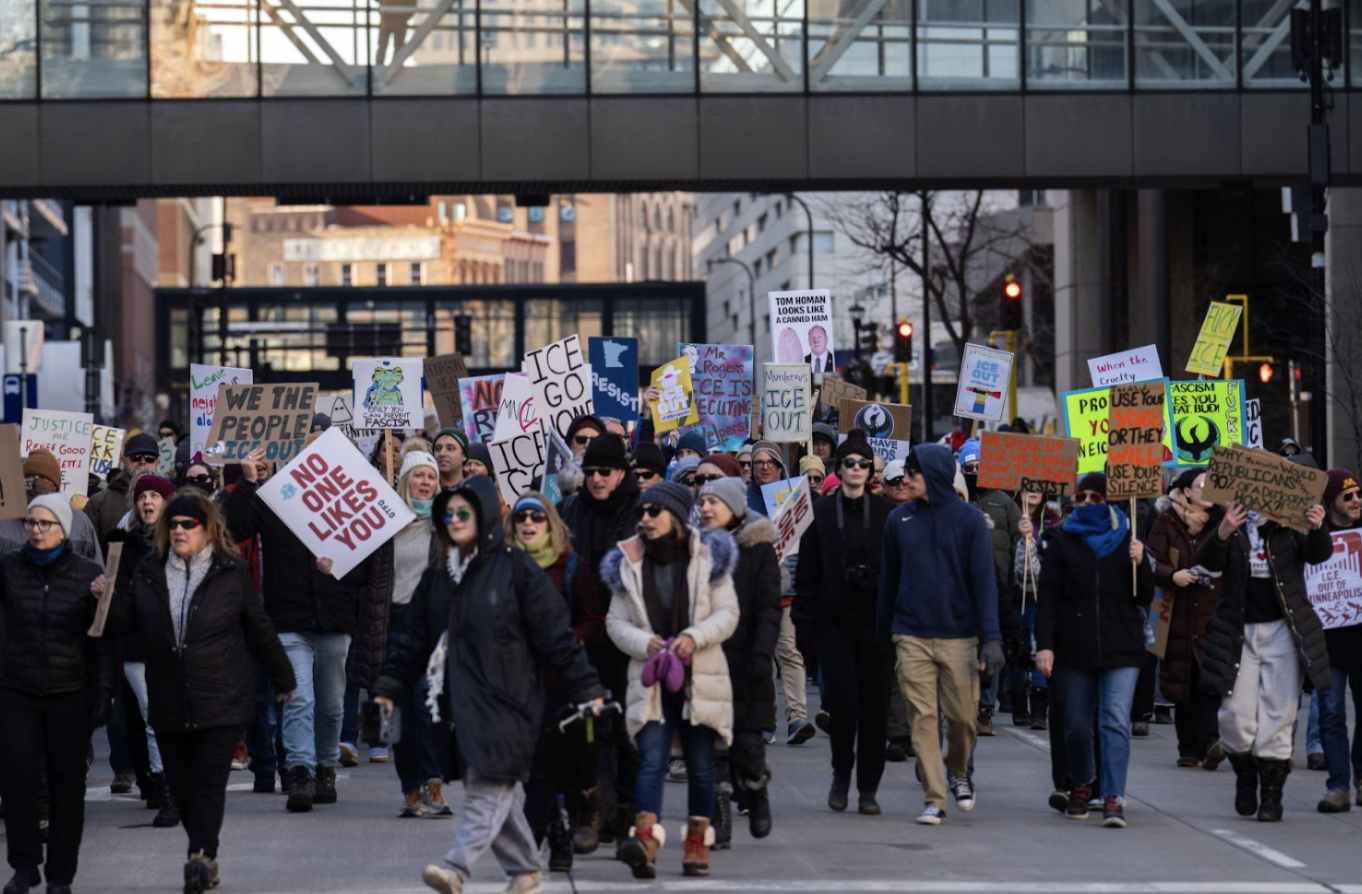
An anti-ICE protest in Minnesota, where participants hold up signs and march throughout downtown Minneapolis. “NO ONE LIKES YOU - Anti-Ice Protest, Minneapolis” is courtesy of Chad Davis and licensed under CC BY 4.0
It seems as though Minnesota is constantly making national news, and not just for its freezing temperatures or famous hockey players. Recently, the state has become the center of major political developments; it has acted as the catalyst for two of the most significant protest movements in the United States in the last six years.
In May of 2020, a Minneapolis police officer’s murder of George Floyd sparked massive demonstrations across the state against police brutality. The Black Lives Matter (BLM) movement spread nationwide, and became the largest protest movement in American history with an estimated 15–26 million participants. BLM raised public awareness of police brutality and sparked notable progress towards racial justice, including the alteration of racially biased data collection efforts in police departments.
More recently, in January of 2026, Minnesota again became a topic of national conversation as protestors mobilized to oppose Operation Metro Surge, a new Trump administration initiative that aimed to deport “thousands of immigrants” who reside in Minnesota. This initiative escalated when two Minnesotan citizens, Alex Pretti and Renee Good, were fatally shot by Immigration and Customs Enforcement (ICE) agents.
The public outcry within the state was immediate. Residents shared social media posts, organized high school walkouts, and rallied in thousands to protest the deaths in Minneapolis and St. Paul. This level of backlash to ICE activity was unparalleled in the rest of the country—even Vice President J.D. Vance wondered “why are we not seeing [the anti-ICE protests] anywhere else?” Deputy General Todd Blanche agreed: “[only in] one city we have this outrage and this powder keg happening. And it’s not right. And it doesn’t happen anywhere else.”
Despite their confounding nature, the actions of Minnesotans appeared to have an impact. On February 12, 2026, the Department of Homeland Security promised to end Operation Metro Surge, though it declined to remove all ICE agents from Minnesota.
Taken together, the strength of these two movements raises the question: why does Minnesota, a state typically overlooked by most Americans, consistently harbor such major political movements? What part of Minnesota’s culture mobilizes citizens to engage in protest, and why doesn’t it happen anywhere else?
To find the answer, it’s necessary to examine Minnesota’s history of civic engagement. The state has long had an important tradition of protest, which began with strikes by farmers in the 1870s and continued with the 1894 Great Northern Railway labor strike in Minneapolis, the very first protest by the American Railway Union (ARU). The ARU then organized the famous Pullman Strike, which resulted in the creation of Labor Day.
Minnesota’s strong labor unions would continue to stage protests into the 20th century, organizing the Minneapolis Teamsters strike of 1934, a movement that is historically recognized as pivotal for the passage of the National Labor Relations Act of 1935. Much like the 2026 ICE protests, the Teamsters strike turned violent when police shot and killed two protesters. Over the course of the 20th century, Minnesotans promoted the civil rights movement, founded the American Indian Movement, and coordinated various other nationwide labor movements.
Historians highlight the connection between these historical events and the more recent protests in Minnesota. “Tragically, there is quite a parallel,” says Peter Rachleff, a retired labor history professor at Macalester College. Rachleff identifies Minnesota’s pro-labor roots as extremely influential in modern advocacy, pointing to the chant of “Get up! Get down! Minneapolis is a union town” that protestors shouted in the anti-ICE demonstrations in January.
Though it may seem unlikely that the most forgotten state in the Midwest harbors such major protest movements, Minnesota’s rich history of labor demonstrations set the scene for Minnesotans to support protests for Black Lives Matter in 2020 and against ICE in 2026. Yet Minnesota’s history of advocacy does not end with protesting.
Engaging with civic life, in all capacities, is ingrained in Minnesota’s tradition. According to data stretching from 1976 to 2024, Minnesota has consistently reported and maintained the highest voter turnout of all states in both general and presidential elections. Additionally, Minnesotans volunteer more than residents of any other state, showing a commitment to direct advocacy in their community.
There is also a cultural factor that enables successful protests in Minnesota. Journalist Adam Serwer posits that “if the Minnesota resistance [to ICE] has an overarching ideology, you could call it ‘neighborism’—a commitment to protecting the people around you, no matter who they are or where they came from.”
The idea of “neighborism” accurately describes the culture of the state in general. Minnesota is ranked by tourists as the number one “friendliest state,” according to the World Population Review, and even movies like Fargo were inspired by how nice Minnesotans are. Julie Beck, writing for the Atlantic, emphasizes how drastically Minnesota’s friendly culture differs from other states. She claims that “Americans are forgetting how to be neighborly… [but] the people of Minnesota suggest otherwise.”
Whether you call it “neighborism” or not, it’s hard to deny that Minnesotans responded to Operation Metro Surge in a uniquely compassionate way. Residents sprang into action, and tens of thousands of Minnesotans participated in massive food collection drives, brought children to school when it was unsafe for their parents to leave the house, and worked volunteer shifts to film and monitor ICE activity.
ICE officers have arrested, handcuffed, and violently assaulted citizens for these actions. Despite the danger, nearly 30,000 Minnesotans have still chosen to train as “constitutional observers,” a rapid civilian response force that has allowed organizations like the Immigration Defense Network to respond to a case every six minutes.
As the former mayor of Minneapolis, R.T. Rybak, says, the culture in Minnesota is “uniquely collaborative and community-based,” and the anti-ICE movements have “not started in city halls and capitols, but in coffee shops and senior centers and parents at schools.”
Protests in Minnesota find such success and popular support because of this collectivist behavior. The state’s history of civic engagement has cultivated a culture of protest that is radical in a country where citizens are increasingly individualistic.
Much like the rest of the nation, Minnesota has its issues. But if Black Lives Matter and Operation Metro Surge have taught us anything, it’s that when you mess with one Minnesotan, you mess with all of them.
Ellie Aars (CC '29) is a proud Minnesotan and staff writer at CPR since 2025. You can reach her at eka2133@columbia.edu.