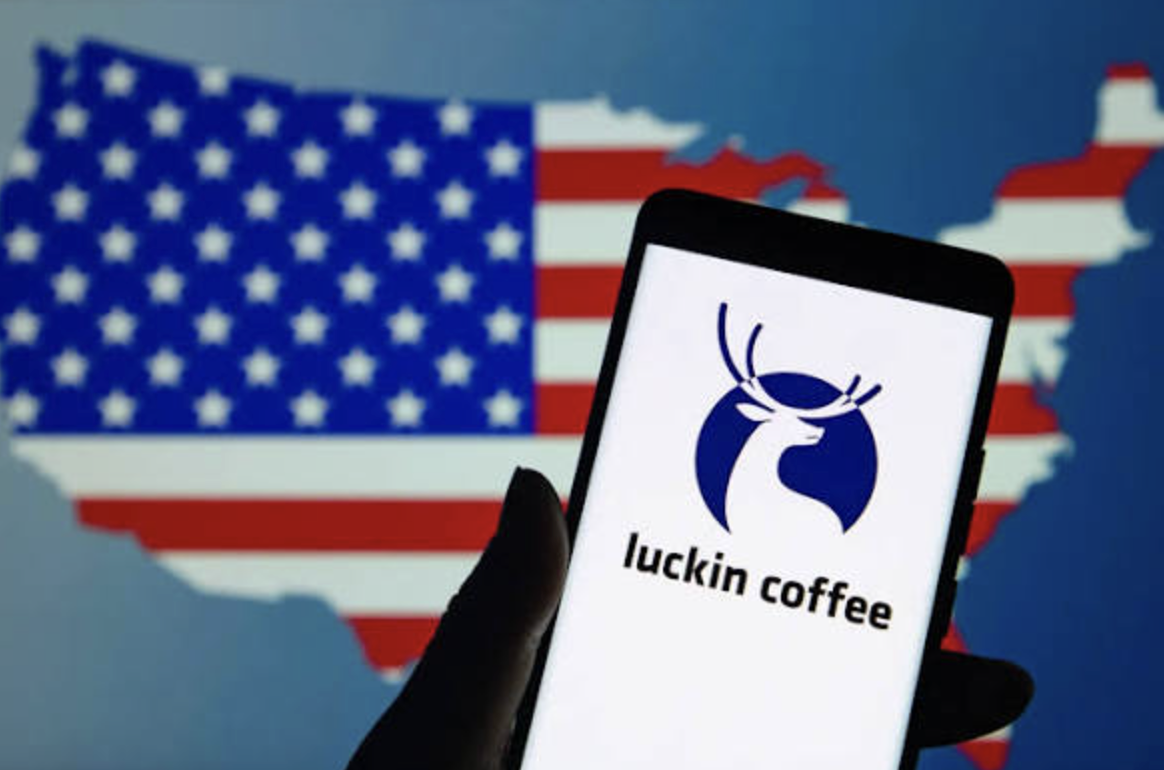
An illustration photo shows the Luckin Coffee logo displayed on a smartphone with the American flag in the background in Chongqing, China.
For decades, Starbucks has represented the gold-standard for mass market coffee, a ubiquitous green logo on American street corners and in American hands. Now, a newcomer is attempting to cut into the coffee giant’s market share. Luckin Coffee, a Chinese chain, opened one of its first locations in New York City in the summer of 2025 as part of a global expansion plan. Luckin’s tech-focused business model centers around speed, discounts, and seamless mobile ordering. The speed and success of their development calls into question whether Starbucks can stave off the competition. In response, Starbucks has begun shuttering some of its own grab-and-go outposts, promising a return to the “coziness” that once defined its stores. It is a curious bet for a company that earns roughly 70 percent of its US revenue from mobile orders. Yet, the coffee war brewing between Starbucks and Luckin extends beyond affogatos and Americanos. It offers a small, caffeinated glimpse into a much larger rivalry between the US and China.
Just as Starbucks once defined the coffeehouse experience and now finds itself outflanked by a more nimble opponent, Washington now confronts the reality that the rules-based international order it designed and sat atop no longer guarantees automatic deference. As China’s economy continues to grow, Beijing seeks a larger say in global rule-making. Meanwhile, Washington has mirrored Starbucks’ retreat back into a bygone era by oscillating between engagement and resentment, slapping tariffs on allies and adversaries alike and periodically questioning the value of the very alliances that uphold the “rules-based order.” The Starbucks–Luckin rivalry offers a useful metaphor for reframing the debate over the China challenge. Just as Luckin is not an existential threat to Starbucks, China’s rise is less of a hostile takeover of the global order than a competitive bid to shape it. It’s a bid the United States should answer, not with panic, but with a renewed push for innovation.
China’s evolution from rule-taker to rule-maker has been underway for some time. Since 2004, China’s share of global manufacturing output has soared from 9% to 29%, a surge that has fed Beijing’s confidence and ambitions abroad. Over the past decade, China has rolled out the Belt and Road initiative to forge deep, globalized economic ties. They have also pursued an “institutional opening-up,” a top-down initiative that seeks to align domestic rules with global standards and build international credibility. Through vigorously proactive foreign policy, China has emerged as one of the only world powers left with the ability, and the will, to challenge a “stagnant” global order. This disruption of the status quo shows up in manners both obvious and subtle. Just as Chinese coffee now fills American cups, Chinese critical minerals run through the circuitry of everyday American life, from advanced machinery to home refrigerators. In Beijing’s view, its widespread presence across the global economy gives China a mandate to lead.
As China’s one-party authoritarian political and economic system conflicts with western liberal democratic values, Beijing’s agenda may appear malicious upon first inspection. Much like how Luckin’s arrival stoked fears of Starbuck’s inexorable decline, China’s rise has unsettled Western analysts and fueled warnings of a looming China-led world. Beijing, however, aims to uphold Washington’s rules based order instead of replacing it. We must remember that China’s spectacular rise occurred inside the order, not outside it. For example, China’s accession to the World Trade Organization in 2001 granted it access to export markets that powered decades of growth. Indeed, that growth often came at other countries’ expense, as Chinese goods flooded global markets and hollowed out industrial bases in the American Midwest. Yet, precisely because China has prospered under these rules, it has little incentive to burn the system down. Rather, Beijing seeks to strengthen and entrench open trade, standardized regulations, and strong international institutions—features long touted as Western achievements. Beijing’s rhetoric has reflected this, as it has repeatedly emphasized the importance of establishing “win-win” relationships with nations around the world, especially in the Global South, while continuing to defend and uphold international institutions like the UN and the WTO. Washington should keep in mind this distinction between the perceived intention of Beijing to tear apart the order and the reality of its ambition to tilt the rules.
Reframing the China challenge as a prompt for innovation and reform presents an interesting opportunity for the US The question for Washington, as for Starbucks, is not whether it can stop the new rival from entering the market. It is whether it can still persuade the world that its version of the product is worth choosing. The last few decades have shown that the American-led neoliberal order that emerged after the Cold War—which was briefly advertised as the “end of history”—was more like a first brew than a perfected blend. Glaring inequalities and exclusionary forces resulting from unfettered globalization have left that system deeply unpopular. In response to Beijing’s ambitious multilateralism, Washington can regain its legitimacy by taking a more active role in global governance. It can offer countries around the world a reimagined liberal order. One that, at its core, still offers the same kind of liberal democracy, international cooperation, and protection of human rights that the original rules-based order promised, but revised to address its shortcomings. This upgrade to the order starts with domestic renewal, Global South partnerships, and clearer guardrails on US-China competition.
First, any sustainable answer to China’s rule-making ambition has to begin at home. The US must show that an open economy can coexist with security, dignity, and opportunity for its own citizens. Just as Starbucks can’t outmaneuver Luckin if its own stores are run down and its baristas are unhappy, the US can’t sustain costly commitments or ask others to trust its leadership if there is no domestic support. This renewal should involve targeted investments in retraining for displaced workers, strong industrial policy to rejuvenate the manufacturing sector, and institutional reform to ensure compliance with the international rules that Washington itself pushed for. Programs designed to help workers reskill for the new economy are not just important for helping those hurt by deindustrialization to get back on their feet, but also to prepare for the AI revolution that could radically reshape work and the labor market. Industrial policy can help pull workers originally boxed out of the economic gains of neoliberalism back into the winner’s circle by creating good jobs that give them more autonomy and upward mobility. Consistency between Washington’s rhetoric abroad and actions domestically, combined with structural reforms, would refresh the US’s image and rebuild trust with other countries. Aside from plain fairness, building trust at home is also strategic—domestic support endows the US with the political and moral authority to lead globally. Only if Americans reinvest themselves in their nation’s success will Washington have the legitimacy to contest China..
Second, Washington should prioritize building bridges with the Global South, not to simply reap the economic rewards it could bring for Americans, but instead to equip them with the power to become co-authors of the order it hopes to rejuvenate. China’s pitch to the Global South is based on finance without lectures and infrastructure without conditionality. It resonates in a context where many feel underrepresented and neglected in Western-led institutions. Luckin wins customers over because it offers affordable drinks without making its customers feel bad for buying them. In this sense, competing with China’s appeal in the Global South requires less moralizing and more genuine partnership. This is not blind altruism, but a necessary maneuver to rebuild the foundations of the order. Many countries in the Middle East, Africa, Latin America, and Southeast Asia do not feel the current order works in their interests. For example, many Global South countries believe that global climate initiatives advocated for by the U.S. and its allies are designed to limit their growth. Rekindling trust begins with delivering on the immediate priorities of the Global South, such as investments in its digital infrastructure, food security, and climate finance. By showing that the US is ready to act in the interest of emerging economies rather than exploiting them for its own gain, Washington can remake the rules-based order to be something countries actually want to be part of, not just something to grudgingly tolerate in the absence of better alternatives. Thus, putting the Global South on more equal footing will not erode US hegemony, but instead strengthen it. In coffee terms, Starbucks wins not by punishing customers who try Luckin, but by offering a better, fairer loyalty program—one where customers feel seen and respected. The US should do the same.
Lastly, instead of resurrecting the old rulebook, Washington should revise it to place the new US-China competitive dynamic within clearer bounds. The post-Cold War order demanded countries to abide by strict liberal rules on capital, industrial policy, and trade that are now politically unsustainable. The order hemmed countries into a single suffocating neoliberal model that demanded low tariffs, minimal industrial policy, tight subsidy disciplines, and deep integration into global markets. That strict vision left little room for governments to pursue other development strategies better suited to their unique economic situation or to shield vulnerable groups from unexpected shocks. It was so restrictive and short-sighted that even the US now finds itself operating outside of the bounds. The new rulebook should allow for more policy flexibility for governments to pursue their own economic agenda, while still ensuring an emphasis on transparency, non-discrimination, and fairness. This reinvented order could perhaps emerge in the form of new subsidy disciplines, centered around flexibility for legitimate objectives and countermeasures for abuse, that allow for countries to simultaneously actualize their economic interests and defend themselves against unfair trade practices. Combined with guardrails such as the maintenance of direct lines of communication during crises, pursuing de-risking and not full decoupling, and prohibiting coercion, this overhaul of the rules will place the US-China rivalry into a more rigorous framework that fosters productive competition rather than destructive escalation. As is for Starbucks-Luckin, the idea is not to ban Luckin’s coupons, but to agree on stricter rules so price wars stay fair and no one can win by hiding endless subsidies behind the counter.
It is crucial to perceive China as a system-shaping competitor, rather than a system-destroying usurper. A rules-based order built on a narrow vision that was inattentive to distributional challenges and developmental diversity was never going to hold indefinitely. The answer is not to forcefully resurrect that model, nor to slide back into a world of power blocs and spheres of influence. What’s needed is a renewed order that’s more inclusive, less arrogant, but still rooted in the timeless ideals of liberal democracy and human rights. In those terms, the task for Washington is to fix up its own shop, reconnect with its patrons, and help set fair neighborhood rules so that, even in a more crowded marketplace, the basic commitments to openness, cooperation, and consent can endure.
Yutong Wu (CC ’28) is a Staff Writer for the Columbia Political Review and a Trade Analyst Intern at China Policy, a research consultancy firm based in Beijing, China. He was also the former Trade Policy intern at the Council on Foreign Relations, a non-partisan foreign policy think tank. He can be reached at yw4696@columbia.edu