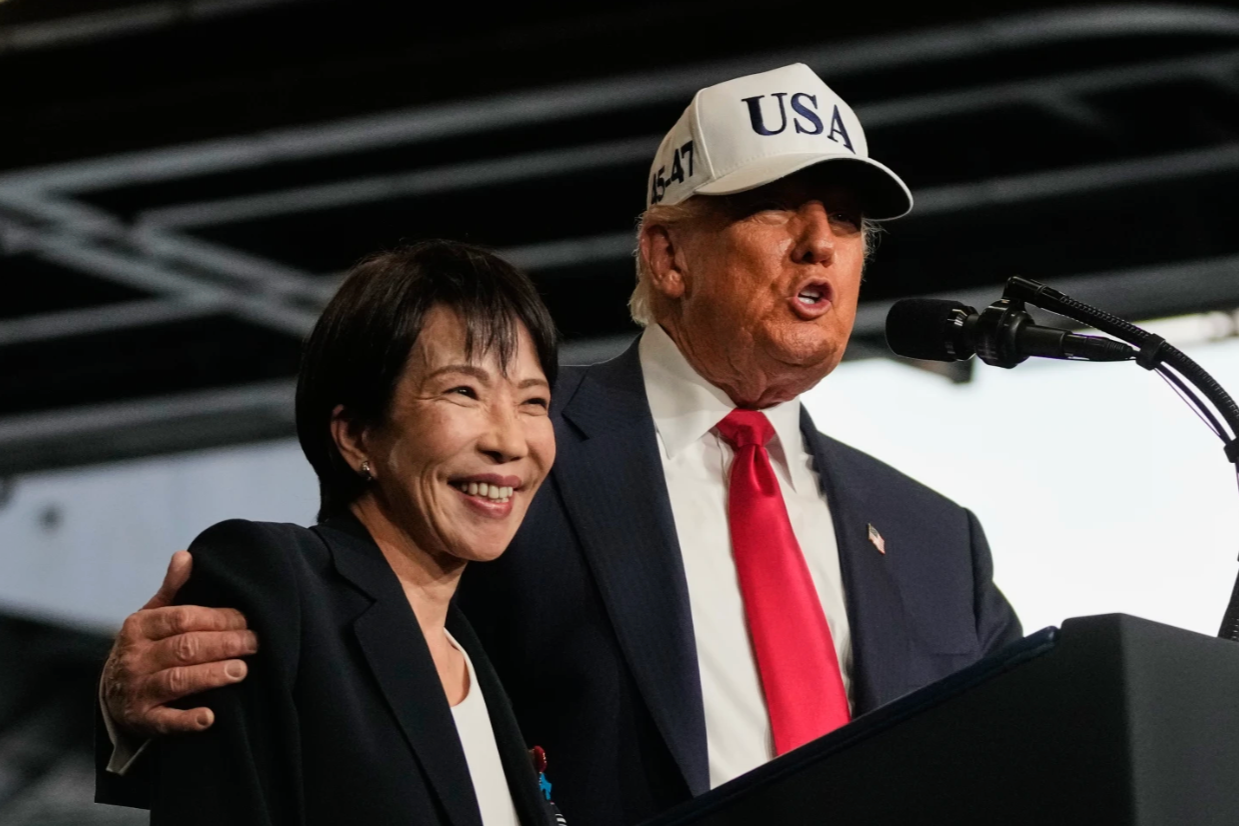
Japanese Prime Minister Sanae Takaichi and U.S. President Donald Trump aboard the USS George Washington in Yokosuka, Japan. “Photo courtesy of AP News”
On October 21st, Sanae Takaichi was elected as Japan’s first female prime minister. As a right-wing traditional conservative, her rise in popularity within the Liberal Democratic Party points to Japan’s growing nationalist trend. Domestically, she holds revisionist views on Japanese wartime history, advocates for the revision of the current pacifist constitution, and intends to tackle immigration in the traditionally ethnically homogenous country. Her nationalistic views extend beyond Japan, maintaining key foreign policies like the expansion of Japan’s defense capabilities, the strengthening of the US-Japan relationship, and an establishment of a harsher stance against China. These policies will further elevate Japan’s geopolitical significance, and will be on the United States’ radar as they attempt to limit China’s growing influence in the region. Sanae Takaichi’s right-wing nationalistic foreign policy aligns well with that of US President Donald Trump, and thus her election may signal the coming of a new “golden era” of US-Japanese relations.
One hint toward the compatibility between Takaichi and Trump lies in their shared connection to the late former Prime Minister Shinzo Abe. Abe was both a close diplomatic friend of Trump and a mentor to Takaichi, and thereby plays a key role in this new relationship between the two leaders. Soon after Trump’s presidential election in 2016, Abe immediately began investing in their geopolitical connection. He became the first world leader to visit Trump himself in New York, ahead of the U.S. president’s official inauguration. The proactive nature of Abe’s diplomacy struck Trump personally, and they strengthened their relationship further through golf, frequent calls, and meetings. Many speculate that this “Abe-era chemistry” will return with Takaichi’s succession.
Takaichi and Trump also share similar diplomatic ideologies, supporting military buildup and condemning China’s developing aggression in East Asia. Trump has positioned China, with its highly competitive economy and growing military, as a target for his “America First” goals. Takaichi aligns well with Trump because she herself has long been a China hawk, especially regarding regional security. Both leaders realize their mutual dependence on their policies against China and have shown signs that they plan to continue this trend. In their first meeting on October 28th, Takaichi and Trump signed an agreement to reduce economic dependence on China, specifically for rare earths. All things considered, the political alignment of both leaders provides significant diplomatic benefits, especially given the historical tensions of East Asian geopolitics.
In terms of regional security, Takaichi is known for her prominent support of Japanese remilitarization through an amendment to Article 9 of the post-WWII constitution, which renounces all forms of war. Additionally, Japan has already promised to increase its defense budget to 2% of its total GDP. Takaichi has also expressed interest in creating a security partnership with Taiwan, directly challenging Beijing’s “One-China” principle. Most importantly, Takaichi longs for a more autonomous Japanese military strategy. Her call for Japan to “take the initiative in fundamentally strengthening its defense capabilities” is demonstrative of her aim to decrease national reliance on the United States as the security guarantor. Geopolitically, Trump likely appreciates the presence of a militarized Japan to prove that he has “powerful friends in the region.” These policy positions indicate that Trump and Takaichi are likely to bond over this mutual “enemy.” Takaichi also aims to rebuild her political capital after major scandals and a lack of leadership that have brought down the LDP’s popularity over the past few years. Together, Trump and Takaichi were able to reaffirm their strong diplomatic ties to satisfy the Japanese public and apply pressure to their mutual “enemy” ahead of Trump’s meeting with China and Xi Jinping.
Perhaps the most powerful aspect of the connection between Trump and Takaichi is their personal chemistry. In Trump’s visit to Japan, there were smiles, back slaps, and hugs that reminded many of when Abe was Prime Minister. Trump publicly called Takaichi "a delight," and a senior official confirmed, "He really likes her." All signs from their first meeting point toward a special relationship, whether through shared goals or having a mutual friend like Abe.
In July 2025, the two countries agreed to a trade deal that lowered tariffs for Japanese exports, and Japan committed to investing $550 billion into the American economy. It is imperative for Japan that this $550 billion is used to satisfy mutual interests with the United States, such as the expansion of joint defense projects, securing critical supply chains, or development of advanced technologies. This kind of economic interdependence escalates the pressure on China, their shared geopolitical rival. This kind of success requires Takaichi to continue building a personal relationship with Trump. Experts such as Ian Bremmer, President of Eurasia Group, are hopeful in Takaichi’s capabilities, asserting that “Trump, at the end of the day, respects people who stand up for themselves,” adding that Ms. Takaichi “has the ability to show that to Trump.” With their first meeting seen as a success, Takaichi has set a positive trajectory for a cordial US-Japan partnership that allows for strategic investment of the $550 billion Japan has promised.
While the $550 billion trade deal and the shared hostility towards China are ultimately what strengthen this strategic partnership, the very personal chemistry seen in Takaichi and Trump’s first meeting may significantly strengthen their rapport. Their smiles and hugs were not just for photos. They are signs of the strong, unwavering relationship that both the US and Japan promise to build. Trump supports Takaichi’s nationalistic stance, and combined with the goodwill from the Abe era, a new “golden era” of the US-Japan relationship may be imminent. The political alignment between Takaichi and Trump could reshape East Asia’s balance of power through the merging of nationalist impulses with pragmatic diplomacy.
Ryu Hattori CC‘29 is a staff writer from Tokyo and Washington DC. He is studying Economics and Computer Science, and is interested in international trade, econometrics, East Asia, and the US-Japan relationship. He can be reached at rh3355@columbia.edu.