
A 21st-Century Biology Bluff: The NIH’s Political Pause on Human Fetal Tissue Research
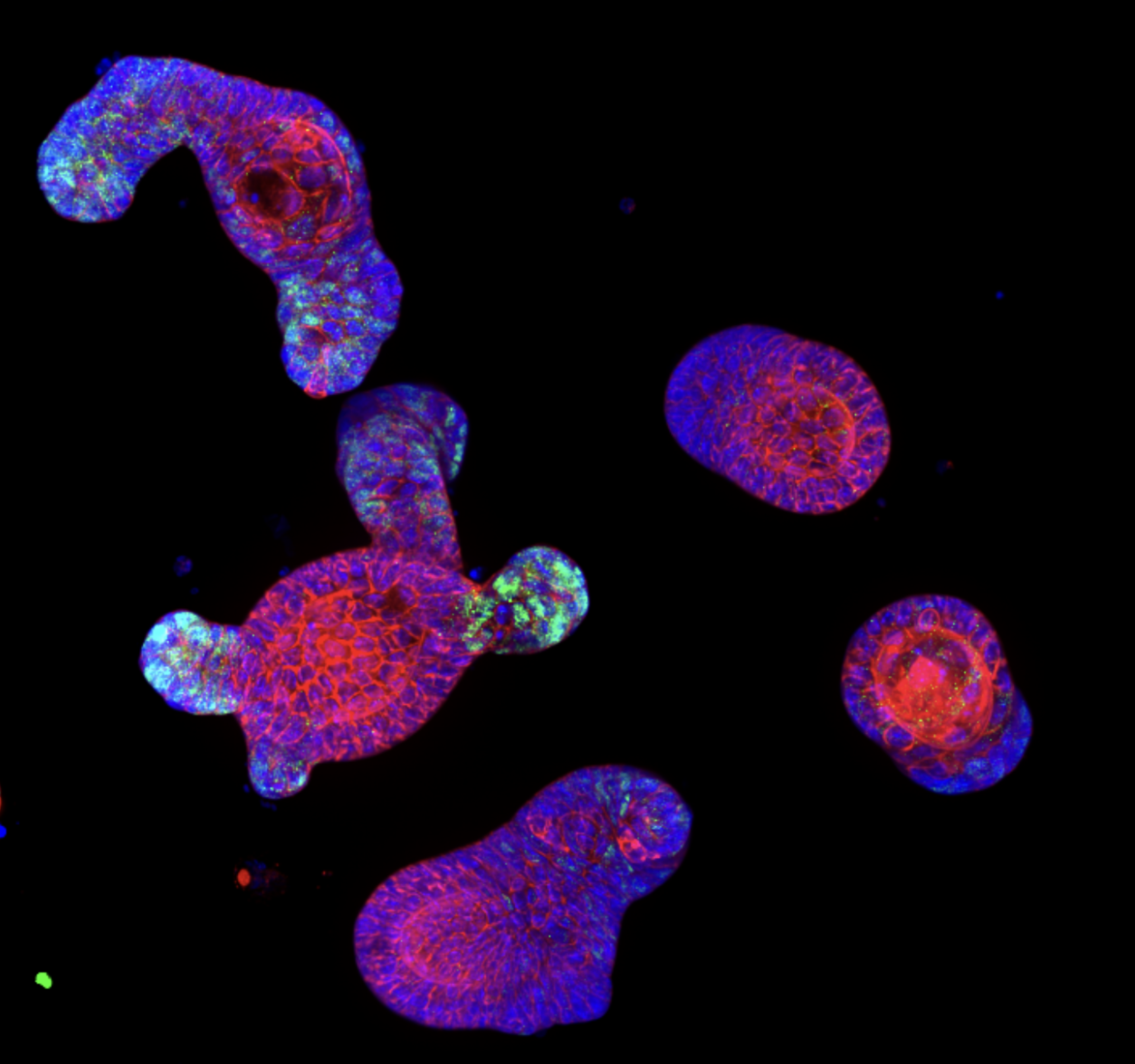
Fluorescent image of an intestinal organoid under a microscope. Photo courtesy of Denise Serra.
Speaking on January 22nd, National Institutes of Health (NIH) Director Jay Bhattacharya publicly announced the agency was “pushing American biomedical science into the 21st century.” The declaration was accompanied by innovation-bound rhetoric concerning “breakthrough technologies,” “cutting-edge platforms,” and “fundamental reinvention of scientific practice.” Ironically, the announcement was a new policy that halted the use of human fetal tissue (HFT) in government-sponsored research. Hidden behind the speech’s rhetoric of scientific progress is the reality that the ban is a step backward for biomedical research.
The move against HFT is a byproduct of the Trump administration’s suspension of $29.86 billion in grants from the NIH, National Science Foundation (NSF), and Environmental Protection Agency (EPA) in 2025. The ban on fetal tissue research was reported on the anniversary of the foundational, since-overturned, case of Roe v. Wade, giving the White House a victory for its anti-abortion base. In the context of broader grant freezes and the targeting of agencies central to public health and environmental science, the government is showing a concerning pattern of defunding research that conflicts with political priorities. In framing the restriction of fetal tissue research as innovative, the administration is attempting to recast ideological intervention as scientific progress. Yet, HFT remains foundational to biomedical discovery.
The ban risks undermining biomedical discovery by prematurely forcing a shift to underdeveloped alternatives and relocating research to the private sphere, where oversight is limited and progress may stall.
With the proposed alternatives being ethically underexamined, the ban threatens to destabilize biomedical discovery, driving critical work out of the public sector and into the private sphere, where it faces even less oversight.
Of note, the NIH’s governing rules on the matter were updated in March to reinforce the ban, citing the Dickey Wicker Amendment, which prohibits research where human embryos are “destroyed, discarded, or knowingly subjected to risk of injury.” The amendment, however, was originally written in the context of in vitro fertilization (IVF) as opposed to fetal tissue from elective abortions, which involves already-terminated pregnancies. The legal application here is then a conflation of two distinct categories of biological material and research.
Human fetal tissue refers to donated tissue and extra-embryonic cells that are obtained from “elective abortions” with patient consent, paired with strict federal oversight. At the forefront of biology, HFT has been used to study how human cells develop and react to different environments–properties that, critically, cannot be fully replicated by animal or synthetic models. With such traits, HFT has further served as a resource for modeling human immune systems, testing vaccines, and studying neurological disease.
Immediately following the news, the International Society for Stem Cell Research (ISSCR) pushed back, cautioning that the “abrupt ending of NIH support... will undermine the development of new therapies for diseases that affect American families.” As Tyler Lamb, director of policy for the ISSCR, emphasized, “human fetal tissue research has been indispensable to biomedical progress and remains the gold standard for revealing how human cells and organs form.” For example, researchers used donated fetal tissue from women who had legal abortions to modify mice to “have immune systems that behave like a human’s.” These “humanized mice” played a “key role in testing and developing treatments for HIV/AIDS.” Without these models, then, lines of research into immune system-based treatments would be stalled.
An outright exclusion of scientific research involving HFT, though, was the predictable next step for a conservative government which has been slowing this research for years. In 2018, the first Trump administration urged NIH scientists to stop obtaining fetal tissue. The NIH subsequently published a “Notice of Intent to Publish Funding Opportunities… that Do Not Rely on Human Fetal Tissue.” In other words, in resuming his presidency, the move was not an improvised policy switch but a continuation of a years-long ideological project.
Yet, the Trump administration claims that fetal tissue research should be replaced on ethical grounds, with Secretary Kennedy arguing the “ethics demand it.” This raises a few questions: what are the proposed technological innovations and specified alternatives? And what are their ethical implications? To the NIH, the future of biology rests on “organoids, tissue chips, computational biology, and other cutting-edge platforms,” which reduce “ethical concerns.”
Human organoids are three-dimensional and self-organized tissue cultures grown from “embryonic stem cells (ESCs), induced pluripotent stem cells (iPSCs), adult stem cells and tissue-specific progenitors.” Per the Harvard Stem Cell Institute, through curating specific environments in the laboratory, organoids “can follow genetic instructions to self-organize.” creating structures that mimic organs made from various types of cells. Though many doctors would caution such a characterization for fear of stigmatizing the technology, organoids have become the “Frankenstein” of stem cell science. Indeed, organoids are a highly promising biotechnology as they have been utilized to study the interactions of pathogens, like Zika virus, with human brain cells. The case for organoids, however, is not without complications.
The groundwork for organoid research was laid in 2008 with scientist Yoshiki Sasai’s published study on “guiding embryonic stem cells to grow into cortical tissue.” While the term “organoid” was not coined at this moment in scientific research, it's a testament to the recency of the technology. Amidst discussions of upcoming biological technologies, one of the most contested and controversial are brain organoids. In essentially re-developing a human brain from scratch, a wave of unprecedented questions surface: how do we weigh the ethical implications of brain organoids relative to isolated human cells? What if the organoids “become self-aware, or capable of feeling pain?” The extent to which the brain organoids are demonstrative of human attributes impacts the moral status that is given to the cell structure. These human attributes demand further research before their widespread use.
Beyond ethical debates, however, organoids are not yet scientifically equipped to replace HFT. Treating them as such risks undermining the quality of biomedical research. Per a February editorial from Nature, organoids were recorded to “not currently mimic fetal cell biology faithfully.” Some studies on complex neural organoids found them unable to “fully mirror, or recapitulate, the gene-expression patterns seen in brain tissue.” Indeed, organoids are a miraculous, fascinating, perplexing technology, but banning the use of fetal tissue removes the benchmark that these underdeveloped technologies depend on to improve. Removing HFT research slows the development of the alternative technologies meant to replace it.
On the matter of the ethics of using HFT and organoids, one of the most important topics of conversation is the adjacent technology of embryoids. Instead of cellularly replicating a specific organ, embryoids are another stem-cell derived technology that model “integrated development of the entire conceptus or a part of it.” These human embryoids have similar “morphological and gene expression features to real human embryos” making them the sole resource in analyzing embryo development past the legal two week post-fertilization limit. Through advances in the use of embryonic and extraembryonic stem cells, studying embryogenesis and embryo development in these embryo-like structures has become more practical, and possible. However, the use of such technologies raises further questions as to whether the embryoids themselves can be considered a form of human life; this tension arises at the dearth of explicit regulation on human embryonic research. So, it would seem that the so-called reduced “ethical concerns” the government claims to be mitigating are only kindled further.
The absence of clear ethical consensus over these technologies has allowed for the government to act on ideology rather than science. Since the political field has yet to address the ethical questions around organoids and embryoids, it allows the government to sneak behind declarations dense with innovation jargon to hide the underlying political move. But, when the federal government chooses the “winners” and “losers” of who gets funding based on ideology instead of scientific merit, the subsequent research becomes destabilized. This instability, and lack of federal support, has the highly predictable outcome of pushing research out of the public sphere and into the private sector. As author Anna Kramer reports for Notus, the current administration has “embraced the privatization of scientific research,” expelling research “out of the federal government wherever possible.” As politicization of science continues, governments use research “to promote a nonscientific agenda.”
With federal grants, applicant proposals are evaluated through a process of rigorous peer review. This system is notably absent though when dealing with private research money, effectively jeopardizing public safety.
David Resnick’s research warns that over-reliance on industry generated studies can cost lives, as was the case for sildenafil’s unexplored association with myocardial infarction. The absence of intense external scrutiny places the welfare of human subjects at risk, and exposes scientific progress to follow the cultural zeitgeist.
Donor autonomy also carries a certain degree of bias. Since private investment is driven by return on investment, funders have the tendency to fixate on one trendy and attention-grabbing topic at a time (e.g., Artificial Intelligence). This leaves a swath of essential research abandoned, particularly “basic science” upon which broader discoveries depend. This further marks a halt in the speed of scientific accomplishment. Per a study at Columbia Mailman School, private equity investments in healthcare are linked with “mixed to harmful effects on healthcare quality” and higher costs to patients. With worse healthcare quality but higher corresponding prices comes a warranted skepticism. A 2023 study found that Republicans and Democrats generally demonstrated equal levels of distrust in scientific research “produced by industry” and “science linked to the private sector.” Here, there seems to be a correlation between the administration's move to privatization and American reaction. In June 2025, a mere 8% of US adults reported a great trust in science, marking a drastic drop from the June 2023 record of 32%. The downstream effect on the American people from privatization is a self-reinforcing cycle: degraded research quality, poorer health outcomes, an erosion of public trust in science, and diminished funding that starts the cycle anew.
Science funding in the private sector, shaped by incentives for profit and absent of transparency requirements, risks turning medical discovery into a pendulum swinging towards whatever is fashionable.
The move against HFT is a microcosm of a larger transformation in American science towards lower public trust, lower quality research in biomedical institutions, and adverse health outcomes for Americans. In light of defunding HFT research, the Trump administration is betting big on alternatives (e.g., organoids) while it simultaneously dismantles the exact research needed to prove those alternatives work: burn the library, and the architects build blindly.
Enzo Dervišević (CC ‘29) is a staff writer for CPR from Aurora, Colorado, studying biology. He can be reached at ed3161@columbia.edu.