Bad Bunny Presses Play, America Pushes Back
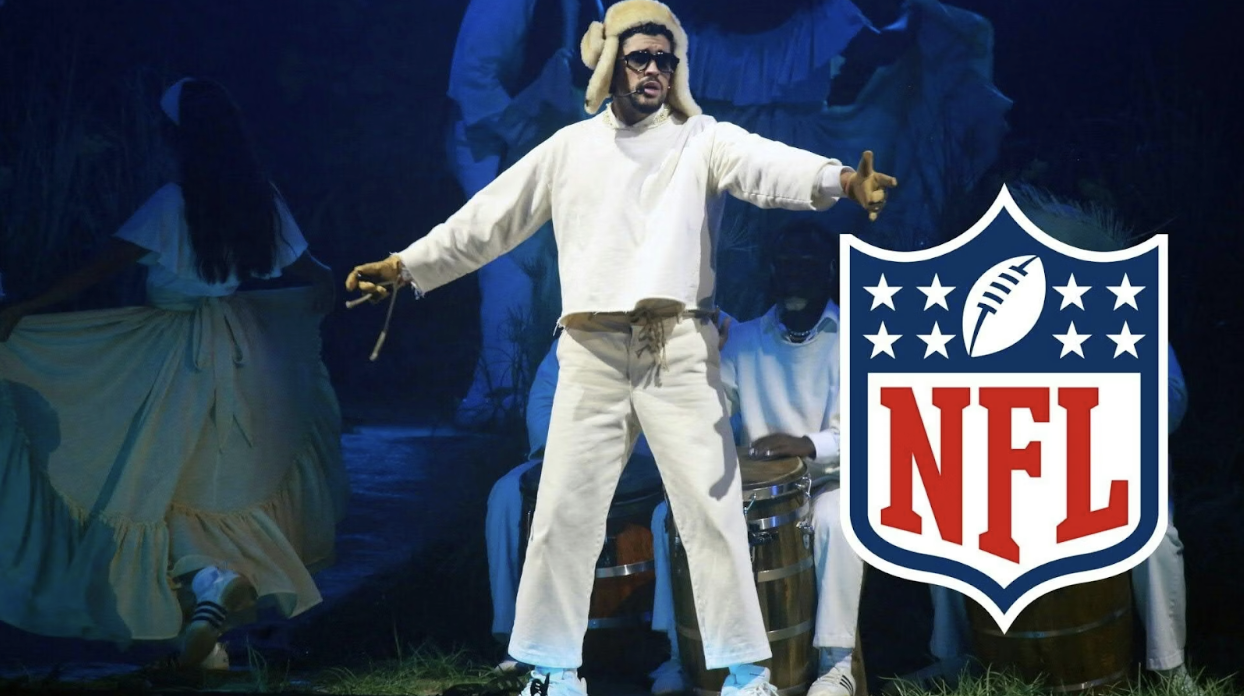
Bad Bunny took the stage at one of the biggest cultural events in America: the Super Bowl. Photo courtesy of Heute.
The 2026 Super Bowl may have been won by the Seahawks but, even before the game started, the Latino community secured a win: Bad Bunny’s Halftime Show performance. At a time when the United States government has placed Latino-American identity firmly in its crosshairs, the NFL made a striking choice by selecting a Puerto Rican artist who sings in Spanish, has openly criticized President Trump, and previously committed to not performing in the United States, citing possible ICE raids.
Since 2019, Jay-Z and Roc Nation have partnered with the NFL to determine the headliners for the Halftime Show. Their original intention, according to NFL Head of Music Seth Dudowsky, was to “start to focus on leading into culture.” This could mean understanding which trends in society and culture currently hold the public’s attention and how the Halftime show can amplify an artist’s platform. However, opinions differ on which artists are culturally relevant today. Despite achieving historic milestones such as releasing the first all-Spanish album to top the Billboard Hot 100, earning the first all-Spanish album Grammy nomination, and producing the most-streamed album on Spotify, Bad Bunny is somehow considered by many, especially those on the political right, to be unqualified as the Super Bowl Halftime Show’s headliner.
While the Latino community was excited to watch the performance of the most influential Hispanic artist of this generation, many Americans expressed fierce opposition to the decision. A viral petition gathered over 110,000 signatures to replace Bad Bunny’s Halftime Show performance with a more “American” artist, country singer George Strait. The petition argued that, unlike Bad Bunny, George Strait “embodies unity, tradition, and the timeless American music that truly deserves the 2026 Super Bowl spotlight.”
For many, the Super Bowl celebrates not only a sport but also American culture, and the Halftime show is a culmination of that. A Spanish-speaking Puerto Rican artist challenges the conception of the American roots that many desire to maintain.
This backlash against Bad Bunny reveals a deeper tension: while the United States continues to imagine itself as English-speaking and culturally monolithic, its popular culture is multilingual, multiracial, and globalized. Bad Bunny, therefore, has become politicized not solely because of his message, but for the cultural and linguistic identity he represents. His exclusion exposes how some Americans endeavour to create boundaries around belonging, especially those that disregard Latino and non-English-speaking identities who are vital to the identity of the United States.
This public attitude toward Latinos has only intensified in recent years. Shakira and Jennifer Lopez performed at the Super Bowl Halftime Show in 2020, but did not receive the same backlash, despite Bad Bunny himself performing alongside the two Hispanic artists. There was, however, criticism over the depictions of children in cages during their performance, perceived as a reference to immigration at the southern U.S. border. Still, this criticism emerged only after their show, whereas Bad Bunny has drawn further significant criticism before even performing.
Kendrick Lamar’s Halftime Show performance last year was noticeably political, but it still did not receive as much backlash before the performance. It seems as though America’s problem with Bad Bunny is not his performance, rather what he represents.
This cultural backlash mirrors broader patterns of exclusion that Latinos face in the United States, especially in recent years. Regardless of citizenship status and/or time spent in the United States, Latinos are consistently framed as outsiders. Latinos’ language, customs, and physical appearance are often read as signs of foreignness, distinct from the imagined white and English-speaking identity of the nation. President Donald Trump has been instrumental in intensifying this rhetoric since 2016. His portrayal of “illegal” immigrants as criminals and threats to existing jobs has increasingly shaped the public perception of Latinos. This is especially consequential following a Supreme Court decision that allowed federal immigration agents to make stops and arrests based solely on factors such as race or ethnicity, their language, or their occupation.
Bad Bunny’s Puerto Rican identity further intensifies the backlash surrounding the Halftime Show. Although the United States claims Puerto Rico as a territory, it has yet to claim Puerto Ricans as part of its national identity. In 2024, comedian Tony Hinchcliffe referred to Puerto Rico as a “floating island of garbage” at a Trump rally. When Puerto Rico was mentioned at a later rally, Donald Trump responded, “I think no president’s done more for Puerto Rico than I have.” Yet, while he congratulates himself on his contributions to Puerto Rico, he calls the NFL’s choice of Bad Bunny as the Halftime Show headliner “absolutely ridiculous.” The United States cannot simultaneously assert its commitment to Puerto Rico while refusing Puerto Ricans an accepted American identity. Thus, even though Bad Bunny is a U.S. citizen, the backlash that he is facing is another inevitable symptom for those who refuse to include Puerto Rico in the nation.
Ultimately, the controversy with the NFL’s decision is tied to the broader question of how individuals define who belongs. Benedict Anderson argues in Imagined Communities that a nation is an “imagined political community” that is both limited and sovereign. It is “imagined” because while individuals will never personally know most of the other individuals in their community, they still uphold a collective mental image of their community through shared rituals and practices.
Anderson’s concept of an “imagined community” helps explain how Americans view the Super Bowl. The event functions as one of the shared rituals that Americans use to envision national unity. However, Bad Bunny’s misalignment within this ritual shows that this imagined community is more exclusionary than it might seem. By performing in Spanish, being Puerto Rican, and singing reggaeton, Bad Bunny expands the criteria of who can participate in the nation’s culture. Many find this threatening because his performance shows how integral Latinos and the Spanish language are to American identity.
These tensions surrounding Bad Bunny’s Super Bowl Halftime Show were less about taste and more about the revelation that millions are still invested in an antiquated picture of the United States. Even if Bad Bunny had avoided a political performance, people must still reckon with the idea that the United States’s reliance on Latino labor and consumption of Latino culture cannot justify the exclusion of Latinos in a country they helped create. Latinos generated a record $4.1 trillion in GDP in 2023, accounted for 82% of the growth in the U.S labor force participation between 2010 and 2017, and paid almost $309 billion in taxes in 2019. America cannot continue to deny the influence that Latinos have on the country, and the discord surrounding Bad Bunny’s performance reveals that Americans have yet to include them in their national identity.
In order to prove that the United States is and has long been multilingual and multiracial, I believe that Bad Bunny was right in making a statement at the Super Bowl. It was not surprising that he used his performance to challenge the political narratives that continue to marginalize Latinos. After Americans complained about his music being in Spanish, he rebutted on SNL, saying that Americans have “four months left to learn [the language].” Bad Bunny already has songs like “El Apagón" or “LO QUE LE PASÓ A HAWAii” that highlight issues affecting Puerto Rico such as gentrification and displacement. With songs such as these, or with strong expressions of Puerto Rican culture, Bad Bunny may have created a lasting cultural impact while urging Americans to confront issues they currently overlook.
Bad Bunny has reshaped the way the nation imagines itself to make space for Latinos’ inclusion in American identity. After all, what would George Strait provide that Bad Bunny could not other than reinforcing the very “imagined community” that is outdated and excludes so many? More than ever, Latinos need representation from people who are willing to fight for them and serve as a space for fans to celebrate their cultural pride. On the field and on the stage, that person is Bad Bunny.
Jazzlee Cerritos (CC ‘28) is a staff writer for CPR from Murfreesboro, TN. She is studying political science and sociology and is interested in Latin American politics, struggling economies, and immigration policies.