Arts Education Is Not Optional for a Healthy Democracy
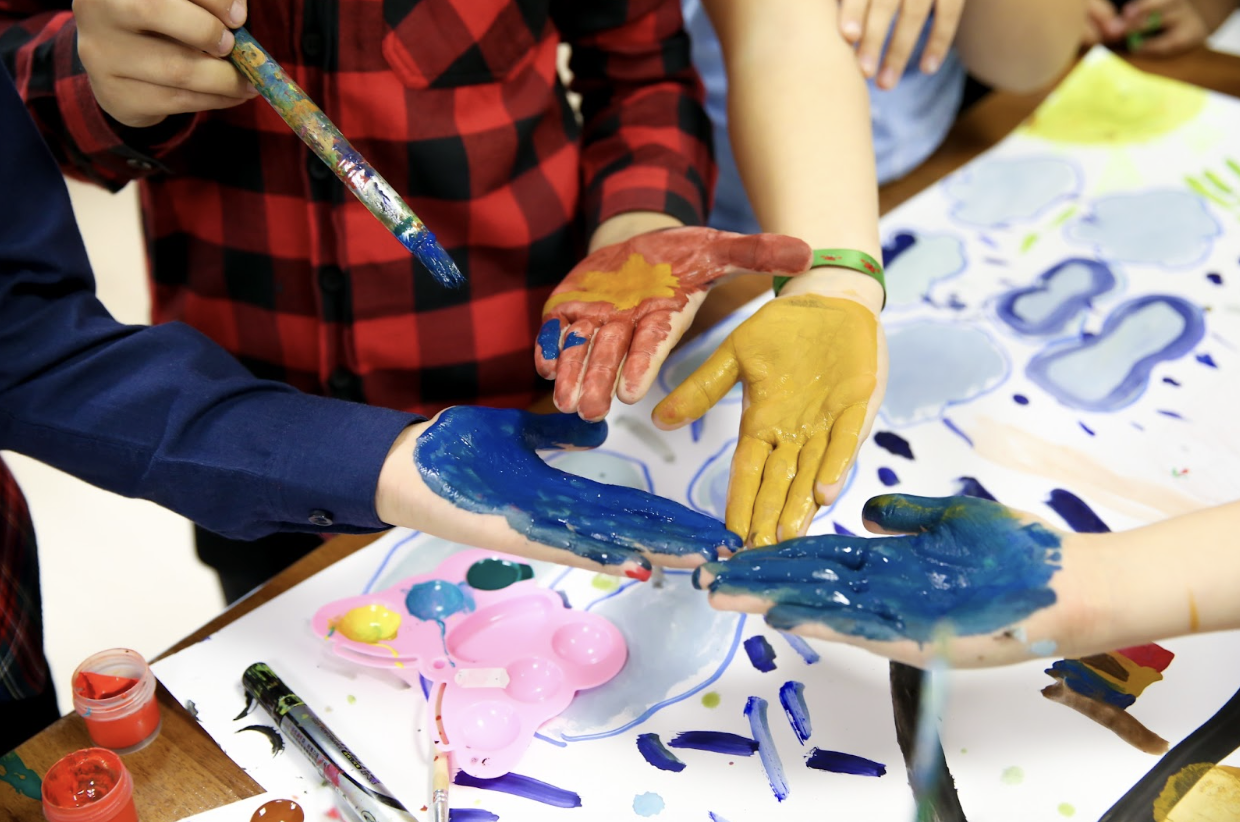
Four children create with finger paint in their school’s art class. Photo courtesy of Rawpixel.
Access to arts education in the United States is declining at a rapid and concerning rate. President Trump’s proposed federal budget for the 2026 fiscal year (FY 2026), threatens the accessibility and equity of arts education for students nationwide. The budget cuts K-12 funding by more than $4.5 billion, including consolidating 18 federal education grant programs and eliminating most of their funding in the process. This consolidation includes the Assistance for Arts Education program and Title IV-A, both of which support a “well-rounded education” and mandate the use of funds for supplemental programs, specifically fine arts curricula such as dance, media arts, music, theatre, and visual arts. Beyond shrinking funding for the Department of Education, the FY 2026 budget also aims to entirely eliminate the National Endowment for the Arts (NEA) and the National Endowment for the Humanities (NEH). These agencies provide essential grants to support artistic groups and endeavors.
The Commission on the Arts at the American Academy of Arts & Sciences warns that the U.S. has been at a “crisis point” in access to arts education since the post-COVID era. These new measures by the federal government will only make things worse. If Trump’s budget cuts pass through Congress, we can expect a severe reduction in arts education that will drastically affect schools across the nation. This reduction will disproportionately harm rural and minority students, as public schools serving low-income communities face the greatest risk of losing arts programming in favor of moving resources towards math and English. Public schools mainly focus on preparing students for standardized tests like the SAT, which measures performance only in reading, writing, and math.
The Trump administration states that their new approach to the Department of Education “allows States and districts to focus on the core subjects—math, reading, science, and history—without the distractions of DEI and weaponization from the previous administration.” The message in this statement is clear: art is not a core subject, and arts education is simply not worth the time and money that math, reading, science, and history are. Jelena Trkulja, senior advisor for academic and cultural affairs at Qatar Museums, observes that, for public schools, “Arts education is still perceived as an add-on, rather than an essential field.” Without federal funding, arts education becomes an “add-on” reserved for private schools and districts that can raise taxes. This unequal access yields an unequal ability to participate in the vast and essential benefits of strong arts education. But what are these benefits?
Despite the Trump Administration’s claims that teaching art is a distraction from core subjects, studies show that arts education actually enhances academic performance and workforce readiness. Students who study the arts are four times more likely to be recognized for academic achievement and three times more likely to be elected to class office within their schools, even when controlling for socioeconomic background. Arts education has a profound relationship with standardized test scores, too: data from the College Board shows that students who take four years of arts and music classes in high school score a substantial average of almost 100 points higher on their SATs than students who only took a half-year or less. This increase also helps dispel inequity later in life, as standardized test scores often accurately indicate a higher graduation rate, pursuit of higher education, and greater starting salaries. If public schools are truly concerned about increasing standardized test scores, then arts education should be prioritized as an equalizer.
Additionally, education is a critical part of raising students to be democratically engaged citizens. The benefits of arts education is not limited to the classroom, but impactful for a wide range of civic life. A study by the NEA found that young adults with high arts experiences in high school are more likely to vote, volunteer, and engage in local and school politics than those with low arts experiences. This correlation is strongest among students with low socioeconomic status. Even more research corroborates the link between arts education and civic engagement. Adults who are active readers and arts participants, two skills cemented through arts education, are more than twice as likely to volunteer in their communities, regardless of education level, age, gender, or ethnicity. Furthermore, the NEA’s research shows that adults who attended arts events or created art within the previous month, or both, were more likely than those who did not to participate in social groups, such as church groups, unions, fraternal or athletic groups, or school groups. These social groups are crucial to participation in political life and activism.
Without protected federal funding, access to arts education will soon become inequitable and sporadic. If public schools and, subsequently, low-income youth, lose access to arts education, both their current academic performance and future democratic participation will decline. It is clear that education in the arts is one of the most important parts of schooling; by giving young people space to create, they are better equipped for civic life. We must treat President Trump’s proposed budget cuts to arts education as a risk to the growth and ability of the next generation. Investing in arts education is not a luxury. It is a democratic necessity.
Ellie Aars (CC ‘29) is a staff writer at CPR passionate about the intersection of culture and policy. You can reach her at eka2133@columbia.edu.