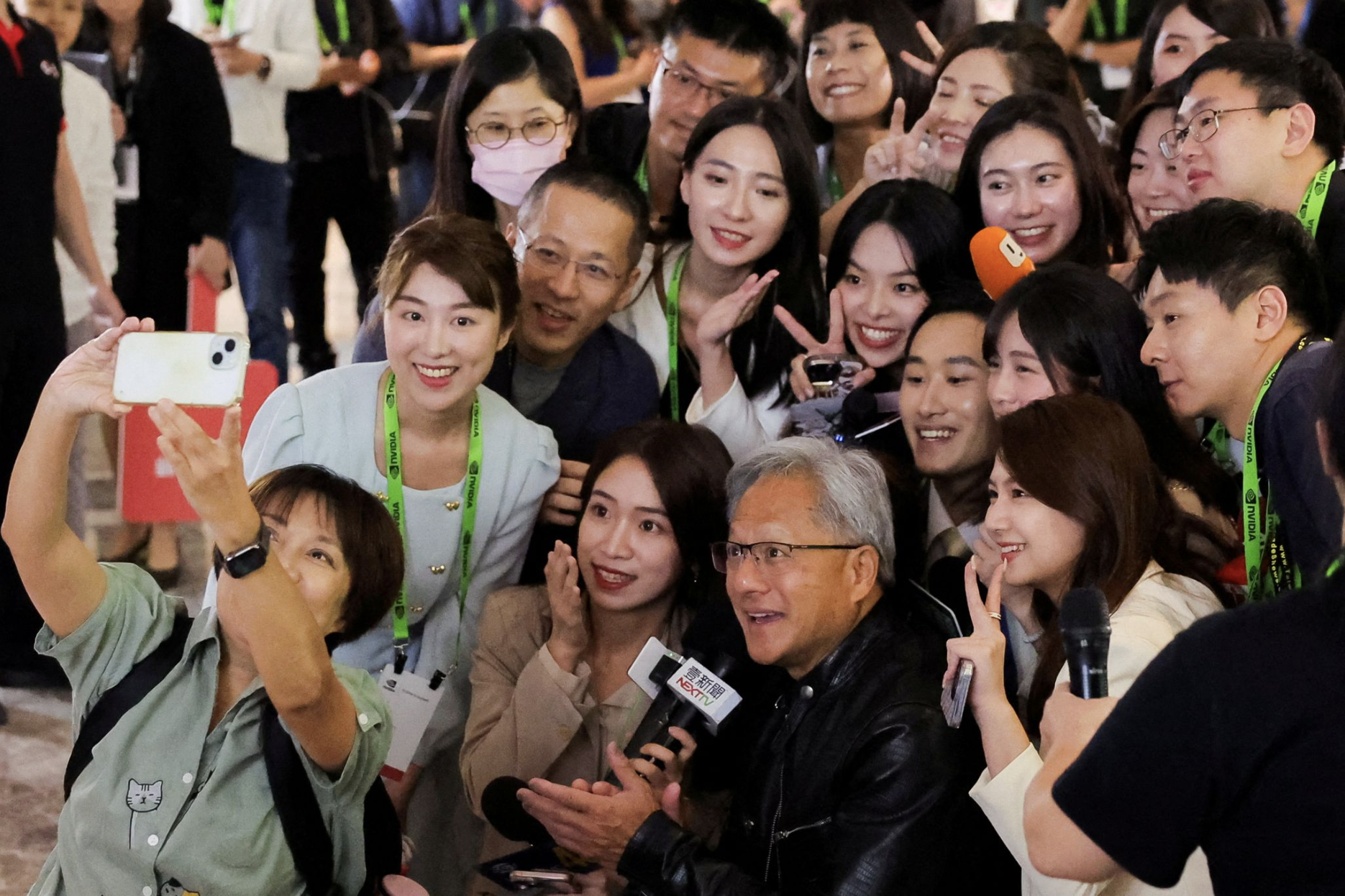
Jensen Huang poses for a selfie with members of the media at COMPUTEX forum in Taipei. Photo courtesy of Ann Wang.
Walking through Taiwan's famed Raohe Night Market, one is constantly bombarded by mouthwatering aromas, the boisterous hollers of various food vendors, and (a relatively newer addition of) pictures of NVIDIA’s CEO Jensen Huang plastered across nearly every available flat surface. During his recent, highly publicized visit to Taiwan on May 23, 2026, Huang solidified public perception of his, perhaps paradoxical, unpretentious trillionaire persona. From handing out drinks to reporters and fans awaiting his arrival at Songshan Airport to taking pictures with countless Raohe Night Market vendors, Huang enjoys a unique celebrity-businessman hybrid status amongst Taiwanese citizens, with the “business” aspect especially spotlighted during his annual “trillion dollar dinner.” This year’s edition included more than thirty major executives such as Taiwan Semiconductor Manufacturing Company (TSMC) Chairman C.C. Wei, MediaTek CEO Rick Tsai, and Foxconn Chairman Young Liu, to name a few. Collectively, the dinner attendees’ companies produce approximately 80% of the world’s AI chips.
Huang’s recurring returns to the island reinforce an obvious message: Taiwan matters. During this same trip, he broke ground on Constellation, NVIDIA’s first global headquarters outside the United States, strategically located in Taipei, and has called Taiwan the “epicenter of the AI revolution.” Amidst the thrilling influx of AI improvements and robust partnerships with Taiwanese chip manufacturers, however, the frequency of Huang’s visits actually hints at a more cautionary undercurrent. In an exclusive interview, former Goldman Sachs executive Michael Parekh revealed that Huang makes nearly monthly trips to Taiwan, asking TSMC to ramp up chip production capacity. While Huang’s nearly-monthly trips to Taiwan may reflect rapid growth in the AI and semiconductor sectors, it is important to recognize these frequent visits for what they really are: asymmetrical negotiation.
Despite Huang’s best wooing attempts, TSMC’s answer to expansion remains a resounding “not yet.” A single leading-edge microchip fab costs tens of billions of dollars and takes three to five years to reach full production capacity, forcing even the world’s most valuable company to wait. Standing outside a Taipei restaurant this February, Huang did not shy away from discussing the purpose of his visit during an interview, saying TSMC “needs to work very hard” because NVIDIA “needs a lot of wafers,” estimating that NVIDIA’s demand alone could force TSMC to more than double its capacity within the next decade. Taiwan doesn’t just supply the AI revolution; it constrains it. Therein lies the irony of each “trillion-dollar dinner”: the island that built one of the world’s most powerful economic deterrents via semiconductor production dominance is now facing a reckoning from its most powerful ally. Taiwan’s “silicon shield” may have protected it sufficiently in the past, but the United States has begun signaling a desire to onshore chip production. If Taiwan wants a real shield to hold, it can no longer rely solely on manufacturing capability; it must maintain technological leadership, convert semiconductor relationships into formal multilateral partnerships with countries beyond the US, and build domestic military capabilities that do not hinge on the goodwill of any single foreign ally.
First coined by journalist Craig Addison in 2000, the term “silicon shield” is now a broadly accepted geopolitical theory predicated on two assumptions: 1) Taiwan’s semiconductor exports are so important to China that Beijing wouldn’t attack the country, and 2) other global superpowers, namely the US, have a vested interest in defending Taiwan due to similar reliance. As of 2026 Q1, TSMC alone produced a staggering 73% of the world’s semiconductors, serving as the exclusive manufacturer for large tech multinationals like NVIDIA and Apple. This market share monopoly essentially positions TSMC as the “Federal Reserve of the global tech economy.” An attack on Taiwan in the status quo would be akin to pummeling the fastest-growing sectors of the economy. For comparison, TSMC’s closest competitor, Samsung, holds only 7% of global market share. There is very little doubt that the silicon shield is real, but the question now is whether it will last.
For two decades, this theory has held, with American administrations of both parties treating Taiwan’s chip dominance as a strategic asset worth protecting. This shield worked precisely because dependency was involuntary; no one could get the chips anywhere else, but now both the US and China are taking deliberate steps to dismantle the current foundry monopoly. In a September 2025 interview, US Commerce Secretary Howard Lutnick expressed US support for reaching a 50-50 production split with Taiwan, citing that the status quo is “unhealthy” for both parties. Under the proposed split, the US would still be “fundamentally reliant on [Taiwan] because the [US] can’t live without the other half,” but it would leave Washington less vulnerable to the bidding of an island halfway across the globe. A relationship built on a more equitable distribution of production would deepen ties between the two countries in a way that decreases the likelihood of animosity due to a foundation of collaboration rather than dependency. Lutnick set a target of 40% domestic semiconductor production by the end of President Trump’s term, dismissing the silicon shield outright by saying, “for [the US] to protect [Taiwan], you need to help us reach reasonable self-sufficiency.” By hinging protection on relinquishing the very leverage that made Taiwan indispensable, the silicon shield protection theory is inverted, going from the reason America defends the island to a dependence that must be corrected.
The offshoring is already well underway. Initial reactions to Lutnick’s proposed split by Taiwanese officials were less than pleased. Taiwan People’s Party Chairman Huan Kuo-Chang condemned the proposal as an attempt to “hollow out the foundations of Taiwan’s technology sector,” while Vice Premier Chen Li-Chiun said that the so-called “50-50” split was never even mentioned during trade negotiations. Despite this initial backlash, as of January 2026, a trade deal was reached: the US agreed to limit reciprocal tariffs on Taiwan down to 15% from 20% in exchange for at least $250 billion in Taiwanese investment in US production capacity. Subsequently, in March 2026, TSMC made the largest foreign direct investment in United States history with a $165 billion expansion of its Arizona production compound. Washington is hardly alone in its sentiment; China launched a $47.5 billion state-backed fund to chase semiconductor self-sufficiency, and the European Union passed its own €43 billion European Chips Act. China already holds about a 30% share of the global legacy chips market, with projections estimating a 39% share by 2027. Legacy chips may not be the most advanced, but they power everything from vehicles to consumer electronics. The race to self-sufficiency is steadily drilling a hole into the silicon shield.
So what can Taiwan do to protect itself? The most obvious answer is to maintain its technological leadership. While production can be offshored, the real power comes from being on the frontier of innovation. For example, existing TSMC plants in Arizona already produce advanced four-nanometer chips used by Apple and NVIDIA, but fabs in Taipei are beginning production of two-nanometer chips. This follows Taiwan’s proactive adoption of the N-2 rule in December of 2025, where any offshore TSMC microchip fab must lag two generations behind Taiwan’s domestic production processes, a stricter regulation than the previous N-1 rule, where all technologies at least one generation behind could be exported. As production capabilities spread, Taiwan’s first imperative is to protect its research and development capabilities by increasing public investment into talent pipelines and infrastructure. NVIDIA’s decision to anchor its first overseas headquarters in Taipei suggests that the industry still believes the frontier lives there; Taiwan’s task now is to make that belief permanent.
Secondly, Taiwan must leverage its current dominance to convert commercial indispensability into institutional partnerships with other countries. Even at its finest, the silicon shield is an informal deterrent that exists in investor spreadsheets rather than any treaty. Through operational TSMC fabs in Kumamoto, Japan, and Dresden, Germany, along with expanded maritime cooperation with Japan, Australia, and India, Taiwan already has the raw material for formalization. These connections must be evolved into explicit multilateral frameworks, such as supply chain security agreements with binding mechanisms, that give multiple democracies a formal stake in Taiwan’s survival. One can reasonably ask what a signature adds when Taiwan has successfully managed thus far without any formalization, and the answer lies in two key distinctions: accountability and endurance. Informal arrangements last only as long as the prevailing interpretation of interest, leaving them vulnerable to new administrations and temporary political headwinds, as Lutnick’s proposal demonstrates. On the other hand, written commitments withstand elections, formalizing not only the partnership but the consequences of defection, and they arrive with institutions attached. Joint research bodies, advisory committees, and budget lines embed the relationship in a system that tends towards continuation. Taiwan has already begun taking the necessary steps on its end. In early July, the Taiwanese government announced plans to open a Taipei Economic and Cultural Office in Phoenix, Arizona, establishing ties with the local government while providing consular services to Taiwanese citizens in the area. Now, the U.S. and other allies need to reciprocate. It is easy to break a shield held by one, but a shield held by many is harder to push back.
Finally, Taiwan must boost its own defense capabilities to function even if foreign support wavers. President Lai Ching-te has already begun moving in this direction, announcing plans to increase defense spending to 3.3% of GDP in 2025 and 5% by 2030, along with a $40 billion special budget focused on building out asymmetric defense infrastructure designed to make Taiwan prohibitively costly to attack. Unfortunately, the version that finally passed the Legislative Yuan in May 2026 was 38% smaller than Lai’s original proposal, with heavy dependence on purchasing American hardware, gutting the domestic initiatives critical to a true asymmetric defense strategy. This shortfall speaks less about Taiwan’s resources than about its priorities. A tax-to-GDP ratio that hit a 26-year high at 14.7% in 2025 reflects decades of fiscal restraint, and President Lai’s Democratic Progressive Party lacks the legislative majority to overcome the opposition. The Kuomintang (Chinese Nationalist Party) favors engagement with Beijing over deterrence, only allowing the special defense budget to pass after stalling it eight times. Moving forward, Taiwan needs to restore funding for defense innovation and combat inertia in the drone industry, missile programs, and civil defense infrastructure with the same seriousness it once applied to building TSMC. Control over the world’s chip supply made Taiwan indispensable, but only control over its own military capabilities will make Taiwan truly resilient.
In this decade, Jensen Huang’s trillion-dollar dinners will likely continue, and his face will keep smiling down from the stalls of Raohe Night Market as Taiwan remains indispensable during the age of the AI revolution. No Arizona investment will drastically change this fact for the foreseeable future, but the “trillion-dollar dinners” should still be taken as much a warning as a celebration. The executives seated at that table represent the leverage that Washington and the rest of the world are actively working to dilute. Ultimately, Taiwan spent forty years building a shield out of silicon, and it now has to reinforce that shield with something sturdier: a defended technological frontier, binding partnerships, and sufficient military capabilities. Rather than relying on its indispensability to the world based on chip dominance, Taiwan must now proactively steel itself.
Karen Wu (CC ‘29) is a staff writer from Las Vegas, Nevada, majoring in Political Science and Economics. She can be reached at kw3255@columbia.edu.