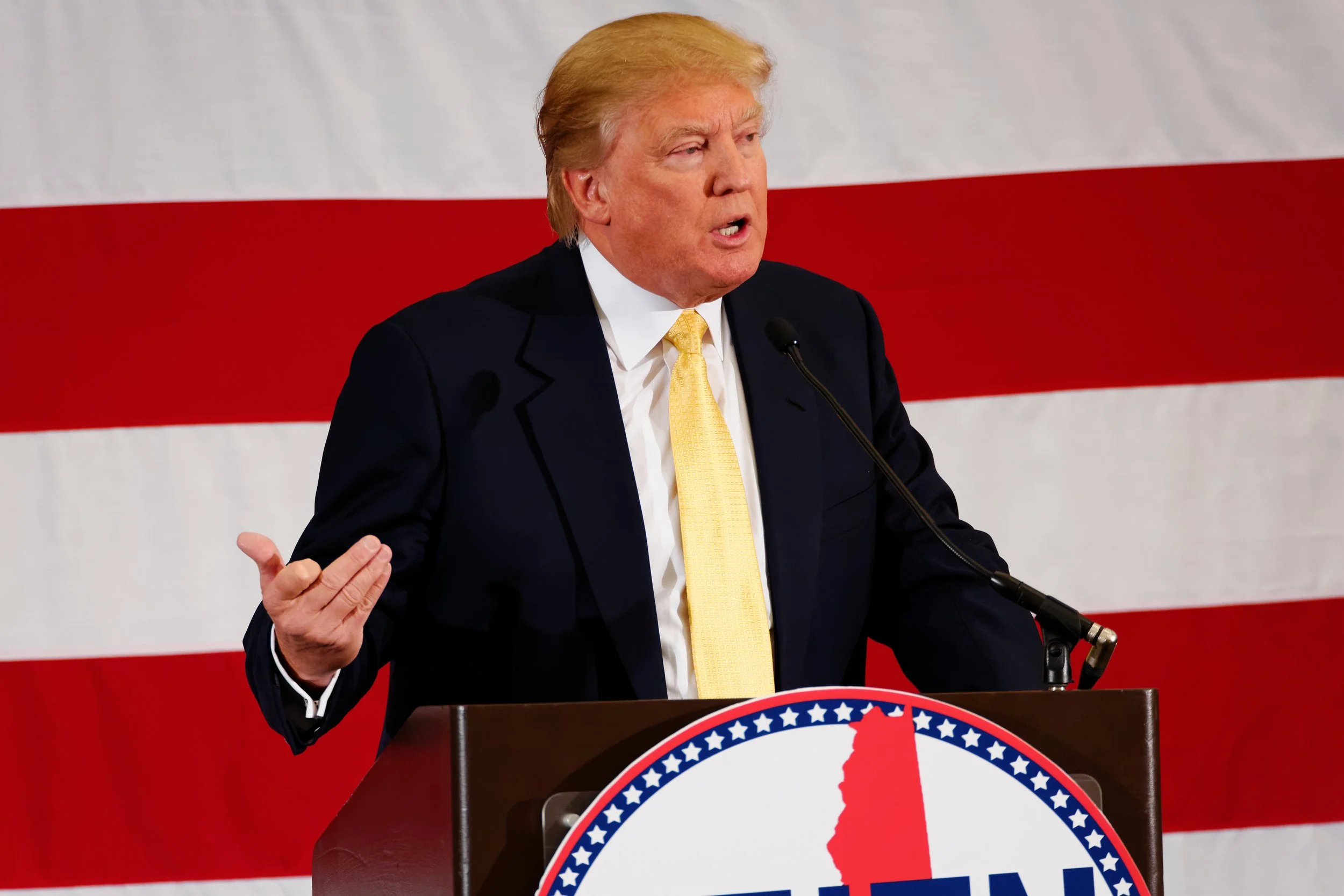
Donald Trump speaks at a campaign event. Photo courtesy of Openverse.
“I look at the Democrats in front of me, and I realize there is absolutely nothing I can say to make them happy.”
When a president divides his audience before he’s even finished his greeting, rhetoric becomes less about governance and more about grievance. President Donald Trump’s 2025 address to Congress exemplifies how the language of American leadership has shifted from collective optimism to moralized division. Comparing the most recent State of the Union with President Dwight Eisenhower’s 1956 address—the first Republican State of the Union of the modern party system— highlights how the party’s presidential rhetoric has transformed over time.
This evolution reveals not just polarization in the electorate but its embedding within the very grammar and rhetoric of governance. In a nation whose political identity is constitutionally anchored by uniting phrases like “We the People” and aspirational declarations like “We hold these truths,” the collective pronoun has historically served as a linguistic stand-in for civic belonging. The eroding of the “we” therefore signals more than stylistic drift: it reframes politics from a shared project into a competitive identity, redefining who counts as part of the national community. As the presidential “we” fractures into “I” and “they,” the grammar of leadership becomes partisan terrain, where word choice, pronoun use, framing, and appeals to moral binaries render presidential discourse a linguistic manifestation of polarization.
Eisenhower’s 1953 State of the Union ranges across foreign policy, fiscal discipline, trade, agriculture, labor law, conservation, and early civil rights measures. However, he frames each area in collective, nonpartisan terms. He opens by calling governing “the joint purpose” of Congress and the administration and lays out aims so “our Nation will ever act with strength of unity.” He defines foreign policy as “genuine, continuous cooperation” between branches of government domestically, and cooperation with allied nations abroad grounded in “mutual security” and “effective mutual cooperation.” Even in mobilization, his grammar is inclusive: “we all—workers and farmers, foremen and financiers, technicians and builders—must produce, produce more.” Domestically, he urges “a middle way” between bureaucracy and neglect, and on civil rights, he pledges to use presidential authority to end segregation in D.C. and the armed forces. His phrasing makes the point clear: policy is presented as a shared mission rather than a partisan fight.
Eisenhower’s address emerged during a period often described by historians as one of broad postwar political consensus, when the 1950s and 1960s were marked by high levels of bipartisanship and ideological diversity within both parties. This consensus was a legacy of the post-World War II stability, moderation, and faith in institutions. This environment fostered a rhetoric of unity rather than division: political conflict was framed as a difference in approach, not identity. Eisenhower’s State of the Union reflects this spirit of cooperation, articulating a collective civic mission rather than a partisan agenda.
Eisenhower favors parataxis, placing clauses side by side without subordination (“earning more, producing more, consuming more, building more”), which conveys rhythm, equality, and shared productivity. Even when addressing the Cold War, his rhetoric couches conflict in moral restraint: “We must walk ever in the knowledge that we are enriched by a heritage earned in the labor and sacrifice of our forebears.” His verbs are largely deontic, meaning they express moral obligation and duty (“should,” “must”), and they are collectively agentive, or action-oriented (“we strengthen,” “we maintain”). These linguistic patterns position Americans as participants in a shared project, “trustees of a great Republic,” with the government serving as mediator rather than combatant. Nowhere does Eisenhower construct a domestic adversary; the only “enemy” is ideological communism abroad. Crucially, anti-communism in the early 1950s was a broadly shared, bipartisan premise: from Truman’s containment to Eisenhower’s call for “mutual security.” By locating the antagonist outside the polity and using inclusive grammar (“we must,” “our Nation,” “trustees of a great Republic”), he avoids turning fellow Americans into an outgroup; the referent consolidates a national “we” rather than mobilizing one party against another. His rhetoric stabilizes rather than polarizes.
Yet, the political environment supporting such rhetorical unity would gradually dissolve over the following decades, as partisan sorting, media fragmentation, and declining institutional trust reshaped how presidents speak to and about the country. Trump’s 2025 joint-session address, delivered in March after his return to office, takes place in a vastly different political environment: one defined by polarization, social media welfare, and distrust in institutions. The speech itself focused on promises to “restore order,” "rebuild the border,” and “reclaim the American dream,” combining policy pronouncements with personal vindication. From its opening line, “America is back,” Trump’s rhetoric frames the nation as something that has been lost, betrayed, or stolen. This inversion stands in sharp contrast to Eisenhower’s description of governance as “the joint purpose of the congressional leadership and of this administration,” framing progress as collaborative rather than recovered from wrongdoing.
Unlike Eisenhower’s collective morality, Trump’s discourse is steeped in deixis, or words like “I,” “you,” and “they” that draw boundaries between speaker, audience, and enemy. He uses these pronouns to divide rather than unify: “I,” “me,” and “our presidency” stand for himself and his supporters; “they” points not to foreign adversaries but to domestic political opponents like Democrats, the media, or bureaucrats. When Trump says phrases like “the Democrats sitting before me” or “they want to destroy our country,” he turns fellow Americans into an oppositional force within the same civic space. The pronoun “they” no longer identifies outsiders but the parts of the collective that disagree.
Trump occasionally reaches for the vocabulary of unity. At one point, he appeals, “So, Democrats sitting before me…Let’s work together and let’s truly make America great again.” On the surface, this echoes Eisenhower’s calls for shared purpose, but the surrounding grammar makes clear that the only “working together” Trump envisions is Democrats aligning themselves with his agenda. Any hesitation becomes evidence he uses to portray them as hyper-partisan, reinforcing his claim that they—not he—are the true source of division. Unity becomes a rhetorical trap rather than a genuine offer, reinforcing the divide in which those who do not stand and applaud are cast outside the boundaries of the legitimate political community.
In Eisenhower’s rhetoric, morality is collective and aspirational (“peace with justice for all nations”). In Trump’s, it is binary and punitive (“Biden’s insane and very dangerous open-border policies,” “criminal aliens,” “Radical left lunatics”). The modal system shifts from Eisenhower’s cautious “must” and “should” to Trump’s performative “will,” signaling certainty and command. Markers of unity like “together” and “all” disappear, replaced by rallying refrains: “We will fight, fight, fight.” The repetition makes conflict itself the predicate of collective identity.
Where Eisenhower presents the president as custodian of a moral collective, Trump positions himself as the singular savior of a besieged nation. Clauses repeatedly begin with “I declared,” “I signed,” “I withdrew,” “I imposed,” and “I renamed,” creating subjectification, a grammatical centering of power in the speaker. This contrasts sharply with Eisenhower’s distributed “we have done much.” Trump’s vocabulary is also charged with emotional polarity: nouns like “invasion,” “monsters,” “savages,” “tyranny,” and “corruption” populate the text, while adjectives amplify affect (“beautiful,” “horrific,” “tremendous,” “horrible”). The tone is cinematic, transforming policy into moral drama, heroes versus villains, loyalty versus treachery. Trump’s syntax, characterized by hypotaxis (short, simple sentences linked by rhythm rather than logic), creates energy through repetition: “Our spirit is back. Our pride is back. Our confidence is back.” This chant-like cadence almost encourages audience participation, blurring the line between governance and rally. The presidency becomes a performance, a political theater.
The contrast between Eisenhower and Trump reveals more than different speaking styles: it exposes a transformation in the linguistic foundations of American politics. Eisenhower’s rhetoric constructs citizenship through shared responsibility and cooperation; Trump’s constructs it through antagonism and allegiance. The evolution from deliberative “we” to performative “I” reflects how political identity itself has become narratively polarized. When the president’s grammar divides the audience into “us” and “them,” the possibility of cooperative governance erodes.
The presidency, once the voice of the republic, becomes the echo chamber of division. Across nearly seventy years of presidential rhetoric, the American “we” has splintered, first politically, now linguistically. Eisenhower’s 1956 address imagined a nation unified by duty and moderation; Trump’s 2025 address transforms that unity into conflict. What has changed is not only tone or policy but the underlying grammar of power: the language of American leadership no longer invites citizens to join in governance; it demands them to choose a side.
Mila Noshirvani (BC ’27) is a staff writer majoring in political science and cognitive science. She is interested in exploring the intersections between law, policy, and the human mind.