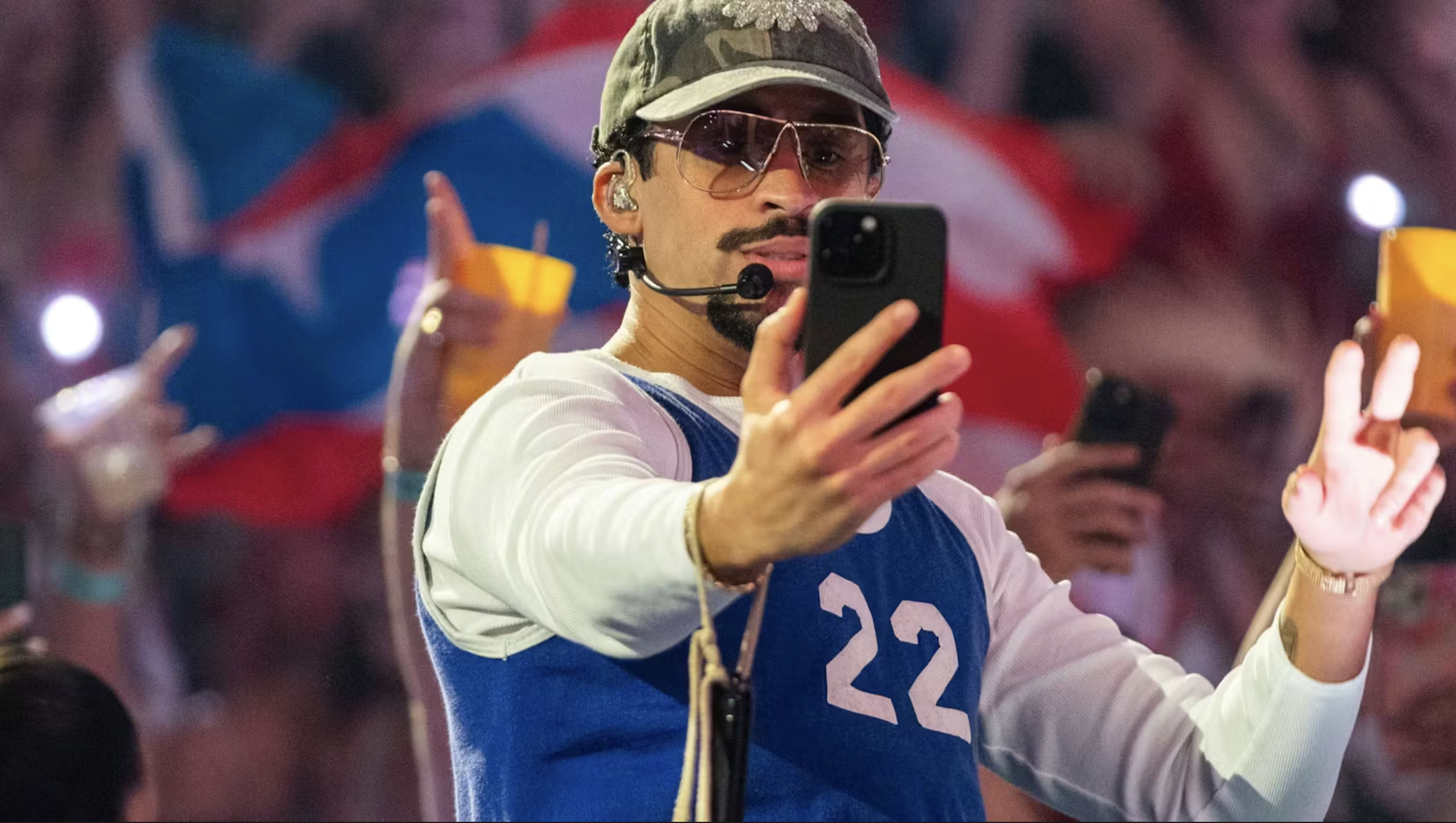
Bad Bunny taking a selfie on stage at one of his concerts. The Puerto Rican flag can be seen in the background. Photo courtesy of Huete.
Soon after the NFL announced Bad Bunny as the 2026 Super Bowl halftime show headliner, discourse regarding the decision took over social media. Fans across the world were excited for the performance, as Bad Bunny is a global sensation, topping the Billboard Global 200 chart and winning three Grammys in his career.
However, President Trump and vocal members of the Republican Party attacked the artist, with Trump calling the decision “absolutely ridiculous” and “crazy.” Commentators such as Tomi Lahren even called into question Bad Bunny’s status as a Puerto Rican resident with blatantly false comments about how he’s “not an American artist.” Turning Point USA, a conservative, youth-focused activist group founded by the late Charlie Kirk, has even planned to host counterprogramming during the halftime show, called “The All American Show,” celebrating “faith, family, and freedom.” The music in Turning Point’s show is required to be in English in order to counter the halftime show’s “lack of patriotism.”
The controversy surrounding Bad Bunny’s upcoming performance at the 2026 Super Bowl halftime show represents the larger work that politicians are engaging in to keep their followers ill-informed and obedient, revealing a deeper issue of the confirmation bias that social media echo chambers provide, chilling political discourse. When unscrupulous right-wing media and politicians capitalize on their lies, critical discussion dies. As a result, those who dictate the narrative maintain power and influence instead of addressing the more complex problems—such as what it really means to be American—which linger beneath the surface.
Firstly, to clear things up, Bad Bunny, born Benito Antonio Martinez Ocasio, is a Puerto Rican musician, making him a U.S. citizen. Puerto Rico is considered an organized, unincorporated territory, meaning that they self-governs without direct constitutional law placed upon them, but is “owned” by the United States. Some of the rights afforded to citizens are that they are allowed to vote in primaries and move around the U.S. freely, although they cannot vote in general elections. Additionally, Puerto Ricans do not pay federal income taxes and therefore receive fewer benefits, like Medicaid. Thus, while Bad Bunny is legally a U.S. citizen and is afforded many of the rights given to those from the 50 states, many still do not understand the connection between Puerto Rico and the 50 states.
As the majority of the Super Bowl audience is English-speaking Americans, many conservative politicians insisted that their backlash against Bad Bunny’s performance was due to his inability to represent the larger American population with his primarily Spanish music. However, their disagreement goes far beyond a language barrier; Bad Bunny is known for his political activism, often using his platform to speak out on issues affecting Latino and marginalized communities. Most recently, Bad Bunny has been a vocal critic of the Trump administration, specifically on the mass deportation of Latinos from U.S. cities. Additionally, he endorsed Kamala Harris in the 2024 presidential election, broke common gender stereotypes with his unconventional outfits, and has declined to tour in the U.S. mainland, fearing that his fans could be deported by ICE. In essence, Bad Bunny is everything that the ‘ideal American’ of Trump’s agenda is not.
In response to Bad Bunny’s political dissent, conservative figures have attempted to counter his anti-MAGA political beliefs and turn MAGA voters against him through online misinformation. Many Trump supporters truly believed that Bad Bunny was not an American citizen, as they were unaware that Puerto Rico was even a part of the U.S. in the first place. Conservatives in power have played into this widespread culture of ignorance with intentional lies, such as Bad Bunny’s citizenship status, leading to a vicious cycle of misinformation and ignorance that plagues America today.
For example, after Tomi Lahren stated that Bad Bunny is “not an American artist,” Polymarket Football’s Twitter account pushed this narrative forward with a tweet insisting that “the NFL DOES NOT CARE about the USA fans.” This account has over 83,000 followers, and once you take into account all the retweets and screenshots people send between each other, a falsehood has suddenly gained an air of legitimacy. Here begins the endless cycle of misinformation via the media that conservatives and liberals alike have played into in order to further their own cause.
We should not be shocked, however, as misinformation has been the playbook for Trump and his supporters to further his power. After the 2020 election, conservatives infamously insisted that Joe Biden’s victory was illegitimate, with allegations that thousands of people “double voted” by assuming different identities. During the pandemic, Trump also made up “nearly 38 percent of the overall ‘misinformation conversation’” regarding COVID-19, telling his followers that the disease itself was a hoax. With countless instances of Trump-fueled misinformation, the debate about Bad Bunny’s citizenship status is predictably unsurprising at best and maliciously divisive at worst.
On the other hand, liberals responded to Bad Bunny’s performance announcement positively and condemned conservative hate towards the artist. These narratives spread just as widely as conservative stories, but on a completely different side of the internet. For example, Jason Kelce, a now-retired football player for the Philadelphia Eagles and sports analyst for ESPN, stated that “If Bad Bunny is a bad fit for the Super Bowl, then maybe the people making these comments are a bad fit for America’s future.” X users retweeted popular posts and joked about how “nothing confuses and upsets ICE more than Puerto Rico being part of America,” poking fun at ignorance around Bad Bunny’s heritage. With liberals and conservatives using completely separate news sources to gain information–paired with social media algorithms dividing the two groups even further–those with differing opinions never receive the opportunity to interact and attempt to form common bonds. Instead, the jumble of fact and fiction reinforced by unrestricted echo chambers makes compromise unattainable and only widens the gap between liberal and conservative ideals.
It is all too easy these days for people to say whatever they want without factual evidence, especially in digital spaces where anyone else can receive the information, internalize it, and pass it forward. The rise of misinformation has further polarized both political sides, as now each side has its own facts and attributions of responsibility, making it nearly impossible to bridge the divide and come to a shared consensus. Supporters of Trump, for example, are loyal to Trump and other MAGA politicians because it is all they know. They’ve only received a certain viewpoint through news and media, and that viewpoint continues to be reinforced by others, making them loyal to the Trump administration and skeptical of all outside opinions.
While the United States has historically insisted that it is a country of freedom, progress, and intellect, these recent surges in targeted misinformation have taken part in a long list of events that are revealing the country’s true colors. Rather than focusing on cooperation and advancement, polarization through misinformation and selective media intake has created a culture of competition and division, all fueled by ignorance. The example of Bad Bunny only shows how normalized blind loyalty to political figures is becoming, and how pervasive this bad behavior is in all aspects of life, including music and the arts. Arts have always been used to express oneself, whether it comes from the music we make or the music we choose to listen to. In a highly polarized world where politicians are exerting their power to take advantage of citizens through misinformation and lies, the arts should never be held down by conflicts in politics, because in doing so, this limits free speech and expression in its most fundamental form.
Shreya Chhaya (BC ‘29) is a staff writer at CPR and a freshman at Barnard College from Dallas, TX. She is studying political science and human rights, and is interested in electoral politics and public policy.