Make Republika Srpska Great Again?

Republika Srpska President Milorad Dodik wearing a “Make America Great Again” hat in Banja Luka. Photo courtesy of Dodik’s X account. Design courtesy of Beatrix Holstine.
While most Americans remain focused on flashpoints in Ukraine, Gaza, and Taiwan, a quieter but potentially explosive crisis is brewing in the Balkans. Republika Srpska is a majority ethnic-Serb political entity within Bosnia that holds half of the country’s landmass and produces a third of the country’s gross domestic product. Milorad Dodik, the region’s pro-Russian, separatist president, is exploiting the uncertainty created by a U.S. foreign policy doctrine that has moved away from post-WWII commitments to global institutions and internationalist ideals. The separatist movement in Bosnia provides a precarious staging ground for a renewed Trump-Putin relationship, destabilizing the fragile peace established in the Balkans 30 years ago by the Dayton Accords.
Under past administrations, it has primarily been the foreign policy of the United States to support the “American values” of economic opportunity, international stability, and liberal democracy. These principles have shaped a majority of the largest U.S. foreign policy decisions, particularly since the fall of the Soviet Union, leading to interventions in the Balkans and Persian Gulf in the ‘90s and Afghanistan a decade later.
However, under the second Trump administration, these values seem to be irrelevant in dictating the United States’ relationship to the rest of the world. With Ukraine, for example, instead of continuing the Biden administration’s defense of a primary opponent to Russia and long-term U.S. ally, Trump demanded that Ukraine provide a lucrative mineral deal in exchange for defense. The second Trump administration has also brought a highly transactional foreign policy perspective to its approach to trade. Building on an overly simplified, black-and-white view of trade relations, the United States has also restructured almost all of its trade deals and replaced them with high tariffs.
On top of that, President Trump has all but abandoned many of the United States’ international duties: dismantling the U.S. Agency for International Development (USAID); leaving the United Nations Educational, Scientific, and Cultural Organization (UNESCO) among other UN organizations; withdrawing from the World Health Organization (WHO); and threatening to leave the World Trade Organization (WTO). Add to this President Trump’s threats to annex Greenland, Canada, and the Gaza Strip, and it is clear that the United States is all but disregarding the world order of the past several decades.
This apathy for traditional international politics and alliances might spell good news for Milorad Dodik and Republika Srpska. Nevertheless, as Ryan D. Griffiths and Seva Gunitsky explain for Foreign Affairs, “Trump does not care about impoverished separatists if they cannot provide him with immediate rewards.” Now, instead of aligning with “American values” of sovereignty and democracy, to gain the support of the United States, separatist movements have to convince President Trump that they have something to offer the United States under the Trump administration’s “America First” doctrine.
Dodik has long been hopeful that a Trump-led government will be sympathetic to Republika Srpska’s secessionist movement from Bosnia. Srpska’s politics leans decisively towards ethnonationalist Serb views. Dodik has spent years trying to undermine Bosnia’s national institutions in order to bolster ethnic-Serb interests and promote Serb unification. He was even issued a now-nullified arrest warrant by Bosnia’s Constitutional Court for refusing to show up to questioning after passing laws in Republika Srpska revoking the authority of the national police. However, despite close Trump affiliates showing deference to Serbian national interests and Donald Trump Jr. meeting with Serbian President Aleksandar Vučić in Belgrade this March to discuss both business and political deals, President Trump himself has publicly shown no attention to Republika Srpska.
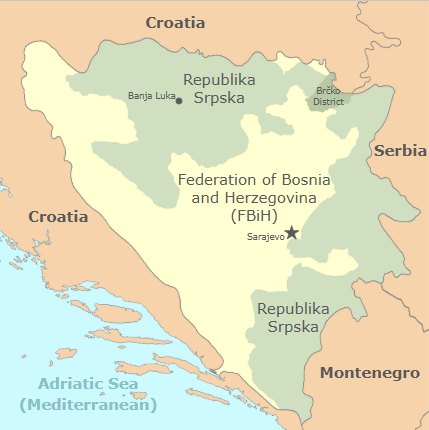
Map of Bosnia and surrounding countries. The Brčko District is a condominium of Republika Srpska and the FBiH, with shared control between the two entities within Bosnia. Blank map courtesy of Wikimedia Commons, labeling by Eli Lester Levy.

Milorad Dodik has also explicitly offered Republika Srpska’s mineral resources to the United States in return for support in his region’s secession movement. Additionally, he stated that Republika Srpska may be open to striking a deal regarding third-country deportations from the U.S. if the Trump administration were to suggest such a stipulation. However, these grasping-at-straws attempts to work with the U.S. government have also thus far fallen on deaf ears.
This hasn’t stopped Dodik from trying to grab the U.S. government’s attention. Unable to court President Trump directly, Dodik has found allies among Trump’s (albeit distant) orbit instead.
In February, former New York City Mayor Rudy Giuliani—who, along with being a long-time friend of President Trump, served on his personal legal team until he was disbarred in New York and Washington, D.C., last year—spoke at a rally in support of Dodik where Giuliani was presented with a hat embroidered with the words “Make Srpska Great Again.” Earlier that day, the two also recorded a podcast together with heavy Islamophobic and anti-Bosniak undertones, echoing old sentiments linking Islam with terrorism.
This July, former Governor of Illinois Rod Blagojevich—whom President Trump pardoned earlier this year after convictions of corruption—wrote an op-ed for the Washington Times in which he posited that “Iran is in Europe.” In an alarmist tirade, he argued that Bosnia’s large Muslim population has become a hub for future terrorism now that Hezbollah and Hamas have taken major beatings in the Levant.
These two examples of prominent Republicans advocating in favor of Republika Srpska’s secessionist movement are alarming. They represent the slow establishment of a foothold for ethnic-Serb interests in American far-right circles. Though Giuliani and Blagojevich may seem like comparatively marginal figures, their rhetoric parrots President Trump’s foreign policy instincts: reactive, manichean, and aimed more at Fox News viewers than North Atlantic Treaty Organization (NATO) allies.
In a direct response to Blagojevich, Bosnian Ambassador to the United States Sven Alkalaj explained that “the unmistakable objective is to derail Bosnia-Herzegovina’s Euro-Atlantic trajectory by deliberately reframing the country from a reliable regional partner into a security threat to the United States.” The tropes employed by Giuliani and Blagojevich provide cover for Dodik’s secessionist ideas. By framing support for Srpska’s secession as a crusade against terrorism, Dodik is recasting his efforts to dismantle the Bosnian state in a way that is palatable to Americans. To proceed with separatism, Dodik doesn’t need a signed treaty, but rather permissive silence and tacit support from NATO’s largest historical guarantor of international security: the United States.
For the Trump administration, Bosnia offers a narrative playground where they can signal toughness on supposed Islamic extremism and continue their campaign against the foreign policy establishment—all without committing to a coherent strategy or values. If Dodik can convince President Trump that Republika Srpska has something of value to offer the U.S., be it a mineral deal or a new location for third-country deportations, Dodik may receive the strategically ambiguous carte blanche from the U.S. that he is looking for. Even though Republika Srpska’s separation from Bosnia would serve as a heavy blow to NATO’s regional hegemony in the Balkans and thus a crack in its promise of international security, President Trump has already shown that NATO priorities do not come first in his evaluations of foreign affairs, opting instead for what he views as benefiting the United States over all else.
At the same time, Dodik is not only looking towards the U.S. government for support, but the Kremlin as well. Moscow’s long-standing interest in a fractured Bosnia aligns neatly with Dodik’s own goals. For Russia, Republika Srpska’s destabilization of Bosnia is a low-cost, high-reward opportunity to shake NATO’s southeastern flank, especially as Western attention is drawn elsewhere, namely Ukraine and the Middle East. As Dodik stated in an April meeting with Putin in Moscow, “Russia will advocate for the ending and cessation of the work of international institutions, especially the fake high representative, or, as he says, the illegitimate representative.” Both Dodik and Putin are hoping for the eventual defeat of NATO.
As the interests of the U.S. and Russia increasingly align, Bosnia becomes more than just a frozen conflict. It becomes a litmus test and herald for what foreign policy might look like under an increasingly post-institutional international doctrine, one that rejects the traditional notion of rigid institutions and the binary between formal and informal institutions.
This large convergence of interests between Dodik’s ethnonationalism, the Trump administration’s “America First” agenda, and the Kremlin’s strategic aims lays the groundwork for reimagined relations between President Trump and Vladimir Putin.
Under the first Trump administration, cooperation between the U.S. and Russia was channeled through formal offices or shared international events. Now, in a second term, collaborations could flow through aligned proxies and anti-institutional ecosystems. The informality of these channels would be plausibly deniable, reducing accountability for both countries.
Unlike the overt diplomatic channels of the first Trump administration, this probable iteration of Trump-Putin relations would be more underground, informal, and perhaps even more dangerous. Amid recent rocky posturing between Trump and Putin, the two can continue to openly scorn the other’s country while cooperating in private. Rather than unproductive tête-à-têtes in Alaska or odd flattery, this new mode of engagement would operate through loosely affiliated actors who speak the same language of anti-Muslim rhetoric and harbor a shared disdain for multilateral institutions.
For other Western governments, the question is no longer whether or not to take Dodik seriously, but whether their own incoherence is already doing his work for him. What’s playing out in Bosnia may soon become a playbook for conflicts where Western allies are outmaneuvered not by traditional armies, formal alliances, high-tech drone attacks, but by rogue politicians, fringe allies, and disinformation campaigns amplifying discord. In this sense, Republika Srpska is not just a local crisis. It is a rehearsal for the establishment of new international norms and a warning that in the next era of geopolitics, chaos may no longer need commanders, only permission.
Eli Lester Levy (CC ‘29) is a staff writer at CPR as part of the New Student Summer Publishing Program. He is interested in studying political science and history. Eli can be reached at ell2166@columbia.edu.