Liar, Liar, Pants on Fire: Presidential Accountability from Watergate to the Post-Truth Era
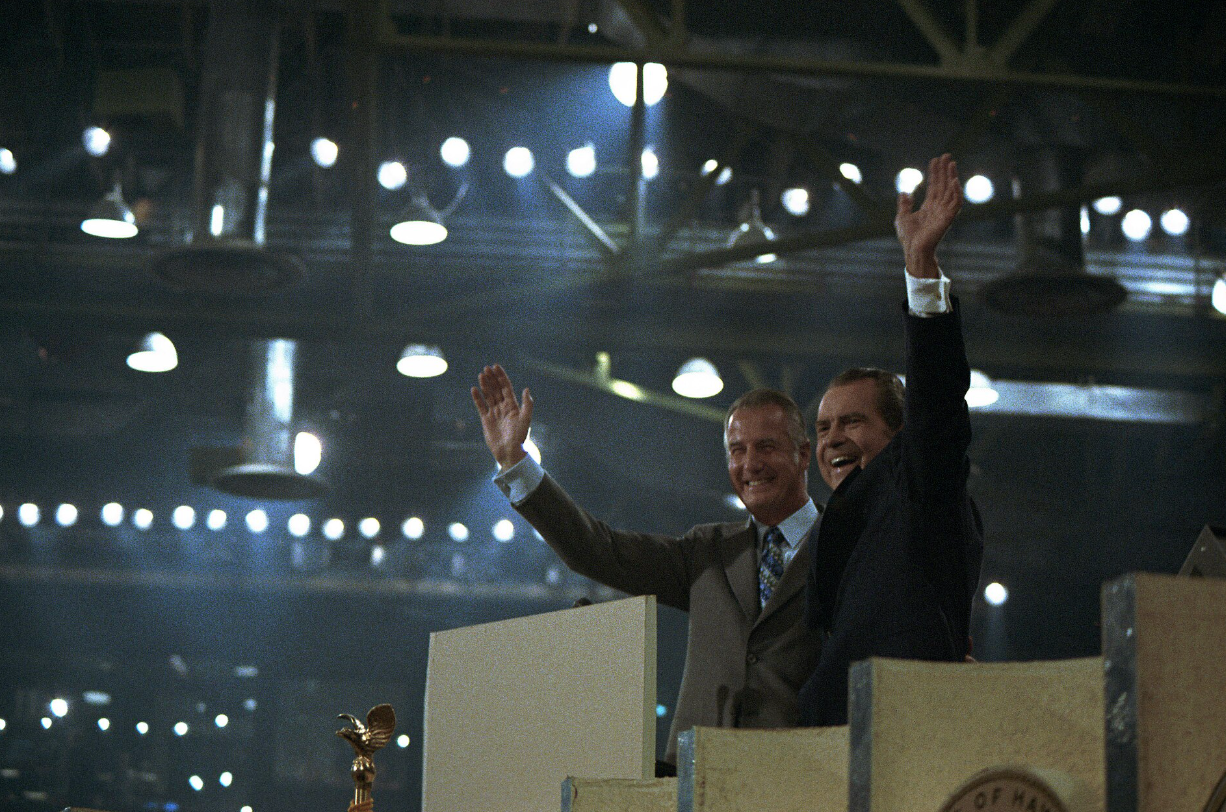
Pictured above is an image of President Richard Nixon (right) along with his Vice President Spiro Agnew (left), waving gleefully whilst attending the Republican National Convention in August 1972. Photo courtesy of the National Archives and Records Administration.
For 15 years, the American nonprofit PolitiFact examined hundreds of political lies to name the most notable each year. In a surprising shift, they did not choose one for 2025; instead, they declared it the ‘Year of the Lies.’ PolitiFact’s editor-in-chief, Katie Sanders, explained that the volume and severity of lies were so overwhelming that naming “the lie” felt pointless. As the lies piled on in 2025, the hope for change and accountability diminished, and instead, the public watched the ridiculousness, like watching a ship sink from shore.
Looking back at the 1970s, a single string of lies about the Watergate break-in was enough to make the president resign. Now, the endless flow of false claims and twisted truths has made Americans numb. As presidential lies grow more frequent, their political consequences diminish, revealing a fundamental change in public tolerance for executive dishonesty.
When Richard Nixon accepted the presidential nomination at the Republican National Convention in 1968, he proclaimed, “America is in trouble today not because her people have failed but because her leaders have failed. And what America needs are leaders to match the greatness of her people.” Entering a crucial presidential race, Nixon positioned himself as a well-qualified, brilliant, and eloquent politician, promising to stand up for the ‘silent majority’ of Americans.
Just four years later, following the Watergate Scandal, the New York Times reported that President Nixon’s presidential approval had plummeted to 31 percent, the lowest any president had held since the end of President Truman’s term in January 1953. Nixon’s fall from grace was rough and abrupt, losing 37 percent approval in seven months. One of the many ironies of Richard Nixon’s political persona was his platform to restore “law and order” at home while chaos unfurled abroad. Of course, this was the crux of the betrayal the American people felt in the wake of the Watergate scandal: how can the president claim to be restoring law and order while he is running amok, engaging in and covering up criminal acts himself? In the Supreme Court case United States v. Nixon, the Court ruled that a president did not have executive privilege that was entirely immune from judicial review. So, he had to release the tapes and resign in shame.
Fifty years later, President Trump encountered growing pressure from the public and released the files of convicted sex offender Jeffrey Epstein. It was a long-awaited breakthrough that the president had promised to accomplish in his campaign. On November 19, 2025, he signed into law the Epstein Files Transparency Act, requiring the Justice Department to “make publicly available in a searchable and downloadable format” all unclassified materials related to its investigation into Epstein within 30 days, with few exceptions. Trump stated, “We have nothing to hide." However, the Department of Justice’s staggered, heavily redacted release in early 2026 featured over 500 pages completely blacked out. The release sparked criticism from U.S. representatives, such as Ro Khanna and Thomas Massie. This administrative truth beatdown not only delayed the facts but also created a vacuum for conspiracy theories and amplified public frustration. The tension across the country grew, imitating the suspense of a thriller, as each day delivered new disappointment with the government.
Despite the many allegations against President Trump, from both the Epstein files as well as entering office as a convicted criminal, he has not been held legally accountable nor asked to step down as Nixon had been. Instead, the 2024 Supreme Court ruling in Trump v. United States granted the President substantial immunity from criminal liability for acts committed while in office. Trump has maintained his public status amid his criminal allegations, facing no legal or career-altering consequences. This is more than a surge in dishonesty; it is a total reconfiguration of truth, where partisan echo chambers have replaced the objective gatekeepers of the past.
This modern ignorance comes not just from more lies but also from a shift in American media. In the 1970s, a few networks made up the “big three”—CBS, NBC, and ABC—providing a shared set of facts and a sense of a “national hearth.” Fast forward to today, and Americans are much more divided over which of their new sources they trust. Republicans predominantly focus on sources such as Fox News, while Democrats spread their attention across major TV and cable networks. As a result, voters now get information in echo chambers reinforced by algorithms that favor participation over accuracy. In this polarized climate, a presidential scandal is not a national crisis. Instead, it is a partisan inkblot test, or what you choose to see depending on your side and direct news sources. For instance, an October 2025 Reuters/Ipsos poll revealed that only 20 percent of Americans, and a larger portion of Republicans, 44 percent, approve of how Trump has handled the Epstein case. This divide, in turn, has ended the public’s power to demand uniform reform. Once, a betrayal could end a career; now, it is just more “drumbeat” noise—and half the country tunes it out.
Despite the lingering controversy around the release of the Epstein files, President Trump’s approval rating fluctuated little, dropping only from a 44 percent approval rating to a 40 percent approval rating over the course of eight months. This minor drop is a sharp contrast to Nixon’s dramatic decline and marks the shift in public reaction to political scandals. Does the public still value honesty and humility in their president?
Ultimately, the “truth beatdown” of 2025 exposed how democracy is at great risk when honesty and accountability diminish. In labeling 2025 the “Year of the Lies,” PolitiFact showcased not only the alarming rise of falsehoods but also the collapse of the shame mechanism in U.S. politics. Without a collective measurement for honesty and humility, democracy’s core—the consent of the governed—falls apart. As leaders face fewer consequences for dishonesty, democratic consensus collapses, replaced by a contest where volume trumps truth.
Eleni Maglaras (BC ‘29) is a sophomore at Barnard College studying history. She can be reached at ebm2176@barnard.edu.