From Disaster to Detention: The Impacts of Crimmigration and Climate Displacement
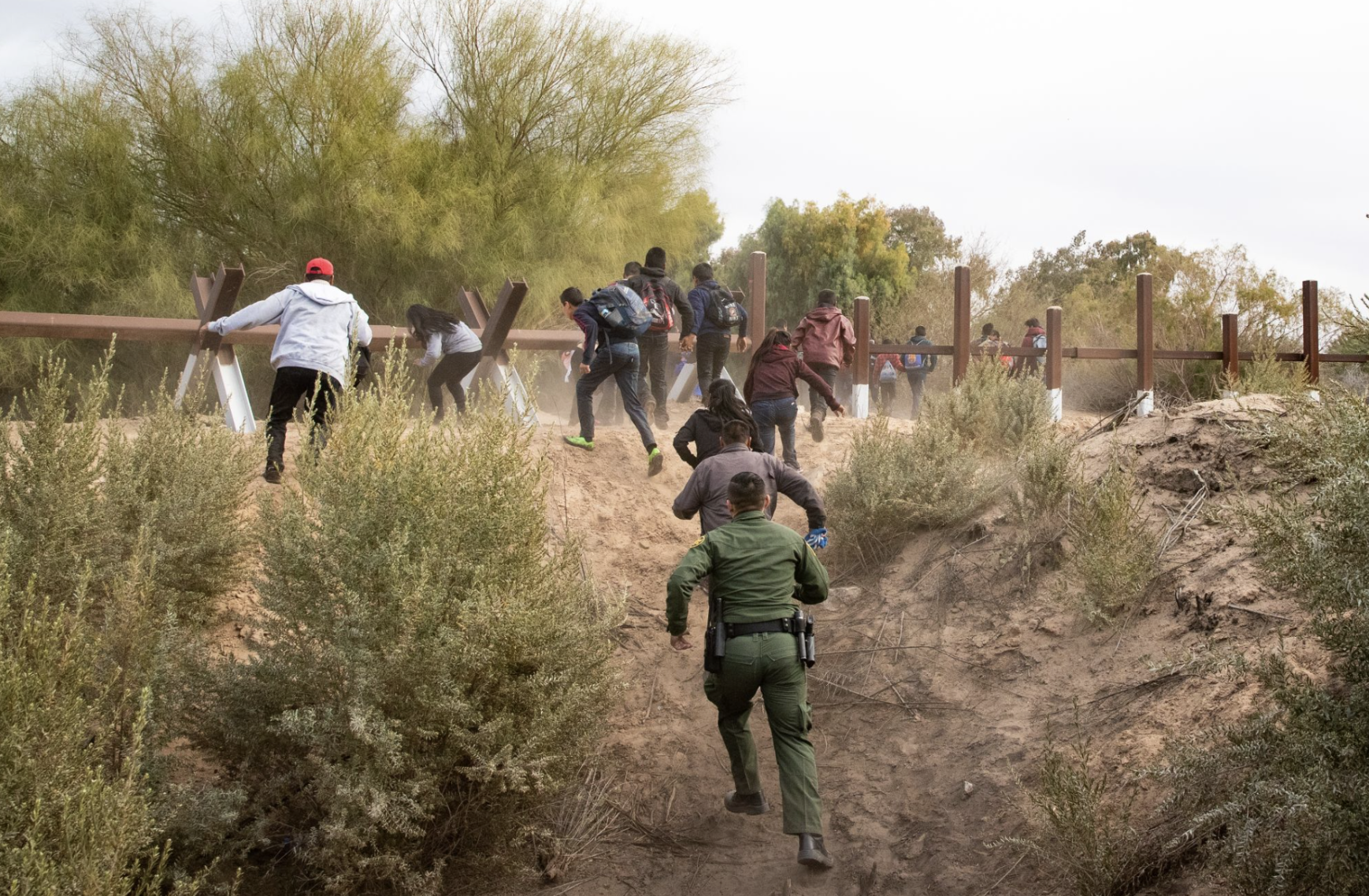
Migrants at the US-Mexico border attempting to cross while being pursued by border patrol. Photo courtesy of anonymous.
As climate change accelerates, natural disasters and environmental collapse are increasingly forcing people across the world to flee their homes. As a result, climate displacement is growing, pushing more individuals across borders without legal recognition or protection. However, the US federal government increasingly treats migration as a criminal issue, not a humanitarian one. In 2006, law professor and scholar Juliet Stumpf coined the term crimmigration, the use of criminal law to police immigration. Although the term was established two decades ago, crimmigration is progressively more relevant as immigration within the US becomes increasingly focused on detention and deportation under the Trump Administration. Such acts include firing over one hundred immigration judges, limiting oversight over the Department of Homeland Security (DHS), the mobilization of joint task forces to arrest immigrants, and imposing Southern border closures and restrictions. Migrants in the US are met with a system that criminalizes their every move. And while being undocumented in the US is a civil offense, migrants face increasing surveillance, an expansion of aggravated felonies, violence from ICE officers, and nation-origin immigration exclusion. People fleeing environmental collapse are directed into this punitive system rather than protected by it because US immigration law does not recognize climate displacement as grounds for asylum. This convergence of criminal and immigration law in the US has created a system that unjustly harms climate-displaced migrants. These individuals lack formal legal protections and increasingly face criminalization rather than refuge, punishment rather than protection.
As climate change intensifies and natural disasters increase in frequency and intensity, climate displacement worsens. Two cyclones hit the Bay of Bengal Region in November 2025, displacing 1.2 million people. Sri Lanka, one of the countries the cyclone impacted, is limited in its ability to invest in disaster preparedness and recovery. However, it is not just Sri Lanka that is struggling with the aftermath of environmental disasters. Climate change impacts are unequally distributed, often felt most by those who have caused the least amount of harm. Climate change disproportionately uproots women, children, and impoverished individuals. While the majority of climate migrants are internally displaced, some still choose to seek international sanctuary. “Climate refugees,” as these individuals are sometimes called, are not actually guaranteed asylum or other protections, as they are not legally refugees under international law.
Climate migrants can pursue two main avenues of sanctuary in the US. One is Temporary Protected Status (TPS). Established in 1990, TPS allows migrants displaced by environmental disasters to live and work temporarily in the United States. In March of 2025, 17 countries had a TPS designation. However, as of the end of August 2026, only 5 countries currently have a TPS designation, and that number is likely to keep shrinking under the current administration. Notably, the program requires renewal every eighteen months and doesn’t include a path to citizenship or permanent residency. TPS is also revoked from its nationals once a country’s designation expires, and they return to their previous immigration status. The individual is undocumented in many cases, making them extremely vulnerable to deportation. As a DHS program, TPS is also subject to shifting political priorities and administrations. Decisions about immigration law often change with each administration, due to the political appointees who lead DHS serving at the discretion of the president in power.
The second potential pathway is asylum, a form of legal protection that grants the recipient permission to reside and work in the US However, an individual can only claim asylum if their case overlaps with at least one of the five protected grounds from the 1951 Convention Relating to the Status of Refugees: race, religion, nationality, membership of a particular social group (PSG), or political opinion. Environmental displacement alone does not qualify an individual for asylum. For example, a trans woman who is forced to seek refuge because she was both targeted by the police for her gender and displaced by flooding may qualify because she can claim a “well-founded fear of being persecuted” as a member of a PSG. Still, she cannot seek asylum solely based on her being affected by a natural disaster. In other words, current asylum laws in the US require migrants to fit their experiences into narrow, preexisting categories that haven’t been updated to account for the realities of climate displacement.
This lack of permanent legal protections makes seeking sanctuary extremely unstable, leaving migrants vulnerable. Neither option is enough. Despite the rise in natural disaster events and displacement caused by climate change, no current international legal framework or US-specific laws exist to offer climate migrants protection. Some argue that expanding protections would overwhelm the immigration system. But the current system is already failing. A World Bank report calculates that by 2050, over 216 million people could be internal climate migrants. This figure only captures displacement within national borders, but it presages large-scale relocations that cannot be contained to internal migration alone. Cross-border climate displacement is far harder to quantify. This is partly due to the lack of legal recognition for climate migrants, and partly because people fleeing disaster often pass through multiple countries before settling somewhere, making it difficult to attribute their movement to a single cause or event. But the strain visible in refugee camps is an indication of what to expect. Many camps are already over capacity, and worsening climate conditions will likely increase cross-border migration. Additionally, many refugee camps are located in countries that have high levels of poverty, bringing the long-term durability of these camps into question.
These global issues are mirrored within the US, where strict legislation and delays in processing applications have created a backlog in immigration hearings, further restricting migrants’ ability to access protection. Rising pre-termination rates in US Immigration Courts, or cases without full hearings, further limit migrants’ abilities to claim protection. Individuals cannot rely on these flimsy methods of temporary protection or an incident that aligns with one of the current grounds for an asylum claim. These stricter measures have contributed to DHS deporting over 675,000 migrants and 2.2 million choosing to leave voluntarily in the past year alone. The lack of legal protections afforded to climate migrants renders them even more vulnerable to DHS arrests and subsequent deportations. There needs to be more stringent legal protections in place to specifically protect climate migrants. The lack of protections available for climate migrants isn’t just a US-specific problem, but the decision to criminalize immigration further exacerbates the issues of displacement from environmental disasters.
The Climate Displaced Persons Act (CDPA) is one potential avenue of climate migration legislation the US could implement. Last introduced in 2023 by Senator Ed Markey (D-MA) and Representative Nydia Velázquez (D-NY), the bill provides a potential pathway for climate migrants to receive resettlement support and legal status. Implementing this bill would codify into law a distinct legal categorization for climate migrants, granting them rights and protections previously not afforded.
Climate migration is not a looming crisis; it is already here. The question is whether the US will respond to this issue with protection or punishment. Expanding crimmigration policies at a time when natural disasters are becoming more frequent does not prevent displacement, it compounds it. Criminalizing already vulnerable individuals fleeing disaster will only put them at greater risk. Protecting climate migrants thus requires meaningful legal reform that recognizes environmental displacement and limits the criminalization of migration. While the CDPA is one example of climate immigration law reform, it was introduced into Congress in 2023 and never made it past the committee stage. However, the CDPA can be utilized to provide a legislative framework that future policymakers can reference and build upon while preserving and strengthening established immigration policies, such as TPS, that have been stripped down by the current administration.
There is no easy or linear path to immigration law reform. It will require collaboration between political parties to decriminalize current immigration policy affecting migrants and prioritizing efforts to combat climate change. Only by establishing a broader legal and political foundation can the US successfully adopt policies that recognize and protect climate migrants. As the CDAP’s failure demonstrates, proposals lacking this foundation are unlikely to succeed. Continuing to criminalize survival is not just cruel; it is a deliberate policy choice aggravated by the current federal administration, placing millions of present and future lives at risk.
Wren Greeley-Havard (CC ’28) is a Senior Editor at CPR studying political science and human rights. She can be reached at wg2446@columbia.edu.