American ‘Energy Dominance’ is Impossible, and Perhaps That’s Best: Lessons from The Iran War
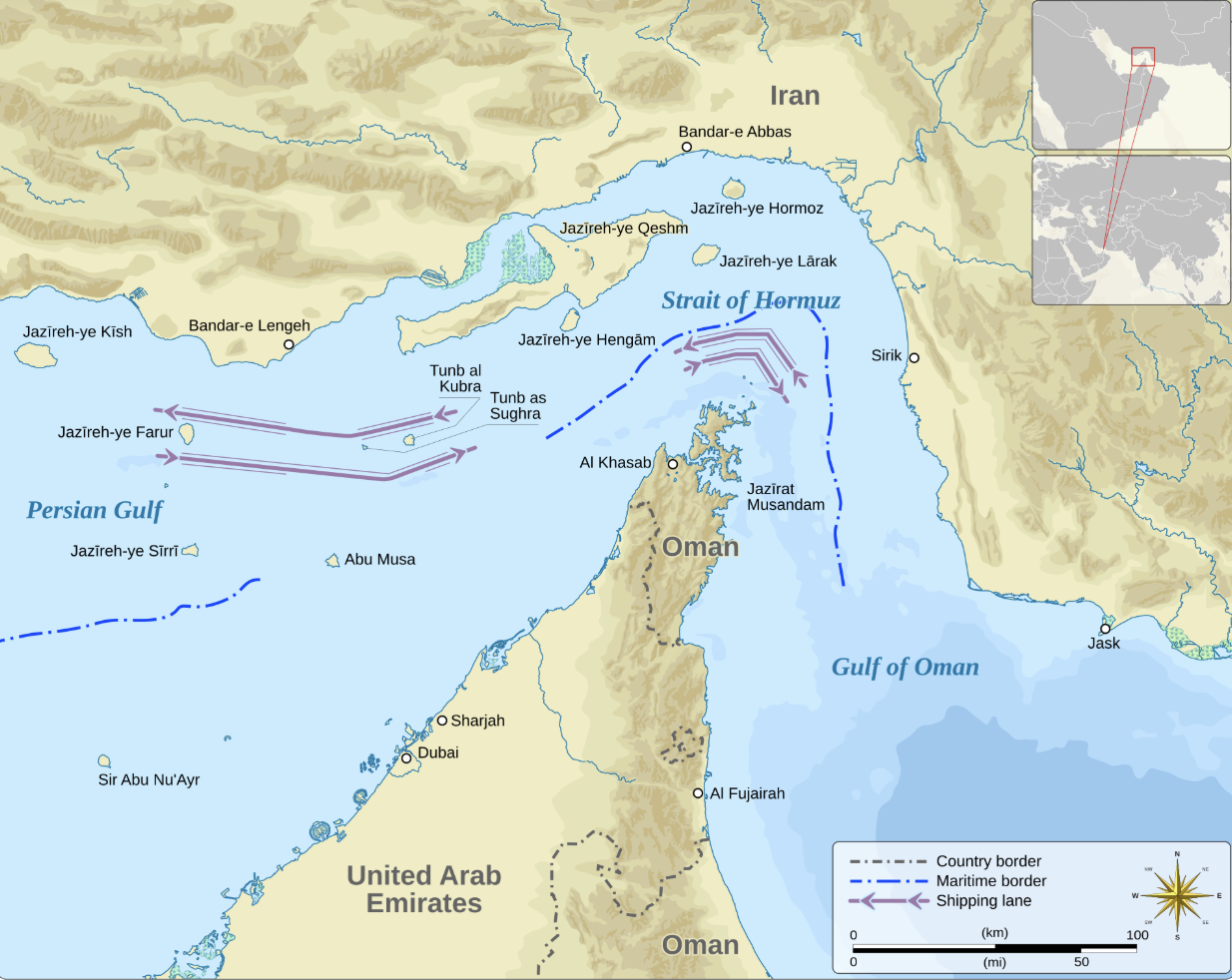
The Strait of Hormuz’s narrow shipping lanes concentrate a fifth of global oil flows; a single chokepoint can transmit grave shocks across an interdependent energy system. Photo courtesy of Wikimedia Commons
Around a century ago, Sir Norman Angell won the Nobel Peace Prize for his development of the Kantian idea that economic interdependence was the key to international cooperation and peace. In his 1910 work The Great Illusion, Angell argues that mutual dependency through trade renders armed conflict economically irrational for both the victor and the vanquished. To believe that military power and conquest could yield national advantage would therefore be a “great illusion,” for all costs one state imposes on another inevitably reverberates onto itself.
A century later, Angell’s theory supports the logic behind Iran's central levers of deterrence and coercive bargaining in its drawn-out conflict with the US. The Strait of Hormuz, over which Iran exerts significant control, sustains the trade of nearly one-fifth of the world’s oil and natural gas supply. For years, Iran has responded to rising tensions with the US by attacking or threatening to attack ships crossing the Strait, a strong signal that all costs inflicted on Iran will be felt by the entire international community. Previous US administrations have, therefore, tried their best to avoid prolonged escalation ever since Iran claimed authority over the Strait in 1979.
On February 28, 2026, President Trump decided to depart from this tradition. Following failed negotiations over Iran’s nuclear program and amid rising Iranian resistance against the Islamic Republic, the US and Israel launched wide-ranging strikes on Iran. Along with counterattacks, Iran decided to make good on its longstanding threat, effectively closing off trade through the Strait of Hormuz.
Since the closure, the resulting energy supply shock has cascaded far beyond the bilateral dimension of Angell’s theory, causing inflationary crises and supply chain disruptions worldwide. The US has certainly not been spared: between February and March, it observed the highest percentage increase in gasoline prices on record—that is, an even higher monthly increase than that during the 2022 Russian invasion of Ukraine.
These developments stand in stark contrast to Trump’s triumphalist narrative about American energy. Just four days before the first strikes were launched, the White House released an announcement titled: ‘American Energy Dominance Is Back Under President Trump.’
For the first time since the energy dominance agenda’s conception in 2016, the news release frames it not as a goal that must be pursued, but as a victory already won. According to the White House, the administration has accomplished two complementary missions. Domestically, it has secured energy independence by expanding fuel production at home, which the administration presents as a way to lower consumer costs. Internationally, it has strengthened American dominance in energy markets by maximizing exports, which it alleges gives the country great influence over global prices. Crucially, the White House presents both as a national security achievement, claiming that Trump has put an end to years of foreign-dependent energy policy.
Put plainly, the energy dominance narrative rests on a deceptively simple promise: if the US produces enough energy, it will no longer be at the mercy of foreign crises. While the full rationale behind launching the first strikes is, and will likely remain, inscrutable, this overconfidence seems to have played a crucial role, leaving Trump with an inflated sense of the US’s insulation from the Angellian costs of escalation. This becomes even clearer in view of Trump’s prompt response to the Strait’s closure: "We're in great shape for the future. The United States imports almost no oil through the Hormuz Strait and won't be taking any in the future; we don't need it.”
Trump is not wrong about the fact that the US displays a vastly different energy picture than it used to. Twenty years ago, the country was far more reliant on foreign oil than it is today. Since the Shale Revolution in the early 2000s, it has gradually transformed into a net exporter of natural gas, crude oil, and refined petroleum products. Trump’s “drill, baby, drill” agenda aims to strengthen this position through surging the issuance of drilling permits, expanding access to federal lands for fuel extraction and production, and rolling back myriad environmental regulations. These actions have left US oil production in the strongest position to date, reaching record levels in 2025.
What the war with Iran has shown, however, is that being less dependent is not the same as being immune. Trump seems to have already come to this realization, in view of his recent invocation of the Defense Production Act—a Cold War-era law that grants the President the power to expand domestic production of goods essential to national defense—to boost oil, coal, and gas infrastructure. The White House states in its rationale: “Without Presidential action under section 303 of the Act, United States industry cannot reasonably be expected to provide these capabilities [...] due to financing risks, regulatory delays, and market barriers.”
All three of these issues trace back to the same reality disrupting Trump’s agenda: oil is priced globally. Even if the US hypothetically produced all of the oil it used, its participation in export markets would expose the domestic economy to the single interconnected system of the international oil market, priced constantly by traders bidding in auctions. Any chokepoint impacting global oil production, therefore, necessarily impacts domestic prices too.
Further, this hypothetical is in no way realizable. The US cannot profitably produce and transport the type of crude oil that is able to be processed in most of its refineries, and thus relies on imports from Canada and Mexico instead. These markets, similarly, have not escaped the ramifications of the Strait’s closure.
Still, being a net exporter comes with its benefits, doesn’t it? In a post on Truth Social, Trump boasted: “The United States is the largest Oil Producer in the World, by far, so when oil prices go up, we make a lot of money.” Well, this is true, if you define “we” as the US oil industry and its shareholders. Market research indicates that these companies could stand to receive as much as a $63 billion boost in annual cash flow, if not more. The domestic portion of this extra revenue will inevitably be borne by American consumers and businesses at the pump—a departure from Trump’s promise to lower energy costs for the public.
The only way to reduce the American public’s exposure to oil shocks is to decrease the US’s overall demand for oil. This can be done in two ways: diversifying the energy mix and improving energy efficiency.
Trump has attempted some diversification under his energy dominance umbrella through the expansion of liquefied natural gas (LNG), coal, and nuclear energy. US LNG has proven to be a huge asset during this crisis. Prices have remained relatively flat, owing to infrastructural limitations that prevent the country from selling more gas abroad even when international buyers are willing to pay higher prices. Far less defensible is the revitalization of near-obsolete coal plants. Even though the war could increase the demand for US coal, orders to keep plants open past their shutdown date have not only prolonged emission-intensive production but also generated massive losses for their operating utilities. These costs are, of course, primarily passed on to customer electricity bills. Nuclear energy occupies a more nuanced position, serving as an affordable and reliable source of domestic power, but prone to extreme cost and timeline overruns. Under these constraints, Trump’s acceleration of nuclear development may be his strongest attempt at long-term diversification, but it is not yet poised to shield the US during this crisis.
What Trump’s energy dominance agenda famously cannot accommodate is renewable sources of energy. The list of anti-renewable policies under the Trump administration is long, including but not limited to the repeal of tax credits, stop-work orders on wind farms, and the suspension of solar grants. Ironically, renewables have proven to offer one of the strongest forms of insulation from oil shocks. Even though many of the initial inputs for solar and wind supply chains are tied to China—a reality Trump has been especially resistant to—this exposure differs from oil reliance in one crucial respect: once they are constructed, they do not require a continuous stream of foreign or foreign-dependent inputs to keep producing electricity. Additionally, their consistently declining construction costs and cheap power make them one of the few tools that can strengthen affordability, long-term security, and decarbonization simultaneously.
Regardless of the opportunities afforded by diversification, however, their central limitation is that they are primarily directed toward power. LNG, coal, nuclear, wind, and solar can all help expand electricity supply, but they do not replace the oil that remains embedded in transportation, aviation, shipping, petrochemicals, and heavy industries. These components form the bedrock of the modern economy, and replacing them would require massive investment across all sectors of production. For this reason, oil will not disappear from the American energy picture overnight. And therefore, at least in the short to medium term, the US will remain exposed to oil shocks no matter how much energy it produces at home.
This is precisely why electrification and energy efficiency must be treated as necessary accompaniments to diversification. Electrification shifts the economy away from oil and toward the power system, while efficiency lowers demand at the source. However, the Trump administration has actively resisted all initiatives toward this end, rolling back fuel economy standards, targeting EV competitiveness, and seeking to terminate incentives for efficient appliances. In doing so, Trump’s energy dominance agenda undermines the very tools that would make Americans require less oil in the first place, leaving them exposed to shocks that reduced consumption may have helped absorb.
Hence, two things can be inferred. First, energy dominance, in its goal of erecting an iron shield against global volatility, is impossible – at least, via the Trump administration’s present methodology. And, second, it benefits the US far more to immerse itself in international economic cooperation than to attempt unprofitable near-autarky.
Given this, let us return to the Iran war. From a game theory lens, both nations are better off avoiding direct conflict: the US does not benefit from an energy shock, and Iran does not benefit from military devastation. Yet, mutual incentives for restraint do not automatically translate into stability. The US holds out the credible threat of overwhelming military force, while Iran counters with the credible threat of turning the Strait of Hormuz into a chokepoint for global trade. The result resembles an iterated Prisoner’s Dilemma, where each actor gains from mutual peace and suffers from mutual confrontation, but reaps much greater losses if it fails to retaliate when the other defects.
When it comes to geopolitical relations like this, actors are in a constant state of uncertainty, bracing for the other to pull the trigger first and vying to be the one to preempt it. Any external event can destabilize this balance, and any sign can be misread. Further, once the ‘punishment phase’ of mutual confrontation begins, there is no telling how long it can go on for without a significant mutual incentive for restoring cooperation. It is here that Angell’s argument becomes hard to ignore. The one deterrent to careless escalation is the internalized cost of conflict, for it demands that leaders scrutinize their strategies, confront the consequences on their people, and cooperate toward maintaining or reinstating peace. Under these conditions, interdependence is critical to achieving well-thought-out foreign policy.
Now, as both sides continue to engage in the elaborate dance toward peace, one conclusion emerges: if energy dominance is fundamentally impossible, then perhaps the most dangerous thing is to pretend otherwise.
Nayantara Alva (GS ‘26) is a columnist with a special interest in energy issues. An economics major across Sciences Po Paris and Columbia University, she is focused on the intersection of markets, policy, and power, particularly as they shape climate outcomes.