Thinking Beyond the Situation Room
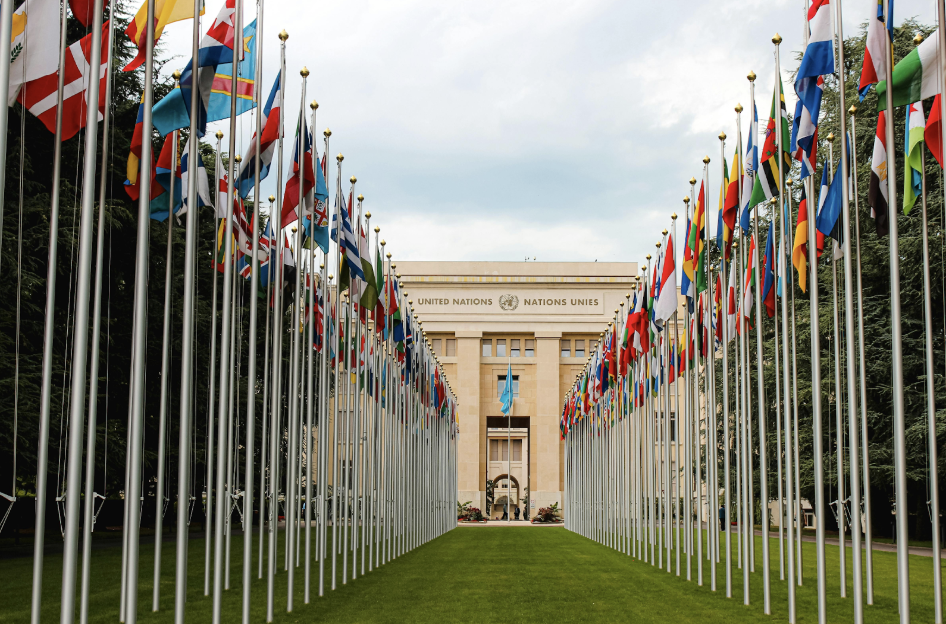
UN member countries’ flags. Photo courtesy of Pexels
Sitting in a classroom at Columbia’s School of International and Public Affairs (SIPA) just rows away from former Secretary of State Hillary Clinton, I imagined myself in the Situation Room. How would I act if I was faced with complex foreign policy decisions with long-lasting consequences? What intelligence would I rely on, what biases would I bring, and how would I know what defines a “good” or “bad” intervention?
The former Secretary’s answer is fairly straightforward: rely on the institutions that have long underpinned the liberal international order. Good decision-making, she reminds us, rests on the established understanding of the American-led global order, promoting free trade, democracy, and multilateralism. Trust the frameworks that built the post-World War II order and have led to America’s hegemony, she argues.
But, for many of us in the room, that worldview feels increasingly outdated. It is rooted in faith in neoliberal institutions that emphasize American exceptionalism, which views the U.S. as having a unique responsibility in leading the world. The course and instructors ask us to analyze decisions using rational-actor models, assuming that leaders act logically to maximize national interest. We are also taught bureaucratic politics theory, which assumes that foreign policy outcomes are a direct result of compromises and deliberations between internal governmental agencies and not just a singular leader’s decision. Alongside these theories are intervention frameworks, shaped from previous foreign policy doctrines and developed for a world in which universal respect for U.S. institutions is presupposed.
Yet, these were tools designed for a bipolar world that no longer exists. Today’s global landscape is multipolar, shaped by regional rivalries and non-state actors. Our generation has witnessed how once-trusted institutions have struggled to adapt and deliver on their original promises. The World Trade Organization has fallen short of rectifying the ongoing trade war between China and the U.S., contributing to the weaponization of interdependence over critical minerals and materials. Meanwhile, U.S. domestic institutions such as the Supreme Court are facing a decline in public trust. Polling from The Center for Information & Research on Civic Learning and Engagement showed that only 16 percent of youth agree that democracy is working well for young people. This decline is further fueled by growing disillusionment with institutions seen as more performative than principled. This sentiment is exemplified by the U.S. withdrawal from the Universal Periodic Review, through which the U.S. had modeled human rights transparency rather than demanding it from other nations. The systems built to preserve stability have become unable to uphold the very norms they were created to protect.
For decades, U.S. foreign policy has been shaped by the dangers of the “Munich Metaphor,” the belief that it is dangerous to concede to an aggressor, as it will only invite further aggression. The Munich Metaphor has been invoked by policymakers to justify interventions from the Cold War to the post 9/11 era, asserting that inaction is the greatest risk. But for students in Secretary Clinton’s class, almost all of whom were born long after the Cold War, there is no single shared historical lesson that defines our worldview. Secretary Clinton asked us directly one day, “What is your generation’s Munich Metaphor?” Without an anchoring event like Munich or 9/11, our generation tends to approach foreign policy less through historical analogies and more through skepticism of our inherited frameworks. This absence makes us less likely to see intervention as inevitable. Instead, our generation prioritizes adaptability and continually questions whether traditional models fit a world shaped by technology, climate risk, and non-state actors. Ultimately, Gen Z’s growing wariness and skepticism mean there is no longer a unifying metaphor to anchor our worldview. That fragmentation speaks to the diversity of ideas within our generation and suggests that future foreign policy decisions will be shaped by increasingly divergent perspectives and a willingness to challenge established frameworks.
The old binaries that defined foreign policy—intervene or don’t, deterrence or appeasement—no longer capture the complexity of global crises. Where Munich once taught policymakers to fear the costs of inaction, Gen Z has now begun to question the consequences of overreach and is wary of interventions that spiral beyond their original intent.
And, beyond that, the world itself has changed. Power is no longer held solely by states; it is distributed across digital platforms, corporations, billionaires, and networks. NATO, the IMF, and even the U.N. were built for a hierarchical world of nation-states, not a decentralized one shaped by “surveillance capitalism”: an economic system where tech companies turn personal data into profit by tracking, predicting, and influencing our behavior. The world has changed faster than the frameworks built to manage it, and there is no model in our readings that explains how to develop foreign policy when billionaires, not heads of state, control conflict.
Research from Dina Smeltz and Emily Sullivan at the Chicago Council on Global Affairs confirms that younger Americans are fundamentally rethinking the purpose of U.S. global engagement. Majorities of Millennials and Gen Z believe the U.S. should stay out of most international conflicts. They think military power is overused and prefer diplomatic, technological, and humanitarian solutions to address global problems. While older generations prioritize defending physical borders, younger Americans support cooperation on transnational issues like climate, inequality, and digital governance. Their priorities reflect a pivot away from the Cold War logic and a shift toward prioritizing international cooperation on global problems over defending physical borders.
Ultimately, the significance of this conversation is not in prescribing how institutions should adapt, but in understanding why generational worldviews matter. The next generation approaches foreign policy with different assumptions: less faith in American exceptionalism, more skepticism of military solutions, and a stronger focus on transnational challenges like climate and digital governance. These shifts will shape the legitimacy of future strategies.
Courses like Inside the Situation Room matter because they bring together two different understandings that are often kept separate: the perspectives of a professor, who provides rigorous scholarly context, and that of a former Secretary of State, who brings lived experience. As academic scholarship shifts away from older models to reflect a changing global order, newer frameworks have slowly begun to adapt to Gen Z’s priorities. Yet many institutions still rely primarily on politicians and rarely incorporate updated theoretical thinking, leaving a disconnect between emerging academic insights and the policies being crafted. If institutions adopted a model that intentionally integrates both scholarly analysis and experience, as this course does, they would produce more relevant, adaptable, and future-oriented foreign policy. Ignoring the evolving perspectives of the next generation risks decisions that are disconnected from public opinion and unresponsive to the world they will inherit.
Jules Kramer (BC ’27) is a staff writer from Los Angeles, California. She studies political science and human rights and can be reached at jrk2214@barnard.edu.