
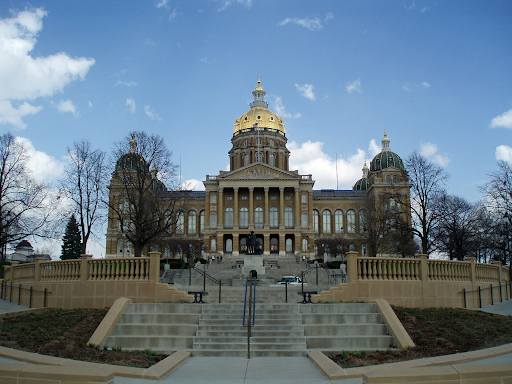
Iowa State Capitol. Photo courtesy of Iqkotze

In rural America, Election Day ballots look very different. Races for local offices are frequently uncontested, so the state legislators that shape education policy and health care regulation often assume their positions without competing for them, as national parties refuse to expend energy on elections seen as ‘lost causes’. Iowa House District 54 candidate Leila Staton seeks to change that reality. At just 22 years old, Leila Staton is a progressive Democrat running for a Republican-held seat that has been uncontested since redistricting in 2021. Staton is one of a wave of Democrats across the country seeking to challenge the idea that seats long held by Republicans cannot become competitive. In this interview, she seeks to re-establish rural politics as something for which it is worth fighting and organizing.
Ajay Balaje (AB):You co-founded the grassroots, progressive advocacy organization The Insufferable Wenches of Iowa a year and a half ago, before stepping into the role of secretary of the Grundy County Democratic Party. Now, you’re making a run for Iowa House, and it all started before the age of 22. Could you tell me about the inspiration for such an early entry into politics?
Leila Staton (LS): I’ve always been really interested in politics. I’ve always been the nerd that’s keeping up with political news and educating all of my friends on what’s happening. From that, it got really easy for me to explain complicated issues in a simple way that’s fast, and that’s what snowballed into Insufferable Wenches.
We summarize legislation that’s happening at the State House and the State Senate here in Iowa so people can be involved, because it is really complicated. Specifically in state legislatures, a lot of bills are swept under the rug, and it’s really difficult to know what’s going on. I wanted to make [it] easy for people.
I co-founded [The Insufferable Wenches of Iowa] with my mom; we were really mad at the end of the 2024 election because we had reached out to our county party and got no response. We wanted to help canvass, we wanted to do as much as we could do to see a win, and we never got a response. So we reached out to the state party—we also didn’t get a response.
We were like, “Okay, how do we organize on our own?” We have 400-plus members doing community work every day, from mutual aid efforts like stocking personal pantries throughout neighborhoods in the Cedar Valley , to fundraising for children’s bands, to summarizing legislation and making sure people have the opportunity to be involved if they want to be.
I know that, specifically for young people, a lot of us want to be involved—we just need to be asked to do a specific task. It’s really difficult for me to see someone hiring volunteers for [their] campaign. What does that actually entail? I think it’s important to have specific asks, because people want to know what they’re getting into. That’s the point of Insufferable Wenches.
Our county’s Democratic party didn’t respond when we wanted to be involved; the party had actually dissolved, so we started it back up because organizing matters everywhere. I know that feeling included is contagious. More people get involved if they see other people who are involved. We’ve seen a lot of people get involved this year—which is really exciting—and it makes me wonder what our politics could look like if that organizing or that inclusivity existed everywhere.
AB: You’re running for Iowa House on a host of largely progressive policies: capping rent increases, repealing right-to-work laws, ending Medicaid privatization, and opposing school vouchers in a part of Iowa that voted for Trump by a margin of ~40 points. How do you adapt your political messaging to voters who overwhelmingly vote against progressives at the national level?
LS: I’m going to talk about a little pattern that I can see from my point of view. This may not be correct everywhere for everyone, but I see a really strong pattern with Democrats running in red areas [and] going to the center. Republicans move to the right to cater further to more of the political spectrum on the right—and it works. But when we see Democrats running to flip a seat, we see them cater to the center, and not to the left. I think that it would be smart if Democrats moved to the left, to cater to more of the progressive base.
Changing the pattern there is really important, and if it doesn’t work, then we’re living the same reality. It’s a little bit of an experiment. But progressive policy is popular with [some] Republican voters, so being bold about what I believe in–I find–is really important. I’m not willing to sacrifice my beliefs to get the seat… I don’t see a lot of value in flip-floppers. I like seeing someone who’s bold, even if I disagree with them on a few political or policy points. I still feel more represented by that person because they actually believe in what they’re saying.
When it comes to capping rent increases to the rate of inflation, that’s really popular. Here in Iowa, our cost-of-living looks low on paper, but our wages are also low. Explaining that states which don’t have right-to-work laws make more money is popular with everyone. These are popular issues that everyone in my area really wants. In our house district, we only have one private school, and it’s a K-8. No student is graduating from a private school here in the district while our public schools are actively being defunded, so no one likes [school vouchers] here. It’s very rare to come across someone who thinks they should be funded by the state. Even in those conversations, we have no public oversight of the private school voucher system. We don’t know where the money’s exactly going, but from other data we can see that 82-83% of the funding is going toward already wealthy families, people who had their kids in private school already, and that’s very unpopular. People want to know where their money’s going. Public schools are public goods; we need to fund them because it benefits all of us.
We haven’t had a Democrat run for this seat, so in the ~25% of the state that has had that problem (and, probably, across rural America), that means a lot of assumptions are made about what political beliefs are, [because] we haven’t had the opportunity to vote in any other way. And down ballot races are different: I don’t know about you, but I’ve never had a presidential candidate knock on my door. People are excited because I’m a younger person who wants to be involved. I’m talking about issues that they care about that also poll well across the state: our water quality polls [with Republicans] at 72%, and 64% of Iowans believe that abortion should be safe, local and legal. Those issues poll well, they’re just not talked about in the ways that they need to be talked about. A lot of rural Iowans feel left out of a lot of political discussions because they haven’t had a Democrat even run to represent them, and I think changing that narrative is really important.
AB: Your run for Iowa House is very unorthodox. 25% of Iowa’s districts last cycle were uncontested Republican victories and, since being redrawn in 2021, the seat you’re running for has never been contested. Could you walk me through what your community’s reaction has been to the unorthodox nature of this campaign?
LS: Specifically in my district, but probably everywhere, people are really hungry for something different. They’re hungry for someone who is fine with being bold and isn’t afraid of upsetting people. I’m not running for this seat to be liked by everyone. I’m running for this seat to represent them.
I think that, because I believe in what I’m saying, people automatically have a little bit of trust that I’m running for good. I also take a bold stance against corporate money, and that’s very popular. I don’t think I’ve met a single person who’s like, “Actually, I’m in favor of some corporation having a bigger voice in our democracy than me.” Having that conversation about campaign finance reform in our state is very popular, and the conversations are great.
I [also] hold bold stances on specific issues. I’m not afraid to talk about abortion. I’m not afraid to talk about health care and how our health care system is not working, because they feel that level of frustration too. I think that saying, “Well, it’s a problem, but what are we going to do to fix it?” is a little problematic. We need to have bold stances. We need to stand with our people, and that’s not just Democratic voters. A lot of Republicans are frustrated by the same things we are. We’re all angry about the same issues, we just phrase them differently, and we see different routes to solutions for those issues.
I think having the conversation on what different solutions [can] look like is also really important, which is why I have “Coffee and Conversation” events. Anyone can come, and we can talk about different solutions to different problems. Just by that, people feel represented because they have a seat at the table. They get to talk about the issues that are impacting them, and they get to talk about what they think could fix it. …If you’re not a common player in your community, why are you representing your community?
AB: You grew up in the district that you’re currently hoping to represent. You’ve experienced firsthand the problems and issues specific to rural America and rural Iowa. Knowing that your lived experience has informed the progressive policies you run on, could you elaborate on how important you think these policies are for rural America specifically?
LS: Our biggest issue right now is our water quality. Our water quality is bad, and our cancer rate is very high. That problem has snowballed throughout the last decade, and nothing has been done about it. Because people like me are running and talking about the problem, more people care. A lot of people didn’t know that their water quality was terrible, and they’ve been drinking it, and they’ve had family members pass away due to cancer. We’re talking about this issue and solutions to this problem, and people are really excited because that’s a problem that we’ve all faced, [and] that needs to be fixed but hasn’t.
I [also] think that there’s a rebellion against establishment politics currently, where people are ready to put in the work to have real representation because these issues [that matter to them] are getting talked about, like prioritizing family and local farms over corporate farming. That’s an issue here, too, where corporate agribusinesses who operate out of state take advantage of small farmers struggling to make ends meet due to policy failure, and then buy their farms right out from under them. That has been happening for many years, and I’ve talked to families who used to farm but don’t anymore because they had to sell due to financial burdens. With specific policy reforms in our farming acts, we can make it easier for people to keep their farms and for younger generations to get involved in farming. The current age of farmers here is 63 to 65 and, at some point, we’re going to run out of farmers!
Our health care is a problem [as well]. We have the least amount of OB-GYNs per capita in the United States, and that’s due to a few different reasons. One, this isn’t a state that a lot of people want to live in right now. … We need to [make] sure that families can afford to live [here], and [that they] aren’t afraid of getting cancer from our water. That’s why OB-GYNs are leaving, along with the really restrictive abortion ban. A few weeks ago, we had a bill in the House that would criminalize abortion care providers, so there aren’t a lot of job opportunities for them. Our hospitals are closing because of the Big Beautiful Bill.
We need to make the state a better state to live in, a better state to practice medicine in, and prioritize people instead of companies and corporate agendas.
AB: In a previous interview with political content creator Amanda Nelson, you talked about seeing a problematic lack of competition in local races and deciding you were going to run. Across our country today, there are candidates with huge amounts of financial backing and higher-level political endorsements that scare away potential opposition for local offices, like the one you are running for. What’s your message to other people taking on the challenge of running for office?
LS: I’m going to be completely honest, and I don’t mean this disrespectfully, no one cares about a big endorsement. It’s very rare to come across someone who cares that the Vice President or an old, tired Senator has endorsed your campaign. No one cares about that. People care about you not taking money from people or companies that are going to hurt them.
You just have to make sure that you’re reminded every day of why you wanted to do it in the first place. Your community deserves better. Your community deserves representation. If you’re that person, do it. You won’t regret it.
Staton’s campaign is part of a broader wave of anti-establishment candidates challenging the political status quo. Across the country, candidates with populist visions like Staton’s have enjoyed renewed success, flipping state- and county-level seats which had remained under one-party control for decades. Since filming the interview on March 10th, 2026, Staton has earned the endorsement of the Iowa Federation of Labor, Leaders We Deserve, Rep. Ro Khanna, and Sen. Bernie Sanders, highlighting the renewed focus Democratic organizers and leaders are placing on fighting for rural America. Staton’s primary election was held June 2nd, 2026; she is now the Democratic nominee for the seat.
Ajay Balaje (CC ’29) is a Staff Correspondent at the Columbia Political Review, majoring in Mathematics-Statistics.