
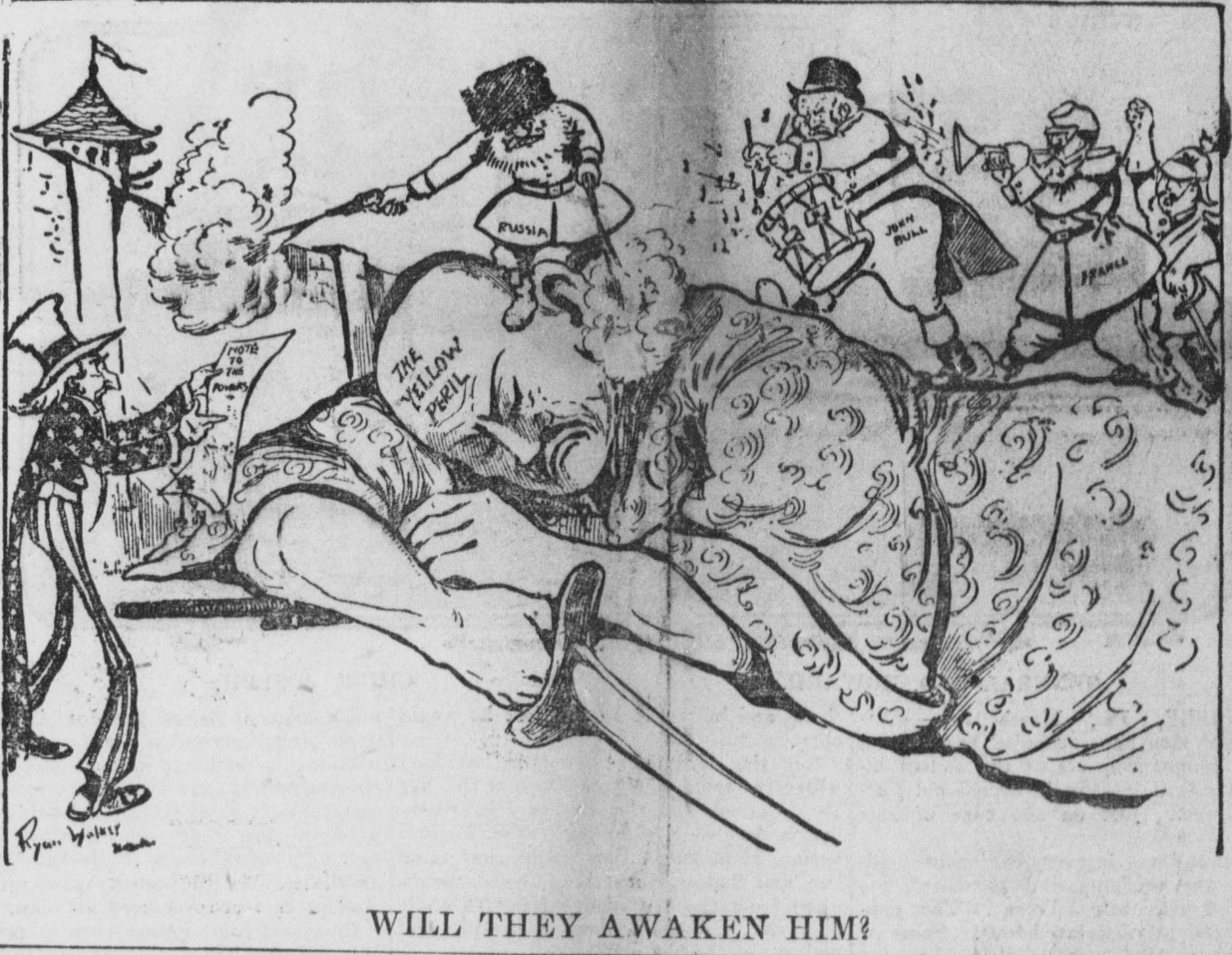
Anti-Chinese cartoon published in the Tacoma Times in 1904. (Photo courtesy of the Library of Congress)
On April 28, 2025, West Virginia Governor Patrick Morrisey signed House Bill 2961 into law. Co-sponsored by 11 Republicans, it took effect on July 10, prohibiting “foreign-party-controlled” entities from buying, selling, owning, or otherwise acquiring public or private property in West Virginia. Strangely, these restrictions apply to all Chinese citizens, save for permanent residents of the United States. “Foreign entities” were given six months to divest themselves of any property they own in West Virginia or face a lawsuit. Though marketed as a way to protect Americans from espionage, this law, and others like it, are based on racist principles. Its proponents seek to clamp down on Chinese immigration, and use xenophobic rhetoric from the past and present to achieve their goal.
As of August 2026, Florida has joined the Mountain State in passing a similar property law targeting Chinese citizens. The rising trend of anti-Chinese sentiment has sparked a massive wave of local and federal bills seeking to rid America of “foreign influence” by restricting or banning the sale or acquisition of property by citizens of “foreign countries of concern.”
Unfortunately, these bills affect both businesses and many prospective immigrants who wish to become homeowners, including those who come to the United States with student and H-1B visas. Florida’s 2023 Senate Bill 264 and House Bill 1355 were met with protests by the local Chinese community. Among the protestors were local business owners, college students, professionals, and other prospective residents who had planned on buying houses in Florida.
To make matters worse for prospective immigrants, anti-Chinese property bills have been introduced at the federal level as well. In March 2025, Representative Andy Barr of Kentucky proposed the Foreign Investment Guardrails to Help Thwart (FIGHT) China Act, which gives the executive branch significant powers to sanction Chinese individuals or businesses it deems to be acting in the interests of the Chinese government. It also requires American businesses and citizens to notify the federal government of any commerce they plan to conduct with Chinese entities and gives the Secretary of the Treasury the power to compel them to divest if they have not obtained an exemption. This bill, like many others under consideration in federal and local legislatures, explicitly targets Chinese citizens, a measure rarely applied to other countries. Some property laws, including Texas’ Senate Bill 17, passed in June of 2025, impose blanket restrictions on businesses and citizens from designated enemies, but when a bill explicitly targets citizens rather than governments or businesses, China is often a target.
One major cause of this recent wave of anti-Chinese legislation is the presidency of Donald Trump and the subsequent tariff war, which has heightened tensions between the United States and China. As of August 2026, state and local legislators have introduced 227 foreign property ownership bills since 2025 that restrict or prohibit Chinese citizens from owning property in some capacity. Representative Barr himself is currently running to replace longtime Kentucky Senator Mitch McConnell. Endorsed by Trump, Barr has made China a key issue in his campaign, criticizing McConnell for a perceived lack of toughness against the CCP. Barr and many of his peers have continued to echo Trump-approved conspiracy theories that COVID-19 was engineered by China, and that China has intentionally flooded the United States with fentanyl.
Although Donald Trump’s second presidency has reinvigorated legislation against Chinese people in the United States, these efforts reflect a much broader anti-Asian trend over the past decade. The COVID-19 pandemic has also caused an increase in anti-Chinese sentiment. Trump himself has promoted theories that COVID-19 was created in a Chinese lab as doctrine, and many Americans have become suspicious of their Chinese neighbors, with the California Department of Justice reporting that anti-Asian hate crimes had increased by 107% from 2019 to 2020. Additionally, the Pew Research Center reported in a June 2020 study that 58% of Asian-American respondents felt racist views had increased against them since the beginning of the pandemic. This increased suspicion and prejudice has also prompted an increase in anti-Chinese property legislation. The narrative of a scheming, sneaky China makes a great excuse to pass laws advertised to stop Chinese spies. According to the Committee of 100, a nonprofit Chinese-American advocacy organization, 340 state and federal bills have been introduced since 2021 that “prohibit or otherwise restrict Chinese citizens from owning some form of property.”
The rise in anti-Chinese sentiment is worrying, but this isn’t the first time the United States has tried to cut down on immigration from Asia. Critics of these property bills have compared them to the Alien Land Laws, a series of local anti-Chinese and anti-Japanese laws passed in various states in the late 19th and early 20th centuries in response to mass waves of immigration from Asia. Chinese immigration to the United States first spiked in the mid-1800s during the California Gold Rush and the construction of the Transcontinental Railroad; however, the employment of Chinese laborers by railroad companies such as Central Pacific caused white workers to see them as a threat to their job security. Labor activists and trade unionists such as Samuel Gompers and Denis Kearney did not want Chinese laborers in their movement, and took a firm stance against Chinese immigration.
In response to the rising anti-Chinese wave, many states such as Oregon and California changed their constitutions to allow only people of European or African descent to own property. Because the Naturalization Act of 1870 only explicitly extended the ability to naturalize to people of African descent, lawmakers were still able to exclude other ethnic groups. Just like the legislators of our time, they recognized that cutting off the ability to own property was an effective way to suffocate burgeoning Chinese communities. Ultimately, in 1882, Congress passed the infamous Chinese Exclusion Act, the only time in US history that an entire ethnic or national group was forbidden from immigrating to the United States.
One reason why the Alien Land Laws and these modern-day property bills work is because they maintain, at the surface level, plausible deniability. The Fourteenth Amendment was introduced to guarantee equality under the law for all citizens. However, before the passage of the Chinese Exclusion Act, many of the Alien Land Laws didn’t explicitly mention Chinese or Japanese people by name, instead stripping property rights from “aliens ineligible for citizenship.” This way, when accusations of discrimination came their way, legislators could simply point to the language of the bill and claim that they had no specific ethnicities in mind when they wrote it.
Modern anti-Chinese bills use a similar strategy. In addition to being easy to justify, alien property laws are also effective at accomplishing their goal. By stopping immigrants from buying homes and setting up businesses, they can stunt the growth of new communities without de jure discriminating based on race or ethnicity. They are often justified in the interest of national security, including Florida’s SB 264, which, in addition to preventing nonresident Chinese citizens from owning property in the state, also prohibits foreigners “domiciled” in a “country of interest,” including China, Cuba, and Venezuela, from owning property within 10 miles of a military installation unless the state government grants them an exemption; however, Florida contains a large number of military bases, many of which are within or near large population centers such as Tampa, Miami, and Orlando. This severely limits the places in and around these cities where immigrants can move and start up businesses. Their broad reach and ease of explanation make property restrictions an extremely popular tool of xenophobic legislators.
Many civil rights organizations accuse modern-day lawmakers of reviving the spirit of the Alien Land Laws. Among them is the ACLU, which helped four Chinese citizens in Florida bring a lawsuit challenging Senate Bill 264 in 2023. The case was dismissed in November of 2025 when the judges of the US Court of Appeals for the Eleventh Circuit ruled that three of the four plaintiffs lacked sufficient standing to challenge the law because it wasn’t clear whether they were “domiciled” in China or Florida; however, because the Eleventh Circuit is a federal court, it cannot definitively say what the state means by “domicile,” though the judges did point out that a domicile is not always where a person physically resides.
For their case to succeed, the Eleventh Circuit argued that the first three plaintiffs first had to prove that they were considered domiciled in China under the Florida statutes. Though the Eleventh Circuit could not definitively determine how Florida defines “domicile,” the court believed the term was primarily determined by intention rather than actual physical residence. The court ruled that the first three plaintiffs, Yifan Shen, Zhiming Xu, and Yonxin Liu, were most likely not going to be considered domiciled in China because all three had lived in the United States for several years and had stated an intention to apply for permanent residency or to remain in the United States indefinitely. The court did conclude that the final plaintiff, Xinxi Wang, had at least some standing to challenge certain provisions of the bill, but ultimately concluded that the bill does not discriminate against people of Asian descent. Despite the fact that Wang owned a home in Florida, the court argued that she could be considered to be domiciled in China because she arrived on a temporary student visa, and had not explicitly expressed a desire to stay in Florida indefinitely.
Though the Eleventh Circuit has not found Florida’s laws to be discriminatory, Chinese immigrants across the country are scared. Many who have come in search of the American Dream have found the doors closed on them, just like their 19th-century predecessors. It’s easy to blame Donald Trump’s tense relationship with China, but his policies and those of his supporters are only part of the anti-Chinese resurgence in America. Factors such as COVID-19 have also fed into this problem, and historical precedent has shown that when times are hard, such as during a tariff war or global pandemic, America has no problem taking out its anger on immigrants. By resurrecting the racist rhetoric of the past, our legislators are setting a dangerous precedent for the future.
Ethan Liu (CC ‘30) is a first-year staff writer studying Political Science. He can be reached at el3546@columbia.edu.