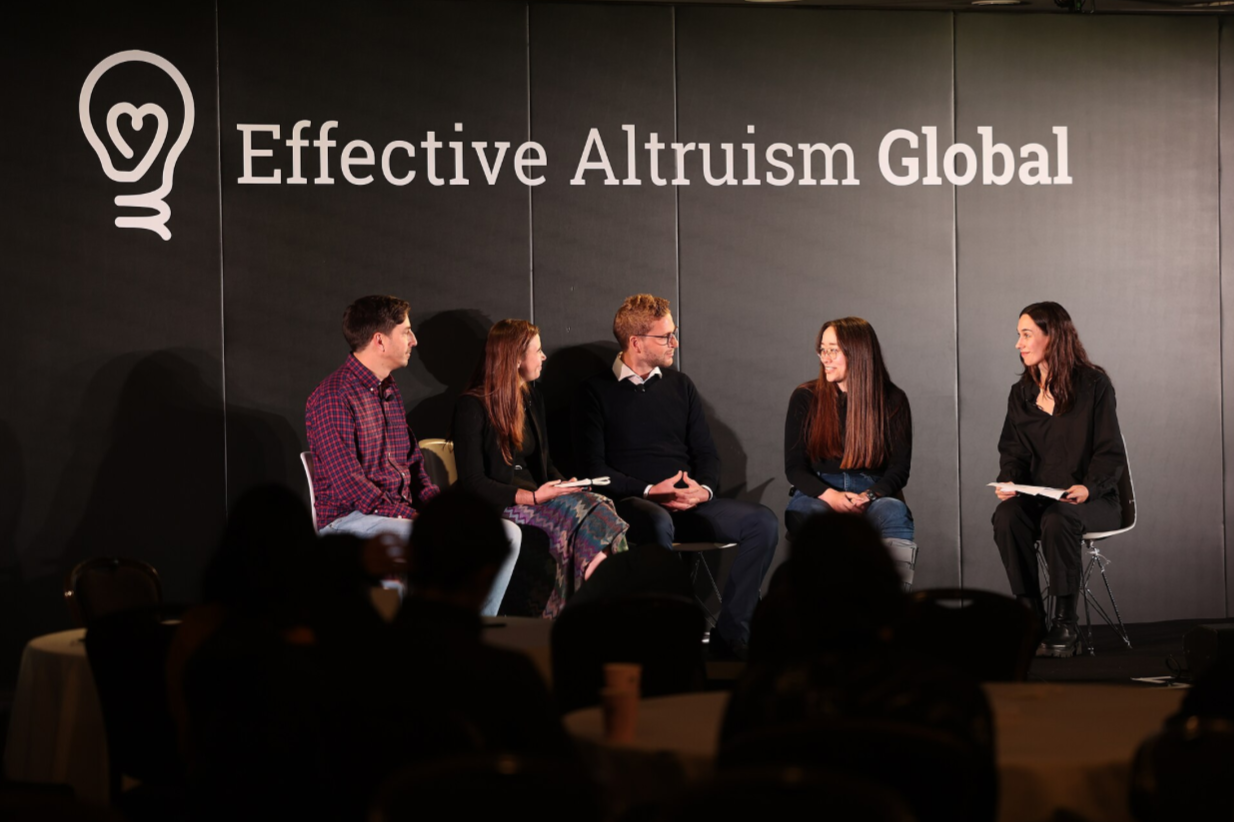
A panel of prominent effective altruists at Effective Altruism Global: London 2021. From left to right: Devon Fritz, Joan Gass, Jona Glad, Meg Tong, and Anneke Pogarell. Photo courtesy of Effective Altruism Global.

Would you rather support malaria prevention or cancer treatment? To an effective altruist, the decision is simple: the Malaria Consortium saves one life for every $4,000 it receives, whereas cancer treatment can cost over $100,000 per person. The former is more cost effective.
This belief that one should direct their charity toward the cause with the most quantifiable impact is known as effective altruism (EA). I was introduced to it at a Bay Area summer camp, and it instantly appealed to me. Many charities are guided by personal biases — donors in wealthy countries are more exposed to cancer than to malaria, so they donate more to cancer foundations. EA instead looks for what helps the most people.
Despite my early enthusiasm, EA has drawn criticism from across the political spectrum. A Columbia Political Review article described it as a religion that justifies billionaires’ accumulation of wealth. The Trump administration accused the artificial intelligence (AI) company Anthropic of practicing “defective altruism,” an ideology that places AI safety above national interests. Some of these criticisms point to genuine flaws within EA. But even the most valid ones misidentify the source of those flaws. EA’s problem does not stem from its philosophy, but from a community where members live, work, and socialize exclusively with each other.
EA is both a philosophy and a movement. The philosophy traces its roots to Peter Singer’s 1972 essay “Famine, Affluence, and Morality.” The first organization in the EA movement, GiveWell, was founded in 2007 to address global health and poverty. Over time, a growing faction within EA embraced longtermism: the idea that ensuring humanity's survival far outweighs any present-day cause. To its adherents, the stakes are the trillions of people who will never be born, grow up, and experience life if humanity goes extinct.
Longtermism was infamously espoused by Sam Bankman-Fried, a crypto billionaire who misappropriated $8 billion deposits from his customers and donated $160 million to AI safety. His actions may seem justifiable through this view: if extinction threatens trillions of future lives, stealing billions of dollars to prevent it is morally justifiable. But longtermism didn't tell Bankman-Fried to channel the remaining $7.84 billion into risky investments and luxury real estate. His logic only made sense within his bubble. He staffed his first company, Alameda Research, almost entirely with effective altruists. His inner circle lived together in a $30 million Bahamas penthouse, ran his companies, and dated each other. Surrounded by people just like him, no one challenged his decisions, and he became convinced that his scheme would pay off.
Bankman-Fried's bubble reflects a broader pattern within the EA community. 75% of effective altruists are white, 69% are male, and 79% studied at elite universities. Most EA funding flows through a few grantmakers like Open Philanthropy. Some people live together in group houses, date within the movement, and find jobs through EA networks. That insularity has consequences beyond bubble-think. It also shapes who gets protected and who gets silenced. In one incident described by Bloomberg, a woman's job offers were rescinded and conference speeches cancelled after she confronted a prominent AI researcher for sexual assault. Community members told her the allegations would harm the advancement of AI safety.
At first glance, this looks like an indictment of EA’s utilitarian philosophy. A community calculates that one life mattered less than humanity’s survival. One may think that a philosophy built on trade-offs will always protect the powerful. But utilitarianism is a tool, not a verdict. It tells you how to weigh the factors you find important; it doesn’t tell you what they should be. The actual problem in these cases was the narrow set of inputs that went into these calculations. When your housing, income, friends, and romantic partners all come from effective altruism, it is easy to undervalue experiences outside that bubble, such as losing your career for speaking up. That community gave little weight to the victim's harms not because the math demanded it, but because no one running the calculation had suffered that harm themselves.
This lack of diversity in existing EA environments has caused serious harm, but it is possible to create spaces in which effective altruists and others can engage in healthy, productive conversations. Take the summer camp that introduced me to EA as an example. From the first day, we were encouraged to challenge any idea. It culminated in a session titled “Why Everything You Learned Here Is Wrong.” Students presented counterarguments to everything we had discussed—why AI fears might be overblown, how longtermism enabled Bankman-Fried’s fraud.
My summer camp worked because the organizers deliberately selected a diverse range of participants. They didn’t just admit students based on their achievements in research and math competitions, but also in art, music, and writing. The instructors included researchers, grantmakers, policy advisors, and counselors. Although we learned EA’s analytic tools (cost-effective analysis, cause prioritization, goal factoring), we were free to question what mainstream EA concluded from them.
My story is not an exception; effective altruism is broader than the longtermist faction that makes headlines. In 2025, Open Philanthropy allocated 38.2% of its funding to AI safety, 14.4% to global health, and 10.4% to animal welfare. None of these causes form an outright majority. The community is also becoming more demographically diverse, with about a 10% increase in female, non-binary, and non-white members joining in 2024. As the community diversifies, it creates more environments where utilitarian calculations can be challenged by people with different experiences and worldviews.
I no longer identify as an effective altruist, but I still use GiveWell’s ratings when I donate. I still think about cost-effectiveness when making career decisions, but I don’t structure my life around the community. When a framework becomes an identity—determining who you live with, date, and work—that’s when the math stops working. That’s when people start calculating whether fraud is justified, whether victims should stay silent for the greater good. This pattern isn’t unique to effective altruism. Any rigorous framework becomes dangerous when it becomes a religion. The solution isn’t to abandon systematic thinking about how to do good. It’s to keep the framework open, to surround it with people who will disagree, to use it as a tool rather than an identity. My experience showed what this looks like: a room full of students willing to argue that everything they'd just learned might be wrong.
Bufan Zhao (Caltech ’28) is a sophomore at Caltech studying Applied Math. He previously attended Columbia College and served on the board of the Columbia University Effective Altruism Society. He is interested in the intersections of ethics and emerging technologies.