
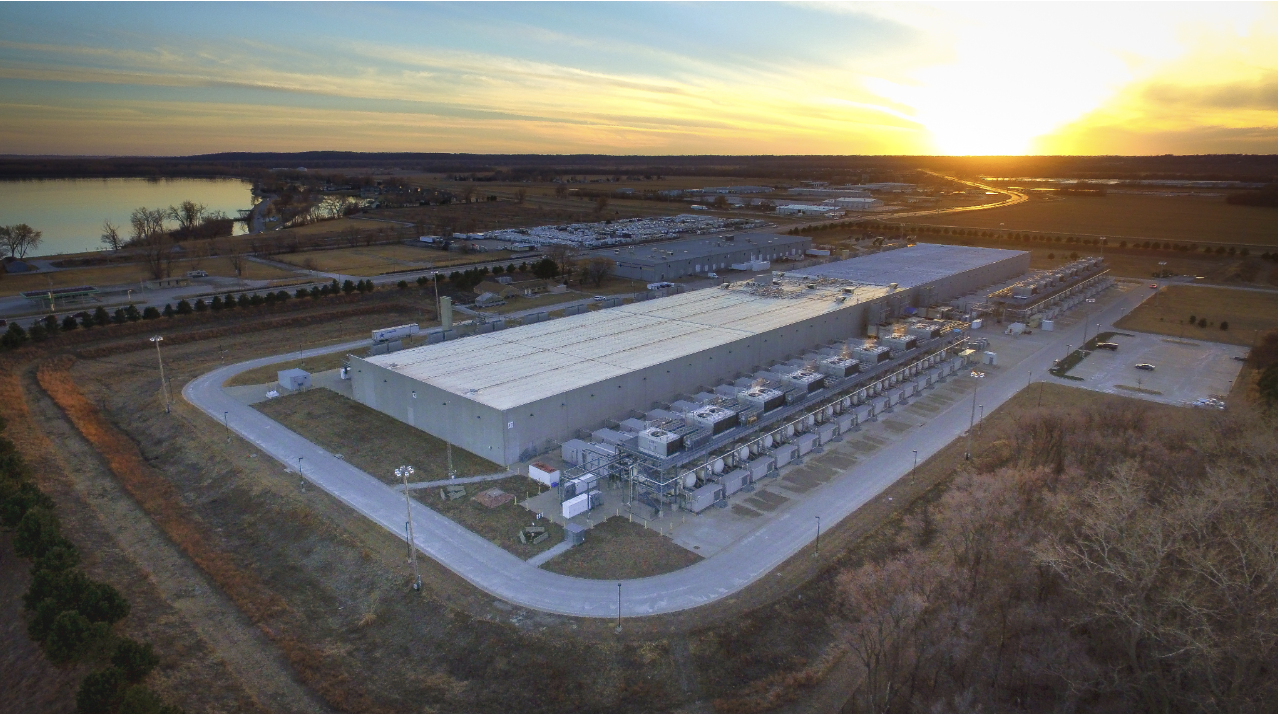
Aerial view of a Google data center in Council Bluffs, Iowa. Photo courtesy of Wikimedia Commons.

From the campaign trail through the first year of his second term, President Trump’s vow to “drill, baby, drill” has been the focal point of his approach to energy policy. His administration has touted deregulation of oil and gas alongside sharp curtailment of renewable energy production in the name of American energy dominance and independence, in line with Trump’s broader anti-globalist rhetoric. Experts have widely criticized this agenda along environmental and economic lines, yet hidden deep within the folds of energy nationalism is one critically important policy item: data centers. In his State of the Union address delivered on February 24, 2026, Trump announced the rollout of a “ratepayer protection pledge,” which he claims will obligate data center developers to construct infrastructure for electricity generation alongside data centers, known as on-site generation. Under on-site generation, data centers utilize small-scale electricity generation such as gas turbines, fuel cells, and diesel-powered reciprocating engines—located at the centers themselves—to generate the electricity required for high volumes of computing. Currently, the vast majority of data centers draw energy from the electrical grid shared by other consumers. When on-site generation is used, it typically supplements grid power but can also be scaled up to power a data center’s whole operation, removing the need for the center to connect to the grid. As of 2024, 13% of American data center facilities had at least some on-site generation, and only 1% were fully powered by on-site electricity. Despite a rocky track record on energy, Trump is right about one thing: these numbers are not enough. More data centers must implement on-site electricity generation to alleviate the pressures of rising energy demand and allow greater flexibility in selecting where they are built.
Under the status quo, American electricity grids cannot meet rising demand. Across the U.S., electricity consumption is projected to increase 17% to 25% by 2030, compared to 2025 levels. Data centers are a major contributor to this rise. In 2023, they accounted for just over 4% of U.S. electricity consumption; that number is expected to skyrocket to as much as 12% by 2028. Notably, these numbers are aggregated across the entire nation. For regions where data center growth is concentrated, such as Texas or the PJM Interconnection (a regional transmission organization that spans thirteen Mid-Atlantic states and the District of Columbia), the pressure on electricity grids is much higher. Even when excess energy is available, the sheer scale of power used by high-volume data centers strains the transmission lines that transport electricity across the grid, which were not designed to handle such high concentrations of demand.
There are barriers to expanding electricity supply that prevent electric utility companies from meeting this demand. The most prevalent energy resource in the United States is natural gas, which comprises 43% of the country’s electricity generation. Electricity is produced by combusting natural gas to turn turbine blades, producing rotational force that drives a generator. However, these turbines are in short supply. Natural gas turbines are incredibly complex to build, requiring specialized foundries to produce materials that can withstand the heat generated by gas combustion. Production is dominated by just three manufacturers, so turbine orders are “booked out” for years. As such, the number of new natural gas power plants is tightly constrained, and expansion of natural gas-powered electricity is consequently limited. Renewable energy production also faces limitations. Supply chain constraints on critical materials like nickel, silicon, and rare earth metals, as well as hostile federal regulatory efforts designed to impede renewable energy construction, prevent the increase in renewable energy necessary to match this demand. The expansion of large-scale nuclear power is also limited by a variety of factors, including high construction costs, low public trust, difficulty of radioactive waste disposal, and lengthy regulatory approval processes.
Even when electricity generation projects are ready to produce, however, they must connect to the grid before they can begin providing power, which delays energy expansion. This process, known as interconnection, is incredibly lengthy, requiring producers to undergo a series of studies to ensure safety and regulatory compliance. Exact processes vary by state, but the average interconnection request takes nearly five years to be approved. As a result, even in cases where new electricity generation is planned, it is held up in a years-long interconnection queue, preventing the timely expansion of electricity supply necessary to meet demand.
These barriers to increasing production mean that as electricity demand rises, driven in large part by data centers, it runs up against the limits of the grid. So what happens when this demand outstrips capacity? On a primary level, the electricity supply becomes unreliable. Electricity system operators may implement various measures to control demand, such as brownouts, in which the voltage delivered to each user is reduced, or rolling blackouts, where power is shut off to groups of users for short durations. These measures are already used during times of peak electricity demand. For example, California often implements rolling blackouts during summer heatwaves, when increased air conditioning usage drives up electricity demand beyond available supply. However, rising demand without appropriate supply means these measures will have to be used more often, impacting more people more severely.
Furthermore, this increased electricity consumption pushes up prices across the country. In areas that use market-based ratemaking, such as New York State, wholesale electricity prices are set through auction. Rising demand from data centers has been responsible for billions of dollars in additional capacity costs, which are passed down to consumers. Similar price hikes occur in areas covered by traditional cost-of-service ratemaking, such as most of the southeastern United States, in which state governments set electricity rates using a formula that incorporates the expenditures incurred by electricity and multiplies it by a given rate of return. Utilities must construct new transmission infrastructure to supply massive amounts of electricity to data centers, increasing their expenditures and thereby the rates that they can charge under this ratemaking system. This results in increased electricity costs for all ratepayers within that utility’s service area, even though the vast majority of consumers gain no benefit from the infrastructure built solely for the data center.
Requiring on-site generation would help sever the link between data center growth and rising consumer utility costs. At a basic level, this means that any new data centers would provide the electricity needed to power their operations, so that they would not contribute to increased demand on the electricity grid. Other grid users would no longer face the same reliability issues and would no longer have to pay the increased wholesale electricity costs under market-based rates. Additionally, on-site generation means the electricity is consumed where it is generated, rather than being transmitted across long distances. This reduces the expense utilities incur for building new transmission lines to data centers, thereby reducing the financial burden on other consumers on the grid. The cost of constructing this generation capacity would be solely borne by the user creating the demand (data centers), producing a much more equitable distribution of costs.
In addition to demand-related issues, relying on grid power incurs a host of regulatory backlogs that slow data center construction and constrain location choice. The main contributor to this is the interconnection process. Just as new sources of electricity generation require lengthy approval processes to connect to the grid, so do data centers that rely on grid power. Thus, years-long regulatory backlogs can substantially delay construction. Delayed construction cuts into data center developers’ profit margins, and as a result, they seek out locations where interconnection wait times are comparatively short. This, along with the desire for cheap electricity, has led to the creation of data center “hotspots” in states with friendly regulatory environments. For example, 90% of Texas is managed by a single grid operator, the Electric Reliability Council of Texas (ERCOT), which processes all interconnection requests under the same body. For developers, ERCOT’s regulatory system is far easier to navigate than those in other states with multiple utility territories, which draws out the permitting process. Consequently, Texas is seeing a massive rise in data center construction, with over 400 new projects currently planned or under construction (second only to Virginia’s 595).
The concentration of data center construction means the concentration of harms. Impacts such as rising electricity prices and environmental damage are magnified in the communities surrounding these data centers. Two-thirds of data centers built in the United States since 2022 were constructed in water-stressed areas, forcing the communities in these areas to compete with the massive volumes of water required to cool data center servers. Concentrated construction in increasingly popular locations like Texas also risks creating bubbles, in which investors submit interconnection requests for massive numbers of speculative data center projects that have yet to be built, eager to capitalize on favorable business conditions. However, regulatory backlogs and constraints on electricity supply make the future of these investments inherently uncertain, potentially leaving investors on the hook if infrastructure is built for projects that never come to fruition.
On-site generation would reduce this burden by allowing greater flexibility of data center siting. When data centers produce their own power, they operate irrespective of local electricity supply constraints and lengthy interconnection approval processes. Electricity availability and regulatory simplicity would no longer be the dominant considerations in deciding where to locate data centers, and other factors, such as land availability or minimizing environmental impact, may begin to take precedence. As such, concentration in specific areas would likely decrease, leading to a more balanced distribution of data centers and a reduction in the burdens that specific communities face.
Skeptics of on-site generation may note that because it is dominated by fossil fuel technology, increasing its usage increases greenhouse gas and particulate matter emissions, contributing to climate change and localized air pollution. Renewable energy sources like solar and wind are not well-suited to the demands of data centers, as they typically require too much space to generate the large volume of electricity needed to power a data center on-site, and suffer from intermittent output due to natural fluctuations in sunlight or wind speed. Solar and wind are often used as supplementary sources for electricity generation, but, given current limitations, they cannot be scaled to serve as the sole power source of a data center. Given this, an increase in fossil fuel use is very likely to occur alongside an increase in on-site generation.
While greenhouse gas emissions are certainly an important consideration, on-site generation is simply worth the tradeoff. When electricity demand exceeds supply, emergency “peaker plants” are turned on to provide a short-term boost in power availability. These plants are typically the highest emitters of both particulate matter and greenhouse gas emissions and are disproportionately located in historically disadvantaged communities. As data centers drive up electricity demand and peaker plants are used more frequently, the climate-related harms credited to on-site generation are incurred regardless. It is therefore preferable to place the responsibility of electricity generation on data centers to reduce the burden they otherwise impose upon consumers. Additionally, renewable on-site generation, though currently uncommon, may become feasible in the near future. Small modular nuclear reactors (SMR) provide predictable, high-volume, zero-emission electricity generation and may be a viable option for on-site generation. There are currently no SMR-powered data centers operational in the United States, but nuclear energy companies have already begun entering agreements with data center companies to provide this power in the future.
Broadly, on-site generation is a direct, effective way to hold data center operators financially responsible for their electricity consumption while enabling more flexible siting to reduce the current concentration of harms. For too long, electricity customers have had to shoulder the financial and environmental burdens of data centers that do not directly benefit them. Requiring on-site generation would ameliorate this harm by forcing data center companies to provide the energy they use, preventing spikes in electricity prices and demand. Trump’s ratepayer protection pledge, while nominally promising, is still voluntary. Legislative action, such as the Power for the People Act proposed in January 2026, is necessary to ensure compliance with this policy change. Congress has an overwhelming obligation to regulate the rapidly developing data center industry and protect its constituents. The rise of artificial intelligence threatens to change virtually every aspect of our society; it must not be allowed to siphon electricity and steal money out of American pockets at the same time.
Emma Listgarten (BC ‘27) is a staff writer for CPR, studying political science and environmental science. She is interested in environmental and energy policy, African and Caribbean politics, and law. She can be reached at ejl2204@barnard.edu.