Tush Pushers or Ass Kissers? Why Trump Has the NFL in His Back Pocket
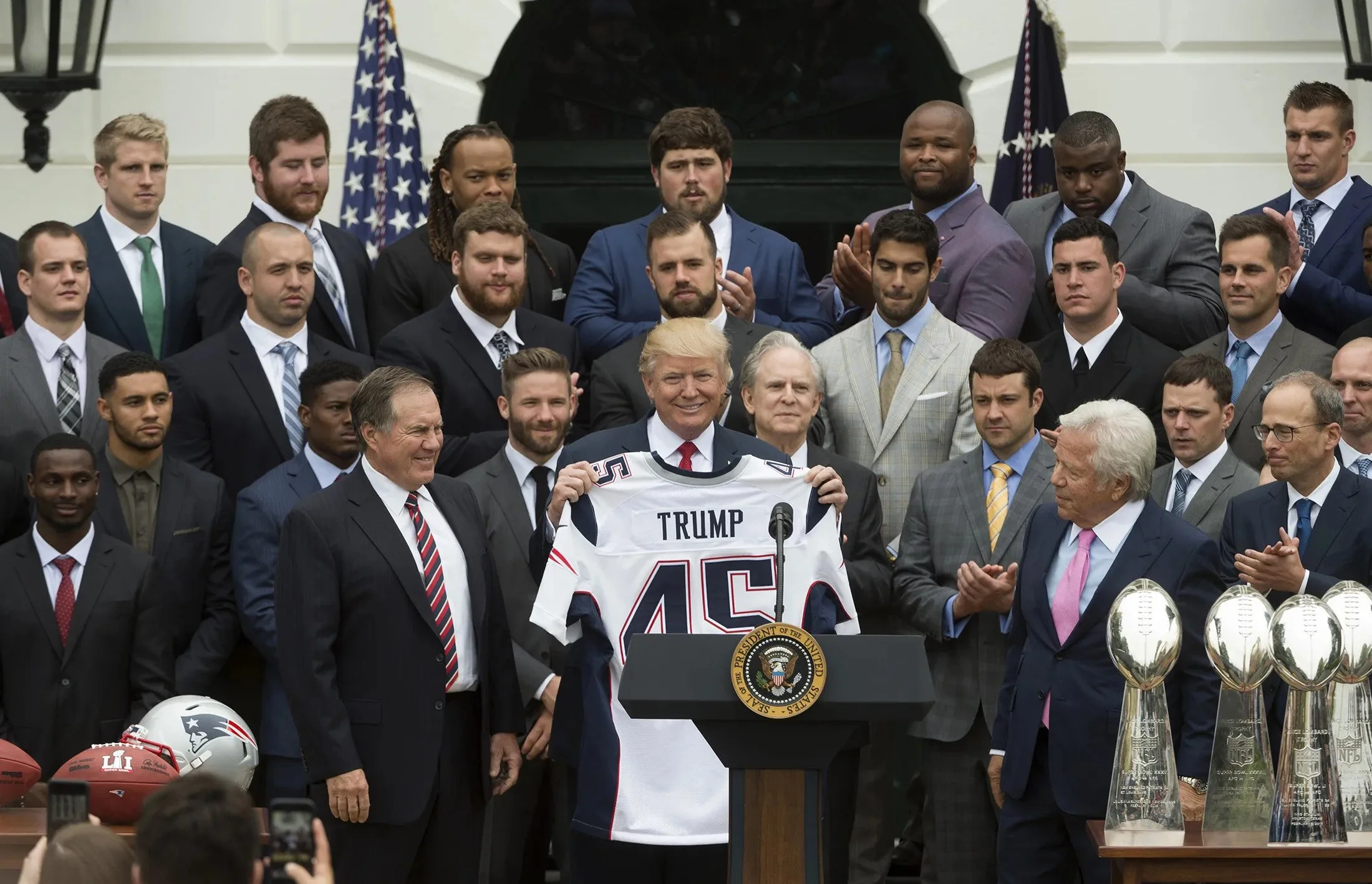
The New England Patriots, Superbowl Champions in 2017, present President Donald Trump with his own helmet and jersey at their visit to the White House. Photo courtesy of Bloomberg.
Plenty of college students can relate to the impending feeling of Thanksgiving Day dread, not least because of the inevitable political battles that will be waged over plates of turkey and mashed potatoes. Speaking for myself, my family represents just about the entire political spectrum: pro-Trump NYPD officers on the right, and the lesbian Ivy League French major (me) on the left. In recent years, however, my family has risen above fruitless Thanksgiving debates. Instead of fighting, we put football on the TV, and everyone enjoys a state of peace.
Our moment of Thanksgiving peace represents the nonpartisanship of American football. People of all ages and political beliefs watch and enjoy the day’s slate of games, putting aside their differences to root for their team and share a couple of beers. The NFL seemingly upholds the apolitical nature of the game. For example, players are banned from displaying political messages as representatives of their teams or the NFL. But one need not look far to see the political undertones of the organization and its practices, particularly that of Super Bowl Champions’ yearly White House visits. While it is not wrong for a big corporation to take a political stand, the fact that the NFL brands itself as neutral while still engaging with the political world is becoming more and more problematic. In the age of the Trump Administration, the NFL’s brand of political “neutrality” actually desensitizes Americans to the Trump-era GOP’s rampant injustices.
Super Bowl champions have been visiting the White House since Jimmy Carter invited the Pittsburgh Steelers in 1980, but this seemingly wholesome display of patriotism continues to spark controversy within and about the NFL. Saquon Barkley–the Eagles running back who faced backlash for visiting Donald Trump in the White House after winning the Superbowl in 2025–said so himself on his X account in response to left-wing critics: “Maybe I just respect the office, not a hard concept to understand.”
Barkley was defending himself against accusations that he supported Trump’s politics, but in doing so purported a level of complicity and acceptance of the administration; after all, accepting a president’s personal invitation to the White House is necessarily a sign of respect and reverence for that president. Despite Barkley’s best attempts, we cannot truly separate the office from the individual who holds it, as the individual defines just what the office of “president” means during each unique administration. The fact that nearly a quarter of Eagles players did not go makes Barkley’s attendance particularly damaging; it hindered the team’s potential to make a unified show of opposition to the administration and spread the message to a huge audience that Trump just must not be “that bad.”
Barkley’s proclaimed respect for the presidential office is just one example of the many ways that sports entertainment disseminates political messaging, whether it tries to or not. Of course, we must also question the extent of players’ individual agency in making the statements that they do. As agents of the NFL corporation, players who openly resist political neutrality risk losing their careers. Colin Kaepernick, for example, who kneeled during the national anthem in protest of police brutality and the systemic oppression of Black Americans in 2016, was effectively blackballed from the NFL, as teams refused to sign him on in any future seasons. President Trump himself even commented on the issue during his first administration, saying that players who kneeled during the anthem were “ruining the game.”
A trip to the White House and recognition by the president of the United States offers further fame and protection for the players themselves, which incentivizes many of them to keep quiet on political issues and stay in Trump’s good graces. Players, however, are not the only ones who benefit from government intervention. The NFL’s Political Action Committee (PAC) spends millions of dollars lobbying the federal government each year for a wide array of company benefits, most recently making a deal concerning game streaming services and the Network’s acquisition by ESPN. This multi-billion dollar deal “require[d] government oversight and approval because of concerns centered around equal competition,” illustrating how the corporate nature of the NFL directly ties it to the government and the good graces of the President.
This same basic principle applies when there is a Democrat in office. Visits seemingly communicate respect for the President and a sense of shared patriotism among players, and, consequently, the NFL’s political complicity becomes disguised as bipartisan respectability. But, again, regardless of who the president is and what party they belong to, these visits are also political statements and a show of public support for the current administration.
With that in mind, one might see how, in our current administration, White House visits are especially problematic–more so than they were during presidential administrations prior–because of the way that President Trump unabashedly spreads lies and hateful rhetoric against minority Americans (including but not limited to immigrants, trans people, and African-Americans). These actions effectively minimize the felt harms of communities impacted by his policies. The message is that those people’s difficulties matter less than the comfort of more privileged Americans, who get to watch a game uninterrupted by political controversy, or the NFL’s ability to cater to a wide audience and maximize profit.
But perhaps the stakes are even higher. President Trump’s administration actively undermines the principles of democracy, disrespecting American citizens, our Constitution, and the very office of the President itself. When the NFL continues to engage with this administration as if it were just like all the others, it tacitly upholds the legitimacy of President Trump’s blatantly undemocratic actions–the overturning of birthright citizenship, for one, or the gross misuse of government funds for White House renovations, to name another. The “office” that Barkley and other athletes in his position so innocently claim to respect doesn’t exist anymore, or at least not as long as it belongs to Donald Trump, and we need to be aware of how the sports entertainment industry benefits from its cowardly complicity.
I’m not claiming that the NFL is singlehandedly responsible for all of America’s many injustices, or that putting an end to its White House visits will bring about the collapse of the Trump Administration. I merely wish to illustrate just one of its many hypocrisies as an organization and remind fans to be critically aware of the messaging that they are receiving as being political. It is political to actively engage with the American president; it is political to punish players for speaking out; and it is political to ingratiate the federal government to monopolize business deals within the entertainment industry. So when you sit down to watch football with your family over Thanksgiving break, remember that there can be no neat divorce of ‘real life’ from politics. Soon enough, we may see Trump’s name plastered on the side of the brand-new Commanders’ stadium. There’s no denying the pandering; we’re just choosing to ignore it.
Ava Devlin (BC ‘27) is a staff writer for CPR, studying history and French. She is passionate about sports of all kinds and hopes to make them more equitable and accessible to all.